1. Introduction
As satellite communications continue expanding through GEO systems, LEO mega constellations, NTN integration, and global broadband deployments, one organization remains at the center of international orbit and spectrum governance:
The International Telecommunication Union.
For many telecom engineers, the ITU is often associated mainly with standards, spectrum discussions, or technical recommendations. However, while studying the third module of the ITU Academy course “Global Satellite Regulation Essentials,” it became clear that the ITU’s role in satellite projects is much broader and far more critical than most engineers initially realize.
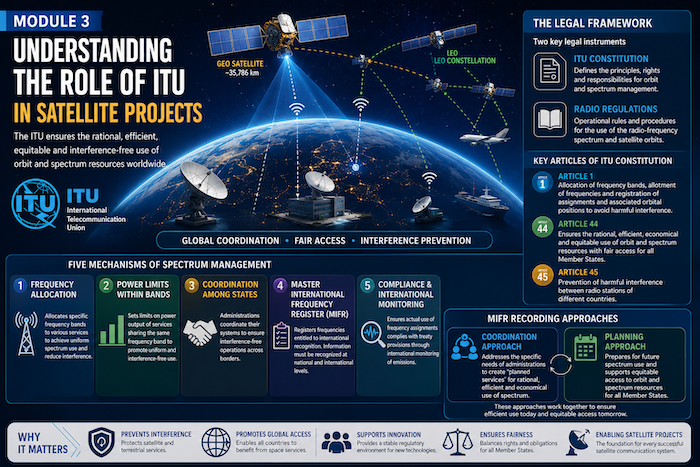
The module explained how the entire international orbit spectrum framework is primarily built upon two major legal instruments:
- The ITU Constitution
- The Radio Regulations
Together, these frameworks govern how countries, operators, and satellite systems share some of the world’s most valuable and limited resources: orbital positions and radio frequency spectrum.
2. The Two Main Legal Instruments Governing Orbit and Spectrum
The international legal framework for orbit and spectrum management is mainly contained within two foundational documents:
| Legal Instrument | Primary Purpose |
|---|---|
| ITU Constitution | Defines the principles, responsibilities, and rights related to telecommunications and orbit-spectrum resources |
| Radio Regulations | Establishes operational procedures, spectrum allocations, coordination rules, and interference management mechanisms |
These two instruments collectively form the backbone of global satellite regulation.
3. ITU Constitution and Orbit-Spectrum Management
The ITU Constitution contains several important articles directly related to satellite communications and spectrum management.
The module particularly emphasized Articles 1, 44, and 45.
3.1 Article 1 – Role of ITU in Orbit and Spectrum Management
Article 1 defines one of the ITU’s core responsibilities:
- Allocation of radio-frequency spectrum bands
- Allotment of radio frequencies
- Registration of frequency assignments
- Coordination of associated GEO orbital positions
- Management of satellite characteristics in non-GEO systems
The primary objective behind these activities is:
To avoid harmful interference between radio stations belonging to different countries.
This becomes increasingly important as:
- LEO constellations expand rapidly
- GEO slots become more congested
- NTN systems integrate with terrestrial networks
- Cross-border satellite services increase globally
3.2 Article 44 – Efficient and Equitable Use of Resources
One of the most important principles highlighted in the module comes from Article 44 of the ITU Constitution.
This article recognizes that:
- Radio-frequency spectrum is limited
- Satellite orbital resources are limited
- These resources must be used rationally
- Access must remain equitable for all Member States
The principle can conceptually be summarized as:
Orbit Resources + Spectrum Resources = Limited Global Assets
The ITU therefore acts as an international coordinator ensuring:
- Efficient usage
- Fair access
- Sustainable operation
- Economic utilization
- Interference prevention
This principle is especially important for developing nations, ensuring they also have opportunities to access orbit and spectrum resources.
3.3 Article 45 – Interference Prevention
Article 45 reinforces another critical ITU responsibility:
Preventing harmful interference between radio systems of different countries.
This includes:
- Satellite-to-satellite interference
- Satellite-to-terrestrial interference
- Cross-border coordination challenges
- GEO and NGSO coexistence
As global satellite deployments increase dramatically, interference prevention is becoming one of the most challenging areas of international telecommunications.
4. Understanding the Radio Regulations
The Radio Regulations are one of the most important operational frameworks in global telecommunications.
Unlike many traditional treaties, the Radio Regulations are dynamic and continuously evolving.
They are periodically reviewed and updated during the World Radiocommunication Conference to accommodate:
- Emerging technologies
- New satellite systems
- Changing communication demands
- Future spectrum requirements
This flexibility is essential because satellite communications evolve much faster than traditional regulatory cycles.
4.1 Rights and Obligations of Member States
Under the Radio Regulations, each Member State has:
- Rights
- Obligations
- Coordination responsibilities
This creates a balance between:
- Access to spectrum resources
- Compliance with international procedures
- Protection against harmful interference
4.2 Frequency Assignments and International Recognition
One of the key rights granted to Member States is the ability to register frequency assignments.
These assignments are recorded within the:
Master International Frequency Register
commonly known as the MIFR.
Once registered, these frequency assignments receive international recognition.
This registration process is critical because it:
- Establishes regulatory protection
- Supports international coordination
- Provides recognition of usage rights
- Facilitates coexistence between operators
4.3 Dynamic Nature of the Radio Regulations
A major takeaway from the module was realizing that the Radio Regulations are not static documents.
Instead, they evolve continuously through:
- WRC updates
- Regulatory refinements
- Emerging satellite technologies
- New service categories
- Spectrum sharing requirements
This continuous evolution ensures that international regulations remain aligned with real-world technological progress.
4.4 Rules of Procedure
In addition to the Radio Regulations themselves, the Radio Regulations Board develops supplementary Rules of Procedure.
These rules:
- Clarify treaty implementation
- Refine operational processes
- Support consistency
- Improve regulatory interpretation
This creates a smoother operational framework for administrations and satellite operators worldwide.

5. Five Key Mechanisms of Spectrum Management
The module also introduced five important mechanisms that collectively form the foundation of international spectrum management.
5.1 Frequency Allocation
Purpose:
Allocate specific frequency bands to various radiocommunication services.
Goal:
Achieve harmonized global spectrum usage while reducing interference risks.
Examples include:
- Satellite communication bands
- Mobile communication bands
- Broadcasting services
- Aeronautical communication bands
5.2 Power Limits Within Frequency Bands
The Radio Regulations also define power limits for systems operating within shared frequency bands.
Purpose:
- Reduce interference probability
- Enable coexistence
- Support uniform spectrum utilization
However, the module emphasized that power limits alone are not always sufficient to guarantee interference-free operation.
5.3 Coordination Among Member States
International coordination is one of the most important mechanisms in satellite regulation.
Administrations communicate and negotiate to ensure:
- Compatible operation
- Interference-free coexistence
- Proper spectrum sharing
This process becomes especially complex in:
- GEO coordination
- LEO mega-constellation deployments
- Cross-border coverage scenarios
5.4 Master International Frequency Register (MIFR)
The MIFR serves as the official international register for frequency assignments entitled to global recognition.
Its purpose includes:
- Regulatory transparency
- International acknowledgment
- Coordination reference
- Treaty compliance support
Administrations must recognize MIFR information at both national and international levels.
5.5 Compliance and International Monitoring
The final mechanism involves ensuring that actual spectrum usage complies with negotiated agreements and treaty conditions.
This includes:
- Emission monitoring
- Verification procedures
- Compliance checks
- Interference investigations
International monitoring plays a major role in maintaining global regulatory discipline.
6. MIFR Recording Approaches
The module also introduced two major approaches used within the MIFR framework.
These approaches support different aspects of spectrum management.
6.1 Coordination Approach
This method focuses on:
- Current operational requirements
- Efficient spectrum utilization
- Administration-specific coordination
Its objective aligns strongly with Article 44 principles related to:
- Rational usage
- Efficient utilization
- Economical operation
6.2 Planning Approach
The planning approach focuses more on:
- Future spectrum usage
- Long-term access
- Equitable opportunities for all Member States
This approach supports fairness and future readiness within the international regulatory ecosystem.
6.3 Complementary Relationship Between Both Approaches
One important realization from the module was that these two approaches are not competitors.
Instead:
- Coordination supports current operational efficiency
- Planning supports future equitable access
Both mechanisms work together to maintain balance within global orbit-spectrum governance.
7. Practical Engineering Perspective
From a telecom engineering perspective, this module highlighted an important shift happening in the industry.
Satellite communication is no longer only about:
- RF optimization
- Coverage planning
- Link budgets
- Throughput
Modern satellite projects increasingly involve:
- Regulatory coordination
- International compliance
- Spectrum negotiations
- Interference management
- Orbit-sharing considerations
As NTN networks continue integrating with terrestrial mobile systems, engineers may increasingly need to understand:
- ITU procedures
- Frequency coordination
- GEO and NGSO coexistence
- Regulatory filings
- Spectrum-sharing frameworks
Future telecom engineering may therefore become a combination of:
Technical expertise + regulatory awareness.
8. Conclusion
The third module of the ITU Academy course provided a strong understanding of how the ITU supports global satellite projects through legal frameworks, spectrum regulation, interference management, and international coordination.
What initially appears to be a technical communication problem is actually supported by a highly sophisticated international regulatory ecosystem designed to ensure fairness, sustainability, and efficient use of limited global resources.
As satellite communications continue evolving through NTN, mega-constellations, and direct-to-device connectivity, the role of the ITU will become even more important in maintaining global interoperability and preventing regulatory conflicts in space communications.