1. Introduction: Congestion in a Moving Beam Environment
In terrestrial networks, congestion management is typically handled at the cell level through:
- Load balancing across neighboring cells
- Admission control
- Scheduling optimization
However, in Non Terrestrial Networks (NTN), congestion takes on a new dimension due to:
- Limited beam capacity
- Moving coverage footprints
- Uneven user distribution
- Shared satellite and feeder link resources
As a result, congestion in NTN is highly dynamic, location dependent, and time dependent, requiring beam level intelligence rather than static cell based approaches.
2. Understanding Beam Level Congestion in NTN
Each beam acts as a serving cell with:
- Finite PRB capacity
- Limited power resources
- Shared feeder link throughput
Congestion occurs when:
- User demand exceeds beam capacity
- Multiple high demand area fall within the same beam
- Gateway or feeder link becomes saturated
Practical Insight:
In NTN, congestion is not fixed, it moves with the beam, creating temporary hotspots.
3. Key Differences: Terrestrial vs NTN Congestion Behavior
| Aspect | Terrestrial Networks | NTN (LEO Based) |
|---|---|---|
| Cell Location | Fixed | Moving beams |
| Congestion Pattern | Persistent hotspots | Time varying hotspots |
| Load Balancing | Neighbor cells | Neighbor beams (dynamic) |
| Backhaul | Stable | Feeder link constrained |
| Control | RAN centric | RAN + Satellite + Gateway |
4. Sources of Congestion in NTN
4.1 Beam Capacity Limitation
- Each beam has limited spectral and power resources
4.2 Uneven Traffic Distribution
- Urban clusters vs sparse rural users
4.3 Satellite Resource Sharing
- Multiple beams share:
- Power
- Processing
- Backhaul
4.4 Feeder Link Bottleneck
- Gateway capacity limits total throughput
4.5 Mobility Induced Load Shifts
- As beams move, user distribution changes
5. Key KPIs for Congestion Monitoring
To detect and manage congestion, monitor:
- PRB Utilization per Beam
- Active User Count per Beam
- Throughput per Beam
- Packet Delay / Latency
- Scheduling Delay
- Blocking Rate
Diagnostic Insight:
- High PRB + low throughput → congestion
- High delay + stable RF → backhaul issue

6. Load Balancing Across Beams
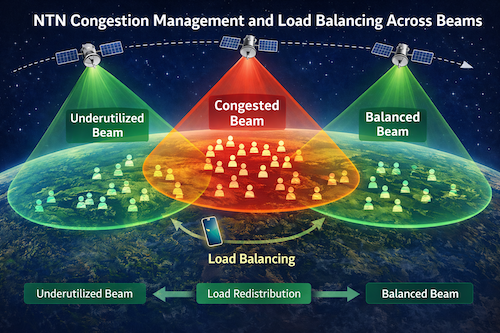
Load balancing in NTN is more complex than terrestrial systems.
Key Concept:
- Shift users from overloaded beams to neighboring beams
Challenges:
- Beams are moving
- Overlap duration is limited
- Signal conditions vary rapidly
7. Load Balancing Techniques in NTN
7.1 Beam Based Reselection Biasing
- Apply offsets to influence UE toward less loaded beams
Use Case:
- Offload traffic from congested beams
7.2 Dynamic Beam Power Redistribution
- Allocate more power to high demand beams
Impact:
- Improves capacity and coverage
7.3 Adaptive Beam Shaping
- Modify beam size and footprint
Use Case:
- Split high load areas into smaller beams
7.4 Traffic Steering
- Direct users to alternative beams based on load
Approach:
- Combine signal strength + load awareness
7.5 Scheduler Optimization
- Prioritize users based on:
- QoS
- Channel conditions
- Service type
8. Trade Offs in Load Balancing
| Strategy | Benefit | Risk |
|---|---|---|
| Aggressive offloading | Reduces congestion | May degrade signal quality |
| Power boosting | Improves throughput | Increases interference |
| Beam widening | Expands coverage | Reduces SINR |
| Load based reselection | Better distribution | Increased signaling |
Key Principle:
Balancing load must not compromise user experience.
9. Time Domain Congestion Behavior
NTN congestion must be analyzed across time:
9.1 Beam Entry Phase
- Low load initially
9.2 Mid Pass Phase
- Peak user concentration
- Maximum congestion
9.3 Beam Exit Phase
- Load decreases as users transition
Optimization Insight:
- Congestion control strategies should adapt to these phases
10. Interplay Between Mobility and Congestion
Mobility plays a critical role in congestion management.
Key Relationships:
- Poor reselection → users stay on congested beam
- Efficient mobility → better load distribution
Practical Insight:
Mobility optimization is indirectly a load balancing tool in NTN.
11. Practical Optimization Workflow
Step 1: Congestion Detection
- Identify overloaded beams using KPIs
Step 2: Root Cause Analysis
- Check:
- RF conditions
- Traffic distribution
- Backhaul limitations
Step 3: Parameter Tuning
- Adjust reselection offsets
- Modify beam power
- Optimize scheduler
Step 4: Validation
- Monitor KPI improvement over multiple satellite passes
12. Common Congestion Issues and Root Causes
| Issue | Root Cause |
|---|---|
| High latency | Beam overload / feeder congestion |
| Low throughput | Resource contention |
| Uneven user distribution | Poor load balancing |
| Persistent congestion | Limited beam capacity |
| High blocking rate | Admission control limitations |
13. Future Direction: Intelligent Load Management
NTN congestion management is evolving toward:
- AI driven traffic prediction
- Real time beam adaptation
- Self optimizing load balancing
- Cross layer optimization (RAN + transport + satellite)
14. Conclusion: From Static Load Balancing to Dynamic Resource Orchestration
In NTN, congestion is no longer a static problem.
It is a moving, time dependent challenge that requires:
- Beam level monitoring
- Dynamic load balancing
- Tight integration with mobility
- Cross layer optimization
For RF engineers, mastering congestion management in NTN is essential to ensure efficient utilization of limited satellite resources and consistent user experience.
Link for NTN Cell Selection and Reselection Optimization blog post as below:
https://adeelkhan77.com/2026/04/07/blog-177-ntn-ntn-cell-selection-and-reselection-optimization/
Link for Troubleshooting Call Setup Failures in NTN blog post as below:
https://adeelkhan77.com/2026/04/09/blog-179-ntn-troubleshooting-call-setup-failures-in-ntn-end-to-end-analysis/