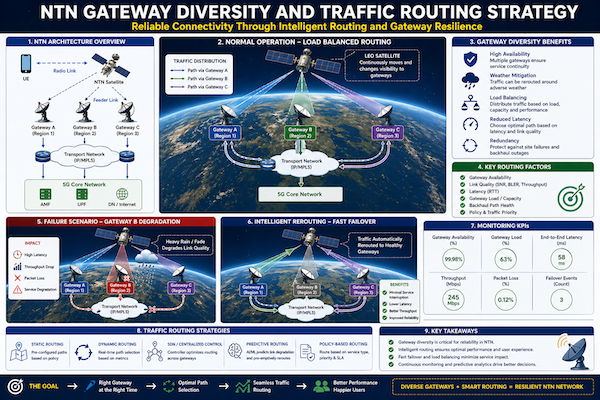
1. Introduction to NTN Gateway Architecture
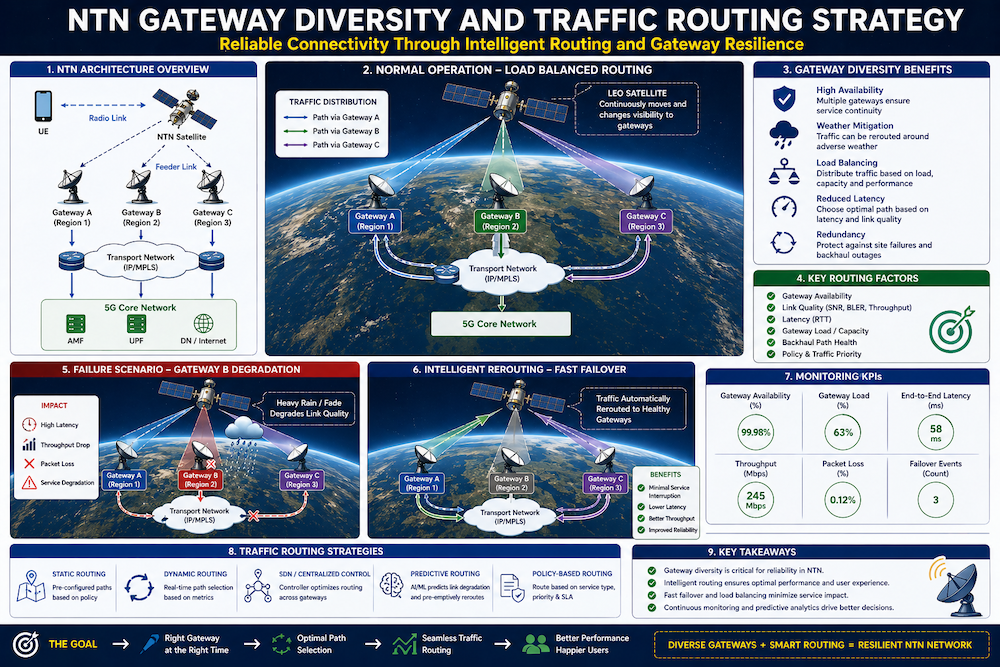
In terrestrial networks, traffic flows through relatively fixed backhaul paths. In NTN, gateways play a critical role as the interface between satellite links and the core network.
- Satellite connects UEs to ground based gateways
- Gateways connect to 5G Core
- Multiple gateways are deployed for redundancy and load distribution
This introduces the need for intelligent gateway diversity and routing strategies.
2. What is NTN Gateway
An NTN gateway is a ground station that:
- Terminates feeder link from satellite
- Connects to transport network and core
- Handles traffic aggregation and routing
Key characteristics:
- Limited geographical coverage
- Weather sensitive (especially at higher frequencies)
- Critical for service continuity
3. Why Gateway Diversity is Required
Unlike terrestrial backhaul:
- Single gateway failure can impact large coverage area
- Weather conditions (rain fade) can degrade link quality
- Satellite visibility varies across regions
Therefore:
- Multiple gateways are deployed
- Traffic must dynamically shift between them
4. Types of Gateway Diversity
| Type | Description | Use Case |
|---|---|---|
| Site Diversity | Multiple physical gateway locations | Failure protection |
| Frequency Diversity | Different frequency bands | Weather mitigation |
| Satellite Diversity | Multiple satellites serving same area | Redundancy |
| Path Diversity | Multiple routing paths to core | Load balancing |
5. NTN Traffic Routing Basics
Traffic flow:
- UE → Satellite → Gateway → Core Network
Routing decisions must consider:
- Gateway availability
- Link quality
- Latency
- Load conditions
6. Challenges in NTN Traffic Routing
Key challenges:
- Dynamic satellite movement (LEO)
- Variable link quality (weather, beam conditions)
- Gateway congestion
- Long RTT affecting routing decisions
Result:
- Static routing is not sufficient

Wireless Car Air Compressor Air Pump Electric Tire Inflator Pump for Motorcycle Bicycle Boat
7. Gateway Failure Scenarios
Typical failure cases:
Complete Gateway Failure:
- Power or hardware failure
- Backhaul disconnection
Partial Degradation:
- Rain fade reducing link quality
- Congestion or overload
Impact:
- Traffic loss
- Increased latency
- Service interruption
8. Traffic Rerouting Mechanisms
When gateway issues occur:
- Traffic is redirected to alternate gateway
- Satellite switches feeder link
- Core network updates routing paths
Approaches:
- Pre configured backup gateways
- Dynamic routing protocols
- SDN based traffic control
9. LEO Specific Routing Complexity
In LEO systems:
- Satellite continuously changes position
- Gateway visibility changes dynamically
Implications:
- UE traffic path may change even without failure
- Frequent path switching required
Optimization challenge:
- Maintain session continuity during routing changes
10. Troubleshooting Gateway and Routing Issues
Common symptoms:
- Sudden latency increase
- Throughput drop
- Packet loss spikes
Root causes:
- Gateway congestion
- Suboptimal routing path
- Delayed rerouting
Key checks:
- Gateway utilization
- Link quality metrics
- Routing path logs
11. Optimization Strategy from Network Perspective
Key actions:
- Deploy geographically distributed gateways
- Implement intelligent load balancing
- Use weather aware routing policies
- Enable fast failover mechanisms
Monitor:
- Gateway load
- Link availability
- End to end latency
12. Practical Deployment Strategies
Operators typically:
- Use gateway pools instead of single nodes
- Implement SDN/NFV based routing control
- Integrate predictive analytics for traffic steering
Real world insight:
- Gateway diversity is as critical as radio optimization in NTN
13. Key Takeaways
- Gateways are critical points in NTN architecture
- Diversity ensures reliability and service continuity
- Routing must be dynamic and adaptive
- Optimization requires coordination between satellite, transport, and core