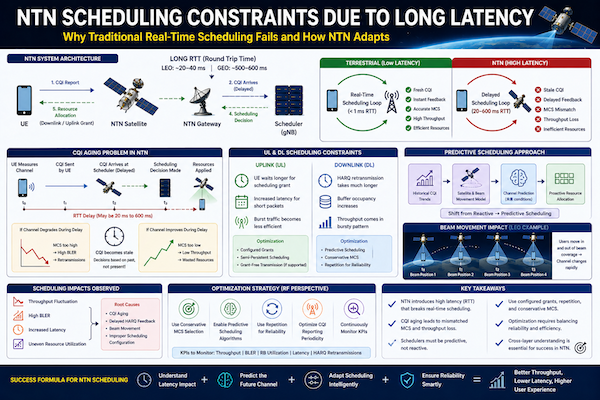
1. Introduction to Scheduling in NTN
Scheduling in terrestrial networks is designed for low latency environments where decisions can be made and executed within milliseconds. In NTN, long propagation delays fundamentally change how scheduling behaves.
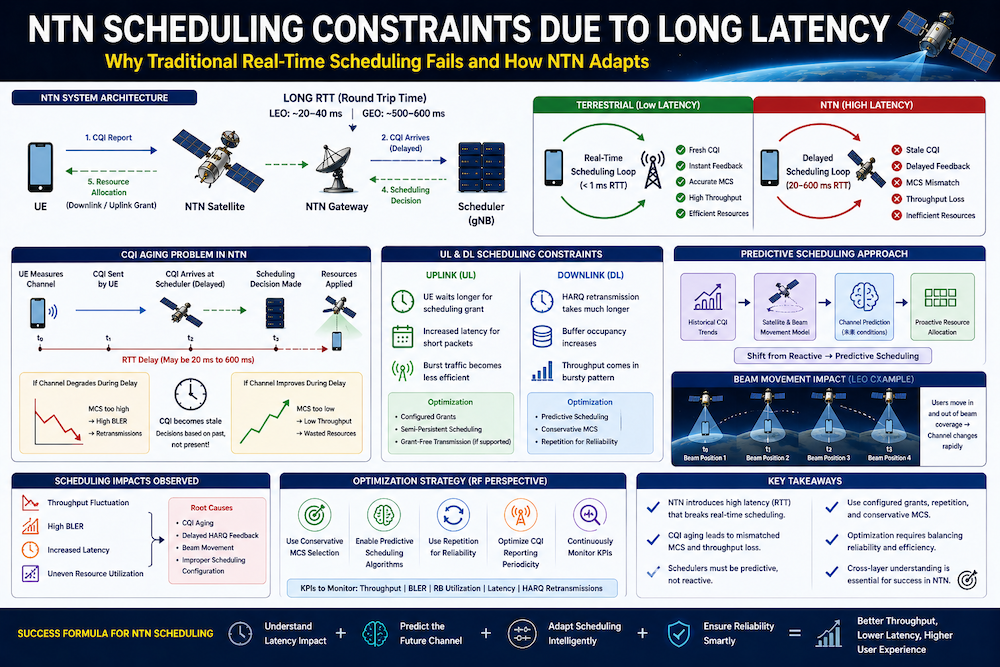
- RTT ranges from 20 ms (LEO) to 600 ms (GEO)
- Real time scheduling assumptions break down
- Resource allocation must anticipate future conditions
2. Terrestrial Scheduling (Baseline Behavior)
In LTE/5G terrestrial systems:
- Scheduler operates on near real time feedback
- CQI reports are fresh
- HARQ feedback is immediate
Key characteristics:
- Fast link adaptation
- High spectral efficiency
- Tight control loops
3. Why Scheduling Becomes Challenging in NTN
| Parameter | Terrestrial | NTN |
|---|---|---|
| Feedback Delay | Instant | Highly delayed |
| CQI Validity | Fresh | Outdated quickly |
| Scheduling Decision | Reactive | Predictive |
| Resource Utilization | Efficient | Prone to inefficiency |
Core issue:
- By the time scheduling decisions are applied, channel conditions may have changed
4. Impact of Long RTT on Scheduler Design
Key effects:
- Delayed CQI reporting
- Delayed HARQ feedback
- Reduced accuracy in link adaptation
Practical result:
- Scheduler cannot rely on real time information
- Increased risk of incorrect MCS selection
5. CQI Aging Problem in NTN
CQI (Channel Quality Indicator) becomes stale due to delay.
- UE reports CQI → arrives late at scheduler
- Scheduler uses outdated channel conditions
Impact:
- Overestimation → high BLER
- Underestimation → low throughput
6. Uplink Scheduling Constraints
In uplink:
- UE must wait for scheduling grant
- Grant delay increases due to RTT
Challenges:
- Increased latency for UL transmission
- Reduced responsiveness for burst traffic
Optimization:
- Use configured grants (grant free transmission)
- Semi persistent scheduling

AOCHUAN 3-Axis Handheld Gimbal Stabilizer for Smartphone with Fill Light for iPhone Android
7. Downlink Scheduling Constraints
In downlink:
- Scheduling decisions are delayed
- HARQ retransmissions take longer
Impact:
- Lower throughput efficiency
- Increased buffering
Real world behavior:
- Data arrives in bursts instead of smooth flow
8. Predictive Scheduling Approach
To overcome delay:
- Scheduler predicts channel conditions
- Uses historical CQI trends
- Incorporates satellite movement patterns
Key idea:
- Shift from reactive to predictive scheduling
9. Role of Beam Movement in Scheduling
In LEO systems:
- Beam moves across users
- Channel conditions change rapidly
Impact:
- Scheduling decisions must consider beam trajectory
- Resource allocation must anticipate coverage changes
10. Troubleshooting Scheduling Issues
Common symptoms:
- Throughput fluctuation
- High BLER
- Increased latency
- Uneven resource utilization
Root causes:
- CQI mismatch
- HARQ inefficiency
- Improper scheduling configuration
11. Optimization Strategy from RF Perspective
Key actions:
- Use conservative MCS selection
- Enable predictive scheduling algorithms
- Use repetition for reliability
- Optimize CQI reporting periodicity
Monitor:
- Throughput trends
- BLER
- Resource block utilization
12. Practical Deployment Strategies
Operators typically:
- Combine predictive + semi static scheduling
- Use configured grants for uplink
- Reduce dependency on HARQ
Important observation:
- Aggressive scheduling strategies from terrestrial networks do not work well in NTN
13. Key Takeaways
- Scheduling in NTN is delay driven, not real time
- CQI aging is a major challenge
- Predictive models are essential
- Optimization requires balancing reliability and efficiency