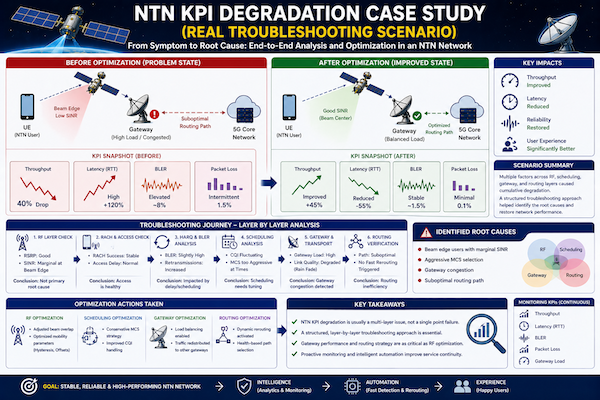
1. Introduction to NTN KPI Degradation Analysis
In NTN, KPI degradation often appears confusing because multiple domains are involved, RF, satellite link, gateway, and core network.
- Issues rarely originate from a single layer
- Symptoms may appear similar across different root causes
- Requires structured, multi layer troubleshooting approach
This case study focuses on a realistic scenario combining throughput drop and latency increase.
2. Problem Statement (Field Scenario)
Observed behavior:
- Throughput dropped by ~40%
- Latency increased significantly
- Intermittent packet loss reported
Initial checks:
- No major alarms
- Coverage appeared stable
- UE remained connected
This is a typical NTN troubleshooting challenge.
3. KPI Symptoms Breakdown
| KPI | Observed Issue | Possible Domain |
|---|---|---|
| Throughput | Decreasing trend | RF / Scheduling / Routing |
| Latency | Increasing | RTT / Gateway / Routing |
| BLER | Slight increase | RF / HARQ |
| Packet Loss | Intermittent | Transport / Gateway |
Insight:
- Multiple KPIs degraded simultaneously → multi-layer issue likely
4. Step 1: RF Layer Verification
Check:
- RSRP / SINR levels
- Beam coverage stability
- UE location (beam center vs edge)
Findings:
- Signal strength acceptable
- Slight SINR variation at beam edge
Conclusion:
- RF not primary root cause, but contributing factor possible
5. Step 2: RACH and Access Stability Check
Check:
- RACH success rate
- Access delay
Findings:
- Stable RACH performance
- No excessive retries
Conclusion:
- Initial access not the issue
6. Step 3: HARQ and BLER Analysis
Check:
- BLER trends
- HARQ retransmission rate
Findings:
- BLER slightly elevated
- Retransmissions increased
Interpretation:
- Possible scheduling or latency related inefficiency

7. Step 4: Scheduling Behavior Analysis
Check:
- Throughput vs resource allocation
- CQI trends vs MCS selection
Findings:
- CQI fluctuations due to beam movement
- MCS occasionally too aggressive
Impact:
- Increased retransmissions
- Throughput degradation
8. Step 5: Gateway and Transport Analysis
Check:
- Gateway load
- Link quality
- End to end latency
Findings:
- One gateway experiencing high utilization
- Slight degradation in feeder link quality
Critical observation:
- Traffic not evenly distributed
9. Step 6: Routing Path Verification
Check:
- Traffic routing paths
- Failover behavior
Findings:
- Suboptimal routing path selected
- No immediate rerouting despite degradation
Impact:
- Increased latency
- Packet loss
10. Root Cause Summary
Combined issues identified:
- Beam edge SINR variation
- Aggressive MCS selection
- Gateway congestion
- Suboptimal routing path
Key insight:
- No single failure, cumulative degradation across layers
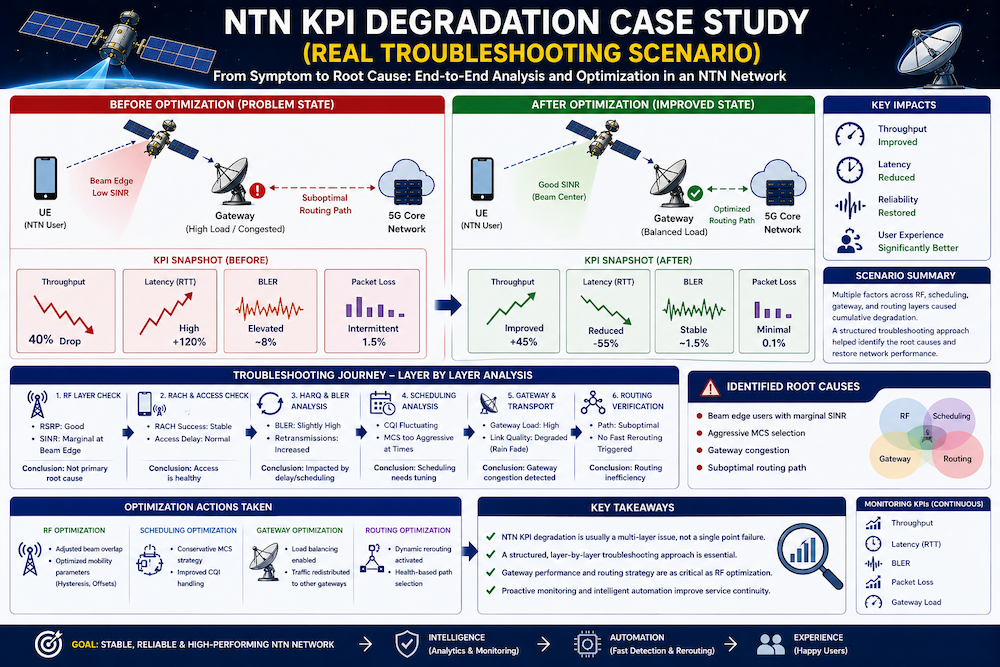
11. Optimization Actions Implemented
RF Layer:
- Adjusted beam overlap
- Tuned mobility parameters
Scheduling:
- Applied conservative MCS strategy
- Improved CQI handling
Gateway:
- Load balancing enabled
- Traffic redistributed
Routing:
- Activated dynamic rerouting policy
- Reduced dependency on congested gateway
12. Results After Optimization
| KPI | Before | After |
|---|---|---|
| Throughput | Low | Improved |
| Latency | High | Reduced |
| BLER | Elevated | Stabilized |
| Packet Loss | Present | Minimal |
Outcome:
- Service stability restored
- User experience improved
13. Key Takeaways
- NTN KPI issues are usually multi layer problems
- RF, scheduling, and routing must be analyzed together
- Gateway and transport layers are equally critical
- Structured troubleshooting approach is essential