1. Introduction
As satellite communications continue expanding through GEO platforms, LEO mega constellations, NTN integration, and direct to device services, one important question naturally arises:
Who actually regulates space communications globally?
While many engineers focus primarily on antennas, payloads, coverage, throughput, and RF optimization, the reality is that modern satellite communication operates within a highly coordinated international institutional framework involving governments, regional organizations, global agencies, private companies, research institutions, and regulatory bodies.
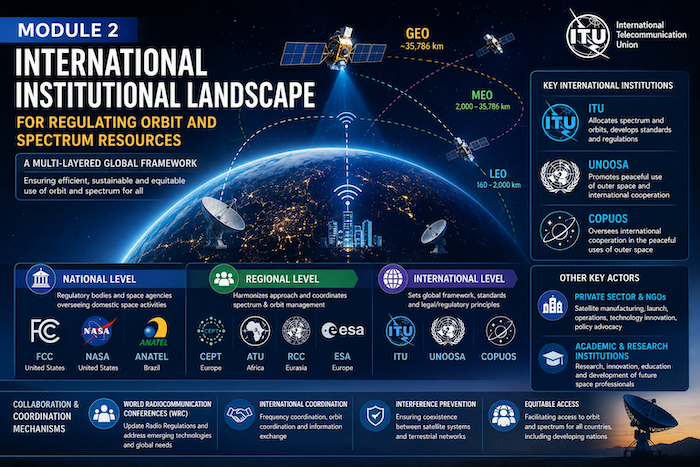
The second module of the ITU Academy course “Global Satellite Regulation Essentials” provided a detailed overview of this multilayered ecosystem responsible for governing orbit and spectrum resources worldwide.
One of the most important learnings from this module was understanding that orbit and spectrum regulation is not managed by a single organization alone. Instead, it operates through coordination across national, regional, and international levels.
2. The Multilayered Institutional Landscape
The institutional landscape for regulating orbit and spectrum resources is built upon three major regulatory layers:
- National Level
- Regional Level
- International Level
Each layer plays a specific role in ensuring:
- Efficient spectrum utilization
- Interference prevention
- Global interoperability
- Sustainable space operations
- Equitable access to orbit and spectrum resources
This integrated governance model is critical because space activities are inherently international in nature. A satellite launched by one country may serve users across multiple continents while sharing frequencies with systems operated by entirely different nations.
3. National Level Regulation
At the national level, countries establish their own regulatory authorities and space agencies responsible for overseeing domestic space activities.
These entities manage:
- Satellite licensing
- Frequency assignments
- National coordination
- Compliance with international obligations
- Authorization of satellite services
Their role is essential in ensuring that local operators follow global regulatory standards while protecting national communication interests.
Some important examples include:
| Organization | Country | Primary Role |
|---|---|---|
| Federal Communications Commission | United States | Regulates radio, satellite, cable, and wireless communications |
| National Aeronautics and Space Administration (NASA) | United States | Space missions and coordination on spectrum matters |
| Agência Nacional de Telecomunicações | Brazil | Satellite authorization and telecom regulation |
The module highlighted that even for satellite operators wishing to provide services inside a country, regulatory approval is often mandatory depending on the ITU radiocommunication service associated with the used frequency bands.
4. Regional Level Coordination
Regional organizations play a major role in harmonizing regulatory approaches among neighboring countries.
This is particularly important because:
- Satellite beams often cover multiple countries simultaneously
- Spectrum coordination challenges frequently cross borders
- Regional harmonization simplifies interoperability
Regional entities help:
- Coordinate spectrum use
- Develop common regulatory policies
- Share best practices
- Represent regional interests internationally
Some important examples discussed in the module include:
| Organization | Region | Primary Focus |
|---|---|---|
| European Conference of Postal and Telecommunications Administrations | Europe | Spectrum harmonization and telecom coordination |
| African Telecommunications Union | Africa | Regional telecom development and spectrum matters |
| Regional Commonwealth in the Field of Communications | Eurasia | Telecommunications coordination |
The module also introduced regional space organizations such as:
| Organization | Role |
|---|---|
| European Space Agency | Joint European space programs and missions |
| Asia Pacific Space Cooperation Organization | Regional space cooperation and development |
5. International Level Governance
At the international level, several organizations are responsible for establishing global regulatory frameworks for orbit and spectrum management.
These entities ensure that satellite communications operate within internationally agreed legal and technical frameworks.
The most important organizations discussed in the module were:
| Organization | Role |
|---|---|
| International Telecommunication Union | Global spectrum and satellite orbit management |
| United Nations Office for Outer Space Affairs | International space law and cooperation |
| Committee on the Peaceful Uses of Outer Space | Development of international legal frameworks |
These organizations collectively support:
- Peaceful use of outer space
- International cooperation
- Spectrum allocation
- Orbit coordination
- Technical standardization
- Space sustainability
6. The Expanding Role of the Private Sector
Another important discussion point in this module was the increasing influence of private companies in the global satellite ecosystem.
Historically, space activities were dominated by governments. Today, however, private companies play a central role in:
- Satellite manufacturing
- Launch services
- Broadband constellations
- Commercial satellite operations
- Space innovation
The module referenced companies such as:
- SpaceX
- Blue Origin
- OneWeb
These organizations are not only advancing technology but are also heavily influencing global policy discussions around:
- Space sustainability
- Orbital congestion
- Spectrum sharing
- Satellite coexistence
7. Role of Academic and Research Institutions
Academic institutions also contribute significantly to the satellite ecosystem.
Their contributions include:
- Space science research
- Satellite technology development
- Spectrum studies
- Policy research
- Education and workforce development
Universities and research centers often collaborate with:
- Governments
- Regulatory bodies
- Satellite operators
- International organizations
This collaboration helps prepare future engineers, researchers, and policymakers for the rapidly evolving space sector.

8. Collaboration and Coordination Mechanisms
One of the strongest messages throughout the module was that global satellite regulation depends heavily on international coordination mechanisms.
Without coordination:
- Interference levels would increase dramatically
- Orbital congestion would become unmanageable
- Spectrum conflicts would escalate
- Global interoperability would suffer
The module emphasized the importance of the World Radiocommunication Conference in updating regulatory frameworks.
These conferences play a major role in:
- Revising Radio Regulations
- Supporting new technologies
- Addressing emerging spectrum demands
- Improving equitable access for developing countries
- Managing coexistence between GEO and NGSO systems
This becomes increasingly important as satellite technology evolves faster than traditional regulatory cycles.
9. Central Role of the ITU
The International Telecommunication Union remains the most important international body for orbit and spectrum regulation.
Its responsibilities include:
- Global spectrum allocation
- GEO orbital coordination
- Technical standardization
- Frequency coordination
- Interference prevention
- Policy facilitation
- International cooperation
9.1 Spectrum Allocation
The ITU allocates radio frequency spectrum bands for multiple communication services including:
- Satellite communication
- Mobile services
- Broadcasting
- Aeronautical communication
- Maritime communication
This allocation process helps ensure efficient and interference free operation worldwide.
9.2 GEO Orbital Slot Coordination
For GEO satellites, orbital positions are limited and highly valuable.
The ITU coordinates these orbital assignments to:
- Prevent satellite interference
- Maintain operational separation
- Ensure fair international access
- Optimize global coverage
This process involves extensive:
- Registration
- Notification
- Technical coordination
- International agreement procedures
9.3 Technical Standardization
The ITU also develops international technical standards known as Recommendations.
These standards ensure:
- Interoperability
- Global compatibility
- Seamless communication
- Equipment standardization
The ITU Recommendations database can be accessed online on ITU website.
9.4 Regulation and Policy Development
The ITU Radio Regulations serve as an international treaty governing:
- Spectrum use
- Satellite orbit usage
- Interference management
- Coordination procedures
These regulations are periodically revised during World Radiocommunication Conferences to accommodate:
- Emerging technologies
- New satellite systems
- Changing communication demands
9.5 Bridging the Digital Divide
Another major role of the ITU is improving global access to ICT services.
Through its development sector, the ITU supports:
- Developing countries
- Underserved regions
- Capacity building initiatives
- Telecommunications infrastructure deployment
Satellite communication remains one of the most effective technologies for connecting remote and underserved populations worldwide.
9.6 Conflict Resolution and Coordination
The ITU also facilitates:
- Frequency coordination
- Negotiation mechanisms
- Interference resolution
- International dispute management
As satellite deployments continue increasing rapidly, these coordination mechanisms are becoming more important than ever.
10. Practical Engineering Perspective
From a telecom and RF optimization perspective, this module highlighted an important reality:
Satellite communication is no longer purely a technical domain.
Modern satellite engineering increasingly involves:
- Regulatory awareness
- International coordination
- Spectrum coexistence
- Multi operator collaboration
- Cross border interoperability
As NTN networks continue integrating with terrestrial mobile systems, engineers may increasingly encounter:
- GEO vs NGSO coexistence challenges
- Cross border interference issues
- Dynamic spectrum coordination
- Regulatory compliance requirements
Understanding the institutional landscape behind satellite communication is therefore becoming an essential skill for future telecom professionals.
11. Conclusion
The second module of the ITU Academy course provided a comprehensive overview of the global institutional ecosystem governing orbit and spectrum resources.
What initially appears to be a purely technical field is actually supported by an enormous international coordination framework involving regulators, governments, regional organizations, global institutions, private companies, and research communities.
As satellite communications continue expanding through NTN, direct to device connectivity, and mega-constellation deployments, the importance of coordinated global regulation will only continue growing.
The future of satellite communication will depend not only on technological innovation, but also on international collaboration and sustainable management of shared global resources.