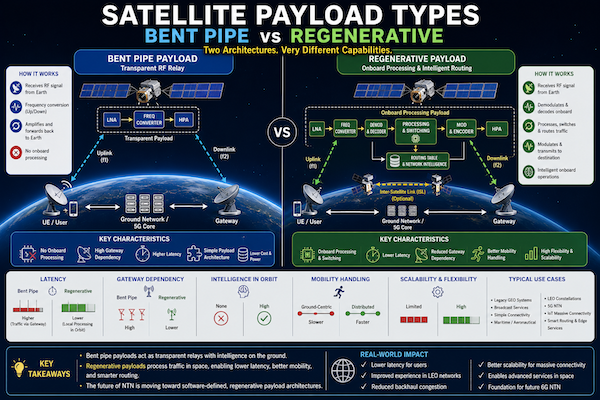
- Introduction to Satellite Payload Types in NTN
The payload is the heart of a satellite communication system. It is responsible for receiving, processing, amplifying, and forwarding signals between users, gateways, and networks on Earth.
In NTN, payload architecture plays a major role in determining latency, flexibility, onboard intelligence, mobility handling, and overall network capability. Modern satellite systems are mainly divided into two payload categories:
- Bent Pipe Payload
- Regenerative Payload
Understanding this difference is critical because it fundamentally changes how NTN networks behave operationally and architecturally.
- What is a Bent Pipe Payload
A bent pipe payload acts as a transparent RF relay in space.
The satellite simply receives the signal, shifts the frequency, amplifies it, and forwards it back to Earth without decoding or processing the data.
Main characteristics:
- No onboard baseband processing
- Signal remains transparent to the satellite
- Most intelligence remains on the ground
Operational flow:
- UE → Satellite → Gateway → gNB/Core
Practical understanding:
- The satellite behaves like a repeater in space
- What is a Regenerative Payload
A regenerative payload performs onboard signal processing before forwarding traffic.
The satellite can demodulate, decode, process, route, and sometimes even partially function as a gNB in orbit.
Main characteristics:
- Onboard processing capability
- Traffic regeneration in space
- Intelligent routing and switching
Operational flow:
- UE → Satellite processing → ISL/Gateway/Core
Practical understanding:
- The satellite behaves like an active network node rather than a simple relay
- Why NTN is Moving Toward Regenerative Payloads
Traditional bent pipe systems worked well for broadcast and basic connectivity, but NTN requires much more dynamic behavior.
Bent pipe limitations:
- Heavy dependence on gateways
- Long routing paths
- Limited onboard intelligence
Regenerative payload advantages:
- Reduced latency
- Better mobility handling
- Smarter traffic routing
Key NTN driver:
- Future NTN requires cloud like processing capabilities in space
Knowledge tip:
- Bent pipe extends coverage, regenerative payload extends network intelligence into orbit
- Architecture Differences
The architectural impact between both payload types is massive.
Bent pipe architecture:
- Centralized processing on ground
- Simpler satellite hardware
- High gateway dependency
Regenerative architecture:
- Distributed processing
- Onboard switching and routing
- Reduced gateway reliance
Practical impact:
- Regenerative payloads can support more autonomous satellite operations
- Vendor Implementation Perspective
Satellite vendors implement payloads differently depending on mission goals.
Bent pipe systems:
- Common in traditional GEO satellites
- Lower complexity and power consumption
Regenerative systems:
- Used in advanced LEO constellations and next generation HTS
- Require onboard processors and software defined payloads
Telecom vendor role:
- Integrate NTN protocols with onboard processing
- Optimize mobility and session continuity
Key insight:
- Regenerative payloads blur the boundary between satellite and telecom infrastructure

Wireless Car Air Compressor Air Pump Electric Tire Inflator Pump for Motorcycle Bicycle Boat
- Impact on Latency and Routing
Payload architecture directly affects network delay and traffic flow.
Bent pipe latency characteristics:
- Traffic always routed through gateway
- Longer physical routing paths
Regenerative latency characteristics:
- Local processing possible in orbit
- Reduced backhaul dependency
Practical observation:
- Regenerative payloads become much more efficient when combined with inter satellite links (ISL)
- Impact on Mobility and Handover
Mobility management behavior differs significantly.
Bent pipe mobility:
- Controlled mostly from ground network
- Gateway transitions become critical
Regenerative mobility:
- Faster onboard mobility decisions possible
- Better local handling of beam and satellite handovers
Key NTN advantage:
- Regenerative payloads improve handover responsiveness in fast moving LEO environments
- Impact on KPIs and Network Performance
Payload type influences many NTN KPIs.
Bent pipe KPI behavior:
- Higher RTT
- More gateway related bottlenecks
- Larger dependency on feeder link quality
Regenerative KPI behavior:
- Lower latency
- Better session continuity
- Improved throughput consistency
Key KPIs impacted:
- RTT
- Throughput
- Handover success rate
- Packet delay variation
- Troubleshooting Perspective
Payload architecture changes how engineers analyze issues.
Bent pipe troubleshooting focus:
- Gateway congestion
- Feeder link degradation
- Ground processing delays
Regenerative troubleshooting focus:
- Onboard processing load
- Satellite software behavior
- In orbit routing decisions
Practical insight:
- Bent pipe problems are mostly ground centric, regenerative problems increasingly become software centric
- Operational and Business Perspective
Payload selection is also a business and deployment decision.
Bent pipe advantages:
- Lower satellite complexity
- Faster deployment
- Lower satellite cost
Regenerative advantages:
- Better scalability
- Reduced infrastructure dependency
- Smarter traffic optimization
Industry trend:
- Future NTN systems are gradually moving toward software defined regenerative payloads
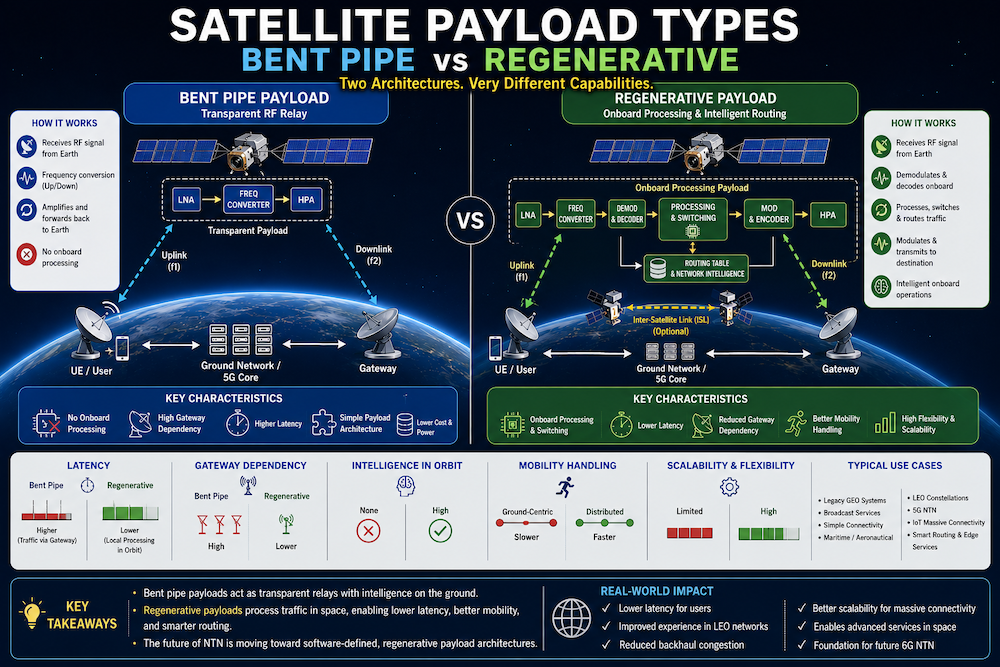
- Bent Pipe vs Regenerative Payload Comparison
| Feature | Bent Pipe | Regenerative |
|---|---|---|
| Processing | Ground based | Onboard |
| Satellite Role | Transparent relay | Intelligent node |
| Complexity | Lower | Higher |
| Latency | Higher | Lower |
| Gateway Dependency | High | Lower |
| Mobility Handling | Ground centric | Distributed |
| Flexibility | Limited | High |
| NTN Suitability | Moderate | Very high |
- Key Takeaways
- Bent pipe payloads act as transparent RF relays with most intelligence located on the ground
- Regenerative payloads introduce onboard processing, routing, and intelligent traffic handling in space
- Modern NTN systems increasingly prefer regenerative payloads due to lower latency and better mobility support
- Bent pipe systems are simpler and cost effective but heavily dependent on gateways and feeder links
- Regenerative payloads improve scalability, flexibility, and autonomous network behavior
- Payload architecture directly impacts KPIs such as RTT, throughput, handover success rate, and latency variation
- Troubleshooting bent pipe systems focuses on ground infrastructure, while regenerative systems introduce software and onboard processing analysis
- The future of NTN is moving toward software defined regenerative payload architectures with cloud like intelligence in orbit