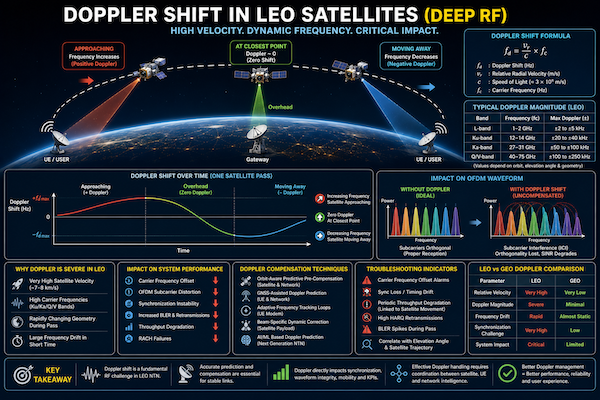
- Introduction to Doppler Shift in LEO Satellites
Doppler Shift is one of the most critical RF challenges in Low Earth Orbit (LEO) satellite communication systems. Unlike terrestrial networks where base stations are stationary, LEO satellites move at extremely high velocities relative to the Earth.
Because of this rapid movement, the frequency observed at the receiver continuously changes even when the transmitted frequency remains constant. This phenomenon is called Doppler Shift.
In NTN systems, Doppler is not a minor RF effect, it directly impacts synchronization, mobility, scheduling, waveform stability, and overall network reliability.
- What is Doppler Shift
Doppler Shift is the change in observed signal frequency caused by relative motion between the transmitter and receiver.
Basic principle:
- If the satellite moves toward the UE → observed frequency increases
- If the satellite moves away from the UE → observed frequency decreases
The faster the relative motion, the larger the frequency shift.
In LEO NTN:
- Satellites move around 7–8 km/sec
- Doppler shifts can reach tens or even hundreds of kHz depending on frequency band
Practical understanding:
- The receiver sees a continuously moving carrier frequency
- Why Doppler is Extremely Important in LEO NTN
Doppler exists in all wireless systems, but in terrestrial networks it is relatively small.
In LEO NTN, Doppler becomes a major system level challenge because of:
- High satellite velocity
- Large carrier frequencies (Ku/Ka bands)
- Rapidly changing orbital geometry
Key NTN impact:
- Synchronization becomes extremely difficult without compensation
Knowledge tip:
- Doppler in LEO NTN is not just a mobility effect, it is a fundamental PHY layer challenge
- How Doppler Shift Behaves During Satellite Pass
Doppler variation changes continuously during a satellite pass.
Typical behavior:
- Satellite approaching UE → positive frequency shift
- Satellite directly overhead → near zero shift
- Satellite moving away → negative frequency shift
Practical observation:
- Frequency drift follows a predictable orbital pattern
Key insight:
- Doppler is dynamic, not static
- Mathematical Understanding of Doppler
The Doppler shift magnitude depends on relative velocity and carrier frequency.
General relationship:
- Higher velocity → larger Doppler
- Higher carrier frequency → larger Doppler
For NTN:
- Ka-band experiences much larger Doppler effects than lower frequency bands
Practical implication:
- Future high frequency NTN systems face increasingly severe Doppler challenges
- Impact on NTN Waveforms and Synchronization
Doppler directly affects waveform integrity and timing synchronization.
Main impacts:
- Carrier frequency offset
- OFDM subcarrier distortion
- Timing synchronization instability
Why OFDM is sensitive:
- OFDM depends on orthogonality between subcarriers
- Doppler destroys this orthogonality
Result:
- Inter carrier interference (ICI) increases
Practical observation:
- Uncompensated Doppler can severely degrade SINR and throughput

- Impact on Mobility and Handover
Doppler variation complicates NTN mobility procedures.
Challenges include:
- Frequency tracking during handover
- Beam switching synchronization
- Satellite transition timing
In LEO systems:
- Doppler profile changes between beams and satellites
Key NTN challenge:
- Mobility algorithms must become orbit aware
- Vendor Implementation Perspective
Satellite and telecom vendors implement Doppler handling differently.
Satellite vendor techniques:
- Predictive Doppler pre compensation
- Beam specific frequency correction
- Orbit based frequency planning
Telecom vendor techniques:
- Advanced synchronization algorithms
- Frequency tracking loops
- Doppler aware scheduling
Key insight:
- Doppler compensation is shared between satellite payload, UE modem, and network intelligence
- Impact on KPIs and Network Performance
Doppler affects many NTN KPIs directly.
Common KPI impact:
- SINR degradation
- Increased BLER
- Throughput fluctuation
- RACH failures
Practical symptoms:
- Periodic throughput degradation during satellite movement
- Increased retransmissions at beam edges
Important behavior:
- Doppler related issues often appear cyclic and time dependent
- Troubleshooting Perspective
Doppler problems create unique RF signatures.
Common troubleshooting symptoms:
- Synchronization failures
- Carrier frequency offset alarms
- Random packet loss during mobility
Logs may show:
- Frequency tracking instability
- Timing alignment drift
- Increased HARQ retransmissions
Troubleshooting approach:
- Correlate issues with satellite movement timing
- Analyze elevation angle versus KPI degradation
- Verify Doppler compensation accuracy
Practical insight:
- Many “intermittent” NTN RF issues are actually Doppler driven phenomena
- Advanced Doppler Compensation Techniques
Modern NTN systems use multiple layers of Doppler mitigation.
Techniques include:
- GNSS assisted prediction
- Orbit aware pre compensation
- Adaptive frequency tracking
Advanced approaches:
- AI assisted Doppler prediction
- Beam specific dynamic correction
Practical trend:
- Compensation is shifting from reactive correction toward predictive compensation
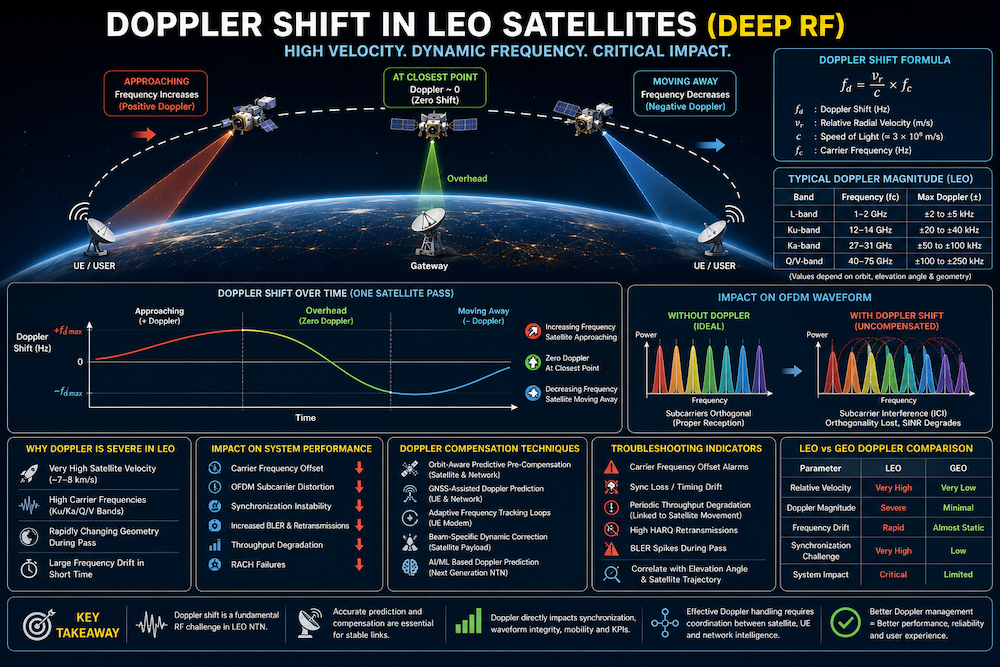
- LEO vs GEO Doppler Comparison
| Parameter | LEO | GEO |
|---|---|---|
| Relative Velocity | Very High | Very Low |
| Doppler Magnitude | Severe | Minimal |
| Frequency Drift | Rapid | Nearly stable |
| Mobility Complexity | Very High | Low |
| Synchronization Challenge | Major | Moderate |
| NTN Impact | Critical | Limited |
- Key Takeaways
- Doppler Shift in LEO NTN is caused by extremely high satellite velocity relative to the Earth
- The observed carrier frequency continuously changes during satellite movement, creating major PHY-layer challenges
- Doppler directly impacts synchronization, OFDM waveform integrity, mobility, and throughput performance
- Higher carrier frequencies such as Ka-band experience much stronger Doppler effects
- Modern NTN systems require predictive and orbit-aware Doppler compensation mechanisms
- Both satellite vendors and telecom vendors share responsibility for Doppler mitigation through payload design, synchronization algorithms, and modem intelligence
- Doppler-related issues often appear as periodic or time-dependent KPI degradation patterns
- Effective NTN troubleshooting requires correlating RF behavior with satellite trajectory, elevation angle, and orbital timing