
- Introduction to Beamforming in Satellite NTN
Beamforming is one of the most critical technologies enabling modern satellite based NTN systems. Instead of transmitting signals in all directions, satellites use beamforming to focus energy toward specific geographic areas on Earth.
In NTN, beamforming is not just about coverage, it directly controls capacity distribution, interference management, and user experience. With the shift toward LEO constellations and high throughput satellites, beamforming has evolved into two main architectures: analog beamforming and digital beamforming.
- What is Beamforming in Satellites
Beamforming is the process of shaping and steering RF signals using antenna arrays to create focused beams.
- Multiple antenna elements are used to form a directional beam
- Signals are combined with phase and amplitude control
- Beams can be steered without physically moving antennas
In NTN:
- Each beam acts like a cell in terrestrial networks
- Beam footprint defines coverage area
Practical insight:
- Beamforming allows satellites to reuse frequency across multiple beams, increasing capacity
- Why Beamforming is Critical in NTN
Unlike traditional wide beam satellites, NTN requires high precision coverage and capacity control.
Beamforming enables:
- High capacity through frequency reuse
- Targeted coverage for demand hotspots
- Interference reduction between beams
Key NTN requirement:
- Dynamic adaptation to moving users and satellites
Knowledge tip:
- Beamforming transforms satellites from broadcast systems into cellular like networks
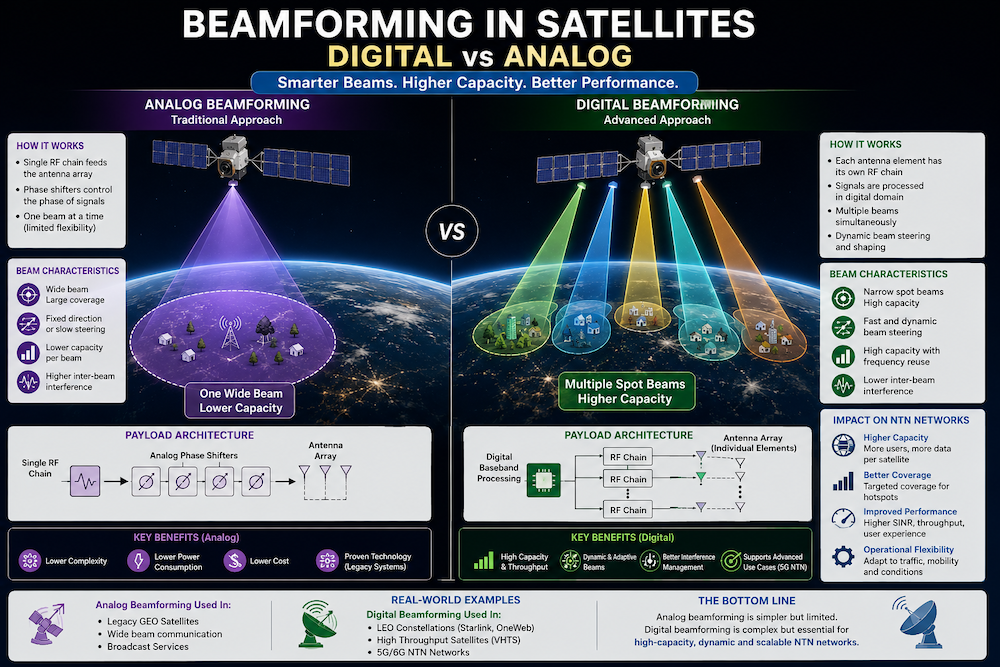
- Analog Beamforming (Traditional Approach)
Analog beamforming is implemented using RF hardware such as phase shifters and combiners.
- Single RF chain controls multiple antenna elements
- Beam direction is controlled by adjusting phase
- Limited flexibility
Characteristics:
- Lower complexity
- Lower power consumption
- Fixed or slowly adjustable beams
Limitations:
- Cannot create multiple independent beams dynamically
- Limited adaptability to traffic variation
- Digital Beamforming (Advanced Approach)
Digital beamforming uses baseband processing to control each antenna element independently.
- Each antenna element has its own RF chain
- Signals are processed digitally before transmission
- Multiple beams can be generated simultaneously
Characteristics:
- High flexibility
- Dynamic beam steering
- Supports multiple users and beams
Capabilities:
- Beam hopping
- Adaptive beam shaping
- Precise interference control
- Analog vs Digital Beamforming Comparison
| Feature | Analog Beamforming | Digital Beamforming |
|---|---|---|
| Control | RF phase shifters | Baseband processing |
| Flexibility | Limited | Very high |
| Number of beams | Few | Many simultaneous |
| Power consumption | Lower | Higher |
| Complexity | Low | High |
| Adaptability | Static | Dynamic |
| NTN suitability | Limited | Highly suitable |

- Vendor Implementation Perspective
Satellite vendors implement beamforming at payload level.
Analog beamforming:
- Used in legacy GEO satellites
- Fixed beam patterns
Digital beamforming:
- Used in modern LEO constellations
- Software controlled beams
Telecom vendors:
- Use beam information for scheduling
- Adapt MCS and resource allocation
Key insight:
- Satellite defines beam capability, telecom stack optimizes user level performance
- Impact on Coverage and Capacity
Beamforming directly determines how coverage and capacity are distributed.
Analog beamforming:
- Large beams
- Limited capacity per area
Digital beamforming:
- Small spot beams
- High frequency reuse
- High capacity in dense areas
Practical behavior:
- High demand regions receive more focused beams in digital systems
- Impact on KPIs and Network Performance
Beamforming affects multiple KPIs.
With digital beamforming:
- Higher SINR
- Better throughput
- Lower interference
With analog beamforming:
- Lower SINR at edges
- Limited throughput scalability
Key KPIs impacted:
- DL/UL throughput
- SINR distribution
- Beam utilization
- Dynamic Behavior in LEO NTN
Beamforming becomes more complex in LEO due to satellite movement.
- Beams must continuously track Earth
- Beam shape changes with elevation angle
- Power must be dynamically allocated
Digital beamforming advantage:
- Real time adaptation to movement
- Better handling of dynamic traffic
- Troubleshooting Perspective
Beamforming issues appear clearly in network behavior.
Common symptoms:
- Uneven throughput across beams
- Sudden SINR drops
- Beam congestion
Logs may show:
- Beam switching events
- Resource imbalance
- Interference spikes
Troubleshooting approach:
- Analyze beam level KPIs
- Check beam allocation vs traffic demand
- Identify overloaded beams
- Practical Optimization Perspective
Optimization in NTN heavily relies on beamforming efficiency.
- Dynamic beam allocation based on demand
- Load balancing across beams
- Interference coordination
Advanced techniques:
- AI based beam optimization
- Beam hopping strategies
Practical insight:
- Beamforming is the main lever for capacity optimization in NTN
- Key Takeaways
- Beamforming enables satellites to focus RF energy into targeted coverage areas, acting like cells in NTN
- Analog beamforming is simpler but limited in flexibility and scalability
- Digital beamforming enables dynamic, multi beam, and high capacity satellite networks
- Modern NTN systems rely heavily on digital beamforming for performance optimization
- Beamforming directly impacts coverage, capacity, interference, and overall KPIs
- In LEO systems, beamforming must continuously adapt due to satellite movement
- Troubleshooting NTN issues often requires beam level analysis rather than cell level analysis
- Effective NTN optimization depends on intelligent beam allocation and resource management