
1. Understanding the Digital Divide
- The digital divide represents unequal access to internet connectivity, digital services, and digital skills.
- Major influencing factors:
- Income level
- Geographic location
- Infrastructure availability
- Education level
- Even today, billions remain disconnected despite existing broadband technologies.
| Region | Internet Usage (%) | Household Internet Access (%) |
|---|---|---|
| Africa | 32.8 | 22.7 |
| Europe | 87.2 | 87.6 |
| Americas | 81.4 | 75.9 |
| Arab States | 66.3 | 62.4 |
2. Fibre Reach and Connectivity Gap
- ITU terrestrial network analysis showed:
- 29.3% population within 10 km of fibre node
- 57.9% within 25 km
- 90.5% within 100 km
- Main challenge is not only technology availability.
- The real challenge is commercial feasibility and sustainable deployment in low density areas.
3. Role of 5G in Broadband Expansion
- IMT-2020 (5G) introduces:
- Enhanced Mobile Broadband (eMBB)
- Ultra-low latency
- Massive IoT connectivity
- 5G business planning must consider:
- Adoption curves
- Market readiness
- Device ecosystem
- Revenue sustainability
- Early technology adoption usually creates rapid subscriber growth before market saturation.
4. Broadband Business Planning Toolkit
The ITU toolkit focuses on evaluating:
- Demand forecasting
- Revenue estimation
- CAPEX modelling
- OPEX modelling
- WACC calculation
- Financing mechanisms
- Net Present Value (NPV)
Main objective:
- Determine whether a broadband infrastructure project is economically viable.
5. Key Variables in Broadband Business Planning
| Variable | Purpose |
|---|---|
| Demand | Determines market size |
| Revenue | Determines business sustainability |
| CAPEX | Infrastructure investment |
| OPEX | Operational costs |
| WACC | Risk adjusted discount rate |
| NPV | Measures project profitability |
6. Net Present Value (NPV) Concept
NPV is one of the most important concepts in telecom business planning.
It estimates:
- Whether future cash flows justify current investment.
NPV Formula:
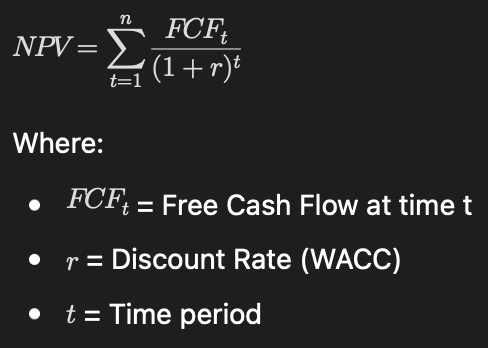
Interpretation:
- Positive NPV → financially viable project
- Negative NPV → investment risk may outweigh returns

Outlet Mount Hanger For TP-Link Smart Hub Deco M9 Whole Home Mesh Wifi Router Accessories
7. Free Cash Flow (FCF) Formula
Free Cash Flow calculation:

8. Demand Forecasting Challenges
Demand modeling directly impacts:
- Revenue
- Capacity planning
- Investment strategy
Key inputs:
- Population density
- Income level
- Spending behaviour
- Existing broadband penetration
- Technology adoption trends
Practical challenge:
- Forecasting future demand accurately in evolving markets.
9. Revenue Modelling Considerations
Revenue estimation depends on:
- ARPU trends
- Existing competition
- Substitute services
- Demographic spending behaviour
Important telecom KPIs:
- ARPU (Average Revenue Per User)
- MOU (Minutes of Usage)
- RPM (Revenue Per Minute)
Benchmarking against similar markets improves model accuracy.
10. CAPEX vs OPEX Perspective
| CAPEX | OPEX |
|---|---|
| Initial infrastructure investment | Day to day operational cost |
| Towers, fibre, routers, spectrum | Power, maintenance, staffing |
| Long term asset creation | Recurring expenses |
| High at rollout phase | Grows with subscribers |
Practical observation:
- CAPEX planning requires strong technical understanding of network deployment models.
11. Regulatory and Audit Challenges
Public sector broadband planning requires:
- Transparency
- Auditability
- Conservative assumptions
- Open datasets
- Recognized methodologies
Regulators face information asymmetry because operators know their real costs and strategies better than regulators.
Methods to reduce asymmetry:
- Cross checking operator financials
- Reviewing auction documents
- Public consultation
12. Practical Learning from This Module
This module highlighted that broadband deployment is not only a technical exercise.
Successful ICT infrastructure planning requires balancing:
- Engineering
- Economics
- Regulation
- Risk
- Market demand
- Long term sustainability
For telecom engineers, understanding business planning is becoming increasingly important alongside technical expertise.