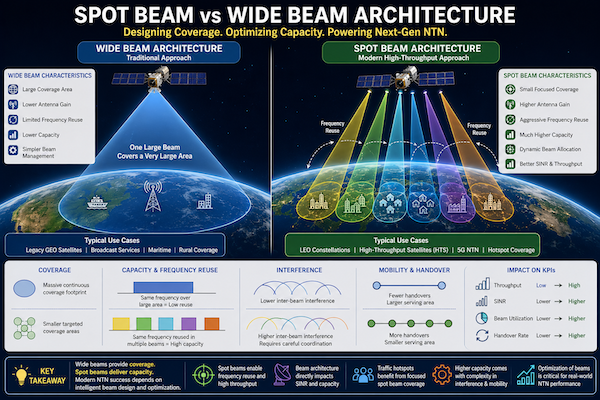
- Introduction to Spot Beam vs Wide Beam Architecture
Beam architecture is one of the most important design decisions in satellite based NTN systems. It directly determines how coverage, capacity, interference, and user density are handled across the network.
Traditionally, satellites used wide beams to cover very large geographic regions using a single transmission footprint. Modern NTN systems, however, increasingly rely on spot beam architectures where coverage is divided into many smaller and highly focused beams.
This transition is similar to the evolution from large macro cells to dense small cell deployments in terrestrial mobile networks.
- What is a Wide Beam Architecture
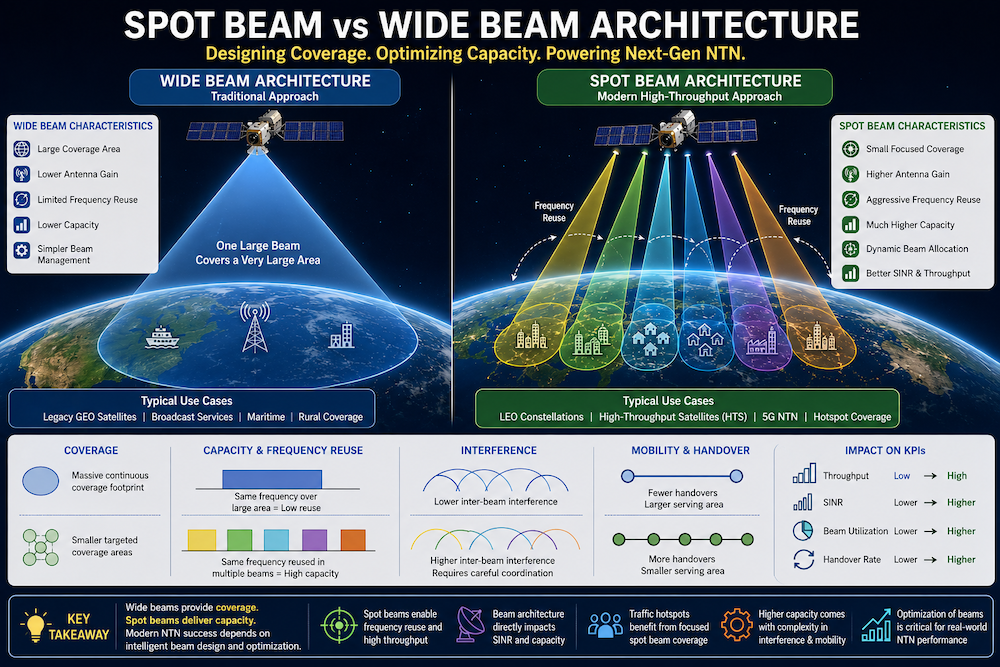
Wide beam architecture uses a large coverage footprint where a single beam serves a very large geographic area.
Characteristics of wide beams:
- Large coverage area
- Lower antenna gain concentration
- Limited frequency reuse
- Lower overall capacity
Typical usage:
- Legacy GEO satellites
- Broadcast services
- Maritime and rural coverage
Practical understanding:
- A wide beam behaves like a very large macro cell covering thousands of kilometers
- What is a Spot Beam Architecture
Spot beam architecture divides coverage into multiple smaller beams focused on specific regions.
Characteristics of spot beams:
- Smaller coverage footprints
- Higher antenna gain
- Aggressive frequency reuse
- Much higher capacity
Typical usage:
- LEO constellations
- High throughput satellites (HTS)
- 5G NTN deployments
Practical understanding:
- Spot beams behave like dense cellular sectors in terrestrial mobile networks
- Why NTN is Moving Toward Spot Beams
Modern NTN systems require much higher capacity and better spectrum efficiency.
Wide beams create limitations:
- Limited throughput per region
- Poor spectrum reuse
- Higher shared congestion
Spot beams solve these issues through:
- Frequency reuse across beams
- Targeted capacity allocation
- Better SINR performance
Key NTN requirement:
- High user density cannot be supported efficiently with wide beams
Knowledge tip:
- Spot beams are the satellite equivalent of sectorization in cellular networks
- Coverage Behavior: Spot Beam vs Wide Beam
Coverage behavior differs significantly between the two architectures.
Wide beam coverage:
- Massive continuous footprint
- Easier mobility handling
- Lower beam management complexity
Spot beam coverage:
- Smaller targeted footprints
- High beam overlap regions
- Frequent beam transitions
Practical behavior:
- Spot beam users may experience more beam handovers in LEO systems
- Capacity and Frequency Reuse
Capacity is the biggest advantage of spot beam architecture.
Wide beams:
- Same spectrum shared across large area
- Low spectral efficiency
Spot beams:
- Frequency reused across multiple beams
- Massive capacity scaling possible
Real world insight:
- Modern high throughput satellites achieve capacity gains primarily through spot beam reuse rather than raw transmit power

- Vendor Implementation Perspective
Satellite vendors design beam architecture based on business and traffic requirements.
Wide beam systems:
- Simpler payload architecture
- Lower onboard processing complexity
Spot beam systems:
- Advanced phased array antennas
- Digital beamforming support
- Dynamic beam allocation
Telecom vendor role:
- Mobility optimization across beams
- Beam aware scheduling and resource allocation
Key insight:
- Spot beam systems require much tighter integration between satellite RF and telecom protocols
- Impact on KPIs and User Experience
Beam architecture directly impacts network performance metrics.
Wide beam KPI behavior:
- Stable coverage
- Lower throughput variation
- Higher congestion risk
Spot beam KPI behavior:
- Higher throughput
- Better SINR
- More dynamic mobility events
Key KPIs affected:
- Beam utilization
- Throughput distribution
- Handover success rate
- SINR consistency
- Interference Characteristics
Interference management becomes much more critical in spot beam systems.
Wide beam interference:
- Lower inter beam interference
- Lower frequency reuse complexity
Spot beam interference:
- Co channel interference between neighboring beams
- Requires careful beam planning
Optimization methods:
- Beam isolation
- Adaptive power allocation
- Intelligent frequency planning
Practical insight:
- Capacity gains from spot beams are only achievable with strong interference control
- Mobility and Handover Impact
Mobility complexity is significantly different between both architectures.
Wide beam systems:
- Fewer mobility events
- Larger serving areas
Spot beam systems:
- Frequent beam handovers
- Rapid beam tracking required
In LEO NTN:
- Beam movement plus satellite movement creates highly dynamic mobility conditions
Knowledge tip:
- Wide beams simplify mobility, spot beams maximize capacity
- Troubleshooting Perspective
Beam architecture influences how network issues appear in operations.
Wide beam issues:
- Congestion over large regions
- Uniform throughput degradation
Spot beam issues:
- Beam edge SINR drops
- Uneven beam loading
- Handover failures
Troubleshooting approach:
- Analyze beam level KPIs rather than satellite level KPIs
- Check beam overlap and interference zones
Practical observation:
- Most NTN optimization work today focuses on spot beam balancing and mobility tuning
- Spot Beam vs Wide Beam Comparison
| Feature | Wide Beam | Spot Beam |
|---|---|---|
| Coverage Area | Very large | Small focused areas |
| Capacity | Lower | Much higher |
| Frequency Reuse | Limited | Aggressive |
| Mobility Complexity | Lower | Higher |
| Interference | Lower | Higher |
| Beam Handover | Rare | Frequent |
| Typical Orbit | GEO | LEO/HTS |
| NTN Suitability | Limited | Highly suitable |
- Key Takeaways
- Wide beams provide large area coverage with simpler mobility handling but limited capacity and spectrum efficiency
- Spot beams divide coverage into smaller focused regions, enabling high throughput and aggressive frequency reuse
- Modern NTN systems rely heavily on spot beam architectures to support 5G level capacity demands
- Spot beams significantly improve SINR and throughput but introduce higher interference and mobility complexity
- Beam level optimization has become a critical operational requirement in LEO NTN systems
- Satellite vendors implement spot beams using advanced phased array and digital beamforming technologies
- Telecom vendors must optimize scheduling, handovers, and load balancing across beams
- Many NTN troubleshooting scenarios today are directly related to spot beam overlap, interference, and beam congestion