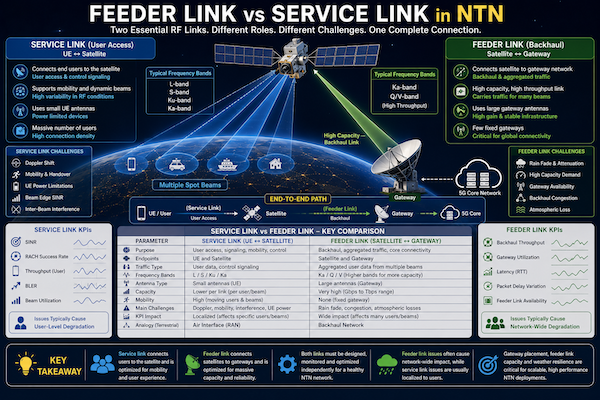
- Introduction to Feeder Link and Service Link in NTN
In NTN architecture, communication is divided into two major RF segments: the feeder link and the service link. These two links together create the complete end to end communication path between the user and the core network.
Although both carry traffic, their design objectives, RF behavior, frequency bands, capacity requirements, and operational challenges are very different.
Understanding feeder link and service link behavior is extremely important because many NTN performance issues originate from confusion between these two domains.
- What is a Service Link
The service link is the RF connection between the satellite and the end user equipment (UE).
Communication path:
- UE ↔ Satellite
The service link carries:
- User traffic
- Control signaling
- Mobility procedures
- RRC/NAS messages
Characteristics:
- Massive number of users
- Dynamic RF conditions
- Mobility sensitive environment
Practical understanding:
- The service link is equivalent to the radio access network (RAN) air interface in terrestrial networks
- What is a Feeder Link
The feeder link is the connection between the satellite and the gateway Earth station.
Communication path:
- Satellite ↔ Gateway
The feeder link carries aggregated traffic from multiple users and beams.
Characteristics:
- Extremely high capacity requirements
- Fixed ground infrastructure
- High gain antennas on both sides
Practical understanding:
- The feeder link behaves like the satellite backhaul connection to the core network
- Why NTN Separates Feeder and Service Links
The RF and operational requirements of user connectivity and gateway connectivity are fundamentally different.
Service link requirements:
- Mobility support
- Small UE antennas
- Power limited devices
Feeder link requirements:
- Massive throughput
- Stable high capacity connectivity
- Large gateway antennas
Key NTN reason:
- Separating both links allows independent optimization of user access and network backhaul
Knowledge tip:
- Service link connects users to satellites, feeder link connects satellites to the network
- Frequency Bands Used
Feeder and service links usually operate in different frequency bands.
Service link bands commonly include:
- S-band
- L-band
- Ku-band
- Ka-band
Feeder link bands commonly include:
- Ka-band
- Q/V band
Why feeder links use higher frequencies:
- Higher available bandwidth
- Higher throughput capability
Tradeoff:
- Higher frequencies suffer more atmospheric attenuation
- Coverage and Beam Characteristics
Beam behavior differs significantly between feeder and service links.
Service link beams:
- Large number of spot beams
- User focused coverage
Feeder link beams:
- Narrow high capacity beams toward gateways
Practical observation:
- A single feeder link may support multiple service beams simultaneously
Key NTN behavior:
- Gateway placement becomes critical for feeder link efficiency

- Vendor Implementation Perspective
Satellite and telecom vendors optimize both links differently.
Satellite vendor focus:
Service link:
- Beamforming
- Mobility optimization
- User coverage
Feeder link:
- Gateway beam design
- High capacity RF chains
- Rain fade resilience
Telecom vendor focus:
- Traffic routing
- Gateway selection
- QoS and congestion management
Key insight:
- Service link optimization is user centric, feeder link optimization is network centric
- Impact on Latency and Throughput
Both links directly influence end to end performance.
Service link impacts:
- UE SINR
- RACH performance
- Mobility latency
Feeder link impacts:
- Backhaul congestion
- Traffic bottlenecks
- End to end throughput
Practical observation:
- NTN throughput issues are often feeder link limited rather than radio link limited
- Impact on KPIs
Feeder and service link problems create different KPI signatures.
Service link KPI degradation:
- SINR drops
- RACH failures
- Beam edge throughput degradation
Feeder link KPI degradation:
- Increased latency
- Congestion spikes
- Throughput collapse across multiple beams
Important distinction:
- Service link issues are localized
- Feeder link issues affect large network regions simultaneously
- Atmospheric and RF Challenges
Both links experience different RF challenges.
Service link challenges:
- Doppler shift
- UE antenna limitations
- Mobility dynamics
Feeder link challenges:
- Rain fade (especially Ka/Q/V band)
- Atmospheric attenuation
- Gateway weather dependency
Practical insight:
- Gateway weather can degrade service for thousands of users simultaneously
- Troubleshooting Perspective
Troubleshooting approach changes depending on which link is affected.
Service link troubleshooting:
- Analyze beam level KPIs
- Check UE RF conditions
- Investigate mobility events
Feeder link troubleshooting:
- Monitor gateway utilization
- Analyze weather correlation
- Check feeder link saturation
Practical observation:
- Many “network wide” NTN outages originate from feeder link failures rather than satellite failures
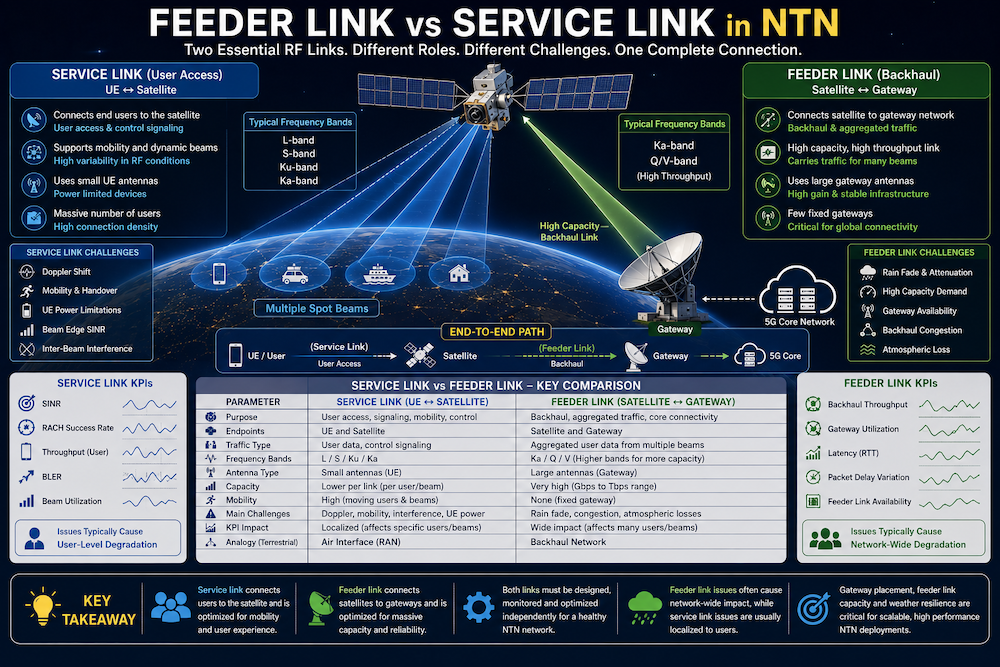
- Feeder Link vs Service Link Comparison
| Feature | Service Link | Feeder Link |
|---|---|---|
| Connection | UE ↔ Satellite | Satellite ↔ Gateway |
| Purpose | User access | Backhaul/connectivity |
| Coverage | Wide user distribution | Fixed gateway connection |
| Frequency Bands | L/S/Ku/Ka | Ka/Q/V |
| Antenna Type | Small UE antennas | Large gateway antennas |
| Main Challenge | Mobility & RF variability | Capacity & weather |
| KPI Impact | User level degradation | Network wide degradation |
| Telecom Analogy | Air interface | Backhaul network |
- Key Takeaways
- The service link connects users to satellites, while the feeder link connects satellites to gateways and the core network
- Service links are mobility sensitive and user centric, whereas feeder links are high capacity backhaul connections
- Both links use different RF designs, beam architectures, and frequency bands based on operational requirements
- Service link issues mainly affect localized user experience, while feeder link problems can impact entire regions or multiple beams
- Higher feeder link frequencies enable massive throughput but increase vulnerability to rain fade and atmospheric attenuation
- Modern NTN optimization requires independent monitoring and tuning of both feeder and service links
- Troubleshooting NTN networks requires correctly identifying whether degradation originates from the user access side or the gateway backhaul side
- Efficient gateway design and feeder link planning are critical for scalable high-capacity NTN deployments