1. Introduction
As per my usual practice, I make summarized blogs for all the courses I learn so I can recall it whenever I need to. Therefore my latest course from ITU "Global Satellite Regulation Essentials" is my new course and it is indirectly linked to the NTN study I am doing on daily basis.
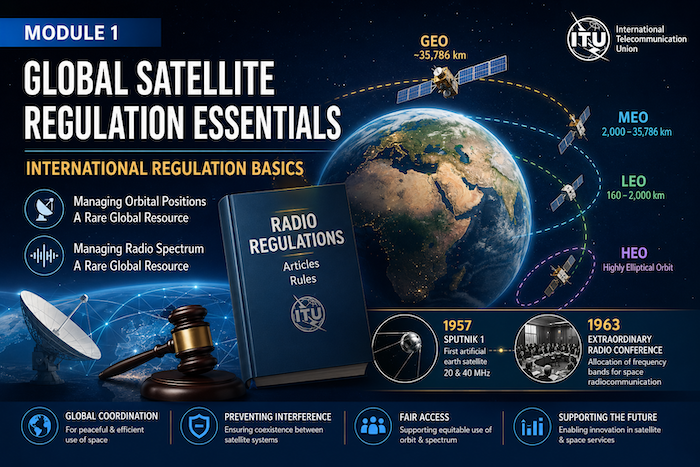
Satellite communication has become one of the most important pillars of modern global connectivity. From television broadcasting and GPS navigation to broadband internet and disaster recovery services, satellites now support billions of users worldwide. However, behind every successful satellite system lies a highly coordinated international regulatory framework designed to manage two extremely valuable resources: orbital positions and radio frequency spectrum.
While studying the first module of the ITU Academy course “Global Satellite Regulation Essentials,” one of the most interesting realizations was how satellite regulation evolved from a relatively small framework into a massive global coordination system supporting today’s rapidly expanding space ecosystem.
The module provided an excellent foundation for understanding how international regulations govern satellite operations, spectrum allocation, orbital usage, and future space communications.
2. Evolution of International Radio Regulations
When the first international radio regulations were introduced, the documentation was relatively small and straightforward compared to today’s standards. However, as wireless technologies advanced and satellite systems became increasingly complex, the regulatory framework expanded significantly.
Today, the Radio Regulations maintained by the International Telecommunication Union span nearly 2,000+ pages.
These regulations are continuously reviewed and updated during the World Radiocommunication Conference, which is typically held every 3 to 4 years.
The primary objectives of these regulations include:
- Preventing harmful interference
- Managing global spectrum allocation
- Coordinating orbital usage
- Supporting fair access to orbital resources
- Enabling coexistence between multiple radiocommunication services
This continuous evolution reflects how rapidly the telecommunications and satellite industries are advancing.
3. Orbit and Spectrum as Rare Global Resources
One of the most important concepts emphasized in the module was that both orbital positions and radio frequency spectrum are considered finite global resources.
Unlike terrestrial infrastructure, satellites cannot simply be placed anywhere without coordination. Similarly, frequencies cannot be assigned randomly because overlapping transmissions can create severe interference issues between satellite systems.
This creates the need for international coordination mechanisms managed by the ITU framework.
The regulatory framework ensures:
- Efficient utilization of orbital resources
- Long term sustainability
- Fair international access
- Interference mitigation
- Compatibility between different satellite systems
The module also highlighted that ITU regulations are not limited only to Earth centric communication systems. They additionally support:
- Deep space missions
- Scientific exploration satellites
- Planetary missions
- Space research systems orbiting celestial bodies such as Jupiter or the Sun
This broader regulatory scope demonstrates how international satellite governance continues evolving alongside humanity’s growing presence in space.
4. Understanding Satellite Orbits
The course introduced the major orbital categories commonly used in satellite communication systems.
| Orbit Type | Approximate Altitude | Key Characteristics | Typical Applications |
|---|---|---|---|
| LEO (Low Earth Orbit) | 160–2,000 km | Fast-moving, low latency | Broadband constellations, Earth observation |
| MEO (Medium Earth Orbit) | 2,000–35,786 km | Moderate coverage and latency | Navigation systems |
| HEO (Highly Elliptical Orbit) | Varies | Extended regional coverage | Polar communications |
| GEO (Geostationary Orbit) | ~35,786 km | Appears fixed relative to Earth | Broadcasting, telecom, VSAT |
One useful way to visualize these systems is to imagine GEO satellites forming a continuous ring around the Earth’s equator, while satellites in LEO, MEO, and HEO constantly move relative to the Earth’s surface.
This orbital movement directly affects:
- Coverage patterns
- Handover behavior
- Tracking requirements
- Doppler shift characteristics
- Network design complexity
5. Geostationary Orbit and Its Importance
The Geostationary Orbit (GEO) remains one of the most valuable orbital regions for satellite communication systems.
A GEO satellite operates at approximately 35,786 km above the Earth’s equator and rotates at the same angular velocity as the Earth.
This relationship can be represented conceptually as:
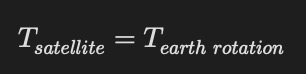
As a result, the satellite appears stationary to observers on Earth.
This unique behavior provides several important operational advantages:
- Fixed ground antennas
- Simplified network deployment
- Continuous regional coverage
- Reduced tracking complexity
- Stable communication links
Historically, this is one of the primary reasons why GEO became dominant for:
- Television broadcasting
- International telecom connectivity
- Enterprise VSAT networks
- Maritime and aviation communication systems
A simple real world analogy is to imagine a satellite “parked” permanently at one point in the sky.
Unlike moving satellites in LEO or MEO systems, ground antennas communicating with GEO satellites can remain permanently pointed in a single direction, significantly simplifying communication infrastructure.
6. Historical Milestones in Satellite Communications
The module also covered several important milestones that shaped the modern satellite industry.
6.1 Sputnik and the Beginning of the Space Era
The modern space age officially began on October 4, 1957, when the Soviet Union launched Sputnik 1 Launch.
Sputnik transmitted signals using:
- 20 MHz
- 40 MHz
Although primitive by today’s standards, this event fundamentally changed global telecommunications and scientific research forever.
6.2 The Extraordinary Radio Conference of 1963
Another major milestone occurred in October and November 1963 when an extraordinary administrative radio conference was organized to allocate specific frequency bands for space radiocommunication services.
This conference laid the foundation for modern satellite spectrum management and international coordination procedures.
Without such global coordination mechanisms, the rapid growth of satellite systems could have created severe worldwide interference problems.

7. Evolution of the Modern Satellite Ecosystem
Since the launch of Sputnik, satellite technology has diversified dramatically.
Today’s satellite ecosystem includes:
- Ultra small satellites
- CubeSats
- Earth observation satellites
- GEO high capacity satellites
- Broadband mega constellations
- Scientific exploration systems
Satellite constellations have become particularly important in recent years, especially for global broadband services and NTN deployments.
These developments are also driving enormous economic growth.
According to the Satellite Industry Association, the global space economy generated approximately 384 billion USD in revenue by 2022.
This highlights how satellite communication has evolved from experimental technology into a major global economic sector.
8. Practical Engineering Perspective
From an RF optimization and telecom engineering perspective, international satellite regulation directly impacts:
- Spectrum planning
- Interference coordination
- Gateway deployment
- Beam management
- Frequency reuse
- NTN integration with terrestrial networks
As the industry moves toward:
- 5G NTN
- Direct to device satellite communication
- Mega constellations
- AI driven satellite operations
The importance of efficient orbit and spectrum regulation will continue increasing.
Future telecom engineers will increasingly need to understand not only RF engineering principles, but also the international regulatory frameworks governing global satellite operations.
9. Conclusion
The first module of the ITU Academy course provided an excellent introduction to the foundations of global satellite regulation and spectrum management.
What started as a relatively small regulatory framework has now evolved into a sophisticated international coordination system managing some of humanity’s most valuable shared resources: orbital positions and radio frequency spectrum.
As satellite communications continue expanding into NTN, deep space exploration, and global broadband connectivity, the role of international regulation will become even more critical in ensuring sustainable and interference free operations for future generations.