Overview
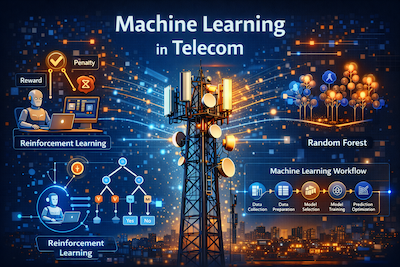
Day 4 marked the final step of my Machine Learning learning sprint, where concepts moved from prediction to decision-making and end-to-end implementation. The focus was on Reinforcement Learning, tree-based models, and the practical ML workflow used in real telecom environments.
Reinforcement Learning in Telecom
Reinforcement Learning Basics
Reinforcement Learning (RL) is based on an agent–environment interaction model. The agent takes actions, receives rewards or penalties, and learns to maximize long-term rewards.
Telecom Applications:
- Smart tower or cell selection
- Dynamic spectrum sharing between 4G and 5G users
- Reducing dropped calls by optimizing handovers
- Dynamic spectrum allocation to maximize throughput while minimizing interference
RL enables real-time decision-making, which is critical for modern self-optimizing networks.
How Reinforcement Learning Actually Works
- Initial Policy: Starts with a random or heuristic-based policy
- Interaction: Agent observes network state (load, interference, mobility)
- Feedback: Receives reward or penalty based on outcome
- Policy Refinement: Actions leading to higher rewards are reinforced
- Convergence: Policy stabilizes to an optimal strategy over time
This mirrors how modern telecom networks learn and adapt continuously instead of relying on static rules.
Decision Trees & Random Forests
Decision Trees
Decision Trees split data into branches based on feature values to make predictions.
Telecom Use Cases:
- Network congestion detection
- KPI-based fault classification
- Traffic load prediction
They rely on variance reduction to create optimal splits, improving prediction accuracy.
Variance Reduction & Feature Importance
- Variance Reduction: Makes each split more homogeneous
- Feature Importance: Highlights key drivers such as
- PRB utilization
- Number of active users
- Signal quality indicators
This helps telecom engineers understand which parameters truly impact performance.
Random Forest
Random Forest combines multiple decision trees to improve accuracy and stability.
Key Advantages:
- Reduces overfitting
- Handles large and high-dimensional datasets
- Robust against noise and outliers
- More reliable for real-world telecom data
Each tree is trained on a randomly sampled dataset, and predictions are averaged or voted.
Random Forest vs Decision Tree
| Aspect | Decision Tree | Random Forest |
|---|---|---|
| Overfitting | High risk | Much lower |
| Accuracy | Moderate | High |
| Speed | Faster | Slower |
| Interpretability | Easy | Complex |
| Robustness | Lower | Very high |
Random Forest is often preferred for network traffic prediction and KPI modeling.
Practical Machine Learning Workflow
Machine Learning Pipeline
A real-world ML workflow includes:
- Data Collection
- Data Preparation
- Model Selection
- Model Training
- Model Evaluation
- Prediction & Optimization
Tools Used:
Python, Jupyter Notebook, Anaconda, Spyder IDE
Data Collection & Preparation
- Data Quality & Quantity: Critical for accurate predictions
- Parameter Selection: Choosing relevant KPIs (e.g., SINR for throughput prediction)
- Cleaning: Removing null values, spaces, and inconsistencies
Example:
Modeling the relationship between 5G throughput and SINR using supervised learning.
Key Takeaway
This final day connected algorithms to real telecom workflows, showing how ML is not just about models, but about data, decisions, and continuous optimization.
Day 3 Learning Blog Post is as below:
https://adeelkhan77.com/2026/01/08/blog-87-machine-learning-in-telecommunications-day-3-logistic-regression-unsupervised-learning/