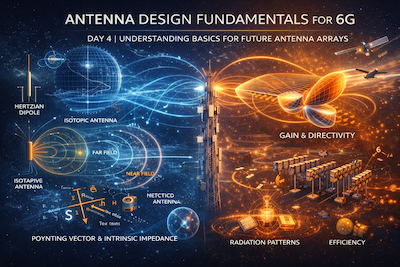
Day 4 of the 6G Deployment learning journey focused on one of the most critical building blocks of wireless communication: antenna design. As 6G targets ultra-high frequencies, massive connectivity, and intelligent networks, understanding antenna fundamentals becomes essential.
1. Why Antennas Matter in 6G
- Antennas are the backbone of wireless systems, enabling transmission and reception of electromagnetic waves.
- Every wireless device—base stations, satellites, smartphones—relies on antenna performance.
- For 6G, antenna design directly impacts coverage, efficiency, safety, and reliability.
2. Antenna Basics
- Antennas convert bounded electrical energy into radiated electromagnetic energy.
- Key characteristics include:
- Radiation properties
- Current distribution
- Field behavior
- The Hertzian dipole serves as a fundamental model to explain wireless radiation between two antennas.
3. Historical and Physical Foundations
- Early pioneers such as Heinrich Hertz and Guglielmo Marconi laid the foundation of antenna theory.
- Antenna operation is governed by electromagnetic field theory, including:
- Magnetic vector potential
- Electric and magnetic field interactions
4. Radiation Patterns and Field Regions
- Antennas radiate energy in defined patterns:
- Main lobe – strongest radiation
- Side lobes – weaker radiation
- Back lobe – ideally minimized for safety
- Three field regions exist around an antenna:
- Reactive near field
- Near field
- Far field – most important for reliable communication
5. Radiation Pattern Representation
- Radiation patterns are best represented using spherical coordinates, simplifying analysis.
- In the far field of a Hertzian dipole:
- Electric field varies in the theta direction
- Magnetic field varies in the phi plane

98000PA Car Vacuum Cleaner Mini Powerful Cleaning Machine Strong Suction Handheld for Car Wireless
6. Power Flow and Impedance
- The Poynting vector represents power density radiated by an antenna.
- Intrinsic impedance (E/H ratio) defines how energy propagates:
- Free-space value ≈ 376.7 ohms
- These concepts help evaluate power losses and radiation effectiveness.
7. Antenna Power and Radiation Intensity
- Total radiated power is calculated by integrating the Poynting vector over a surface.
- Radiation intensity measures directional power per unit solid angle and is independent of distance.
8. Directivity and Gain
- Directivity describes how focused an antenna’s radiation is compared to an isotropic antenna.
- Gain includes antenna efficiency and losses.
- These parameters are critical for:
- Cellular base stations
- Beamforming
- Controlled coverage areas
9. Antenna Efficiency
- Radiation efficiency = radiated power ÷ supplied power.
- Losses include:
- Ohmic (heat) losses
- Structural and material losses
- High efficiency is essential for multi-antenna and array-based 6G systems.
10. Preparing for Antenna Arrays
- Understanding single-element antennas is the foundation for:
- Antenna arrays
- Massive MIMO
- Beam steering in 6G
- The session sets the stage for advanced array design in upcoming modules.
Key Takeaway
A strong grasp of antenna fundamentals—radiation, efficiency, gain, and field behavior—is essential before tackling antenna arrays and intelligent beamforming, which are central to future 6G networks.
Blog post for Day 3 as below:
https://adeelkhan77.com/2026/02/09/blog-120-day-3-from-5g-reality-to-6g-readiness-an-operators-perspective/
Blog post for Day 5 as below:
https://adeelkhan77.com/2026/02/11/blog-122-day-5-antenna-arrays-the-engine-behind-beamforming-in-6g/