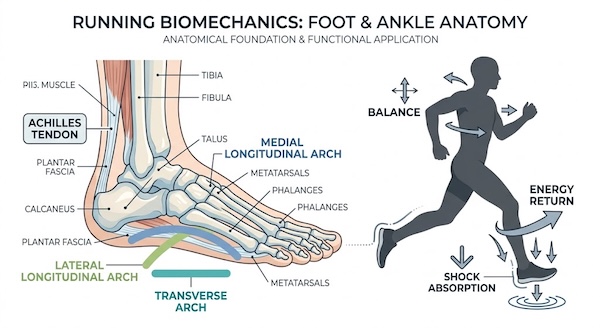
When it comes to running, the spotlight often goes to endurance, speed, and leg strength. However, every stride begins and ends with the foot and ankle complex. This system acts as the body’s primary point of contact with the ground, making it essential for movement, balance, and shock absorption.
Understanding how the foot and ankle function can help runners improve performance, maintain better posture, and reduce the risk of injury.
Structure of the Foot and Ankle
The foot and ankle form a highly complex structure designed for both stability and mobility.
- The foot contains 26 bones, numerous joints, ligaments, and muscles
- The ankle joint connects the foot to the lower leg and allows controlled movement
Together, they provide a balance between flexibility (to adapt to surfaces) and rigidity (to push off efficiently).
Key Components for Running
1. Ankle Joint
The ankle primarily allows:
- Dorsiflexion (bringing the foot upward)
- Plantarflexion (pointing the foot downward)
These movements are essential for absorbing impact during landing and generating force during push-off.
2. Foot Arches
The foot has three main arches:
- Medial longitudinal arch (inner side)
- Lateral longitudinal arch (outer side)
- Transverse arch (across the midfoot)
These arches act like natural springs, helping to:
- Absorb shock
- Store and release energy
- Maintain balance
3. Muscles and Tendons
Key structures include:
- Achilles tendon – connects calf muscles to the heel and plays a major role in propulsion
- Plantar fascia – supports the arch and absorbs stress
- Intrinsic foot muscles – stabilize the foot during movement
Role of Foot and Ankle in Running
The foot and ankle perform several critical functions during each stride:
1. Shock Absorption
When the foot strikes the ground, it absorbs impact forces that can be multiple times body weight.
2. Stability
They provide a stable base during the stance phase, especially when running on uneven surfaces.
3. Energy Return
The arches and tendons store elastic energy and release it during push off, improving efficiency.
4. Adaptability
The foot adjusts to different terrains, helping maintain balance and control.

Ankle Straps Resistance Bands Set Fitness Workout Exercise Equipment
Foot Strike and Running Mechanics
The way the foot contacts the ground, known as foot strike, affects how forces are distributed through the body.
Common patterns include:
- Heel strike
- Midfoot strike
- Forefoot strike
Each pattern influences how the ankle and foot absorb and transfer forces during running.
What Happens When Foot and Ankle Function is Poor?
When the foot and ankle are not functioning properly, it can lead to a chain reaction throughout the body.
1. Overpronation (Excessive Inward Rolling)
- Increased stress on the arch
- Can lead to knee and hip alignment issues
2. Supination (Insufficient Inward Rolling)
- Reduced shock absorption
- Increased stress on bones and joints
3. Limited Ankle Mobility
- Reduced dorsiflexion can affect stride length
- Leads to compensations in knees and hips
4. Weak Foot Muscles
- Poor stability
- Increased risk of fatigue and injury
Common Foot and Ankle Injuries in Runners
Plantar Fasciitis
Inflammation of the plantar fascia causing heel pain, especially during the first steps.
Achilles Tendinopathy
Overuse injury affecting the Achilles tendon, leading to pain and stiffness.
Ankle Sprains
Ligament injuries caused by sudden twisting or instability.
Stress Fractures
Small cracks in bones due to repetitive stress, often linked to poor mechanics or overtraining.
Impact on Running Performance
Healthy foot and ankle function contributes to:
- Efficient stride mechanics
- Better balance and coordination
- Reduced energy loss
- Lower risk of injury
On the other hand, dysfunction can lead to:
- Poor running form
- Increased fatigue
- Compensation injuries in knees, hips, and lower back
Foot, Ankle, and Posture Connection
The foot is the base of the body’s kinetic chain. Any imbalance here can affect alignment all the way up:
- Foot instability → affects ankle
- Ankle issues → affect knee tracking
- Knee misalignment → affects hips and pelvis
- Pelvis imbalance → impacts spine posture
This highlights why foot health is critical not just locally, but for overall movement efficiency.
Final Thoughts
The foot and ankle are often overlooked, yet they are fundamental to every running step. They absorb impact, provide stability, and generate the force needed to move forward.
A well-functioning foot and ankle system supports efficient running mechanics, while dysfunction can lead to poor performance and increased injury risk.
Understanding their role is an important step toward running smarter, staying injury-free, and improving long-term performance.
Running Series Blogpost for Pelvis as follows:
https://adeelkhan77.com/2026/03/19/blog-159-running-the-pelvis-the-foundation-of-efficient-running/