Initial Scenario
In large scale Ka-band LEO NTN deployments, some of the most difficult optimization incidents do not originate from satellite failures, gateway outages, or transport issues.
They start quietly at the beam edge.
Users initially report inconsistent throughput, random buffering, unstable VPN sessions, and fluctuating latency. OSS dashboards may still show acceptable average cell throughput. Satellite payload telemetry may appear healthy. Gateway CPU utilization may remain normal.
But underneath, the RF environment at the beam edge is collapsing.
This is one of the most operationally dangerous scenarios in modern NTN systems because the degradation is highly localized, mobility sensitive, weather sensitive, and scheduler dependent. It can rapidly propagate across adjacent beams and trigger cascading QoS instability across the constellation.
In this case study, we analyze a realistic operator grade Ka-band LEO NTN incident where massive beam edge throughput collapse affected maritime and mobility users during evening traffic peaks across multiple overlapping spot beams.
1. Network Background
The operator was running a commercial Ka-band LEO NTN network providing:
- Maritime broadband
- Enterprise mobility services
- Remote industrial connectivity
- Aviation backhaul support
Network architecture included:
- Regenerative payload satellites
- Digital beamforming
- Multi gateway distributed architecture
- Adaptive coding and modulation (ACM)
- AI assisted beam load balancing
- Inter satellite links (ISL)
Deployment characteristics:
- Orbit altitude: ~1200 km
- Spot beam diameter: 180–260 km
- Frequency reuse: aggressive multi color reuse
- Ka-band service link: 27–31 GHz
- Beam overlap margin: intentionally high for mobility continuity
Primary vendors involved:
- Satellite payload vendor
- Telecom RAN vendor
- NTN core integration vendor
- OSS analytics platform provider
Affected geography:
- Arabian Sea maritime corridor
- High density shipping lanes
- Coastal mobility zones
2. Initial Customer Complaints
Customer reports initially appeared unrelated.
Maritime operators reported:
- VPN instability
- Video conferencing interruptions
- Random throughput drops
- Excessive buffering
Enterprise mobility users reported:
- TCP session resets
- High RTT spikes
- Cloud application instability
Aviation customers observed:
- Throughput fluctuations during beam transitions
- Temporary packet freezes
- Intermittent QoS degradation
Interesting observation:
- Complaints were highly concentrated near predicted beam edge overlap regions.
3. KPI Symptoms Observed
The OSS analytics platform revealed unusual KPI behavior.
Primary degraded KPIs:
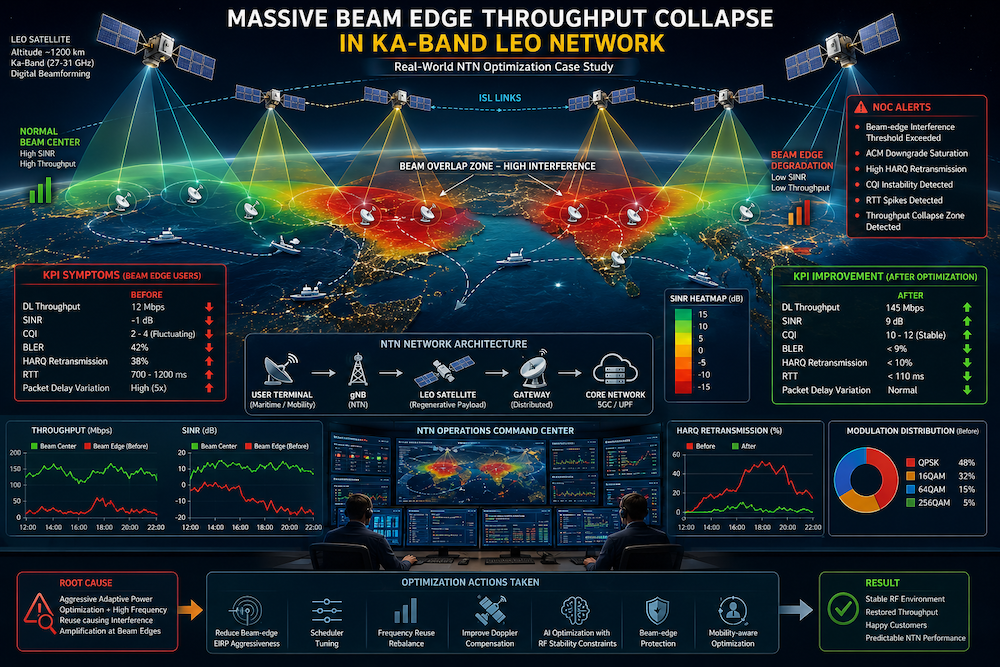
- DL Throughput collapse from 180 Mbps → 12 Mbps
- SINR degradation from 14 dB → -1 dB
- CQI instability oscillating between CQI 12 and CQI 2
- HARQ retransmission spikes >38%
- BLER increase from 6% → 42%
- Packet Delay Variation increase by 5x
- RTT spikes reaching 700–1200 ms
- Scheduler utilization instability
Beam-edge users experienced:
- Extreme MCS fluctuations
- Frequent modulation fallback
- Massive retransmission bursts
Core observation:
Average beam throughput remained deceptively acceptable because center-beam users continued operating normally.
This delayed escalation severity recognition.
4. OSS/NOC Alarms Seen
The NOC observed multiple correlated alarms across adjacent beams.
Satellite NMS alarms:
- Beam-edge interference threshold exceeded
- Dynamic beam overlap instability
- Adaptive power balancing saturation
- ACM downgrade saturation
Gateway alarms:
- Excessive retransmission queue growth
- Traffic scheduling imbalance
- Queue latency threshold exceeded
RAN-side alarms:
- High NTN HARQ retransmission ratio
- Timing drift compensation instability
- CQI volatility alarms
- Radio link instability events
AI optimization platform alerts:
- Predicted beam-edge congestion risk
- Abnormal SINR variance detected
- Mobility-edge degradation anomaly
5. RF Stats and Counters Analysis
Deep RF counter analysis revealed the real problem.
Critical counters:
- Beam-edge SINR variance
- Cross-beam interference ratio
- Doppler compensation residual error
- Scheduler fairness deviation
- ACM downgrade distribution
- Beam overlap user density
- Modulation fallback counters
Important finding:
Users at beam overlap regions were simultaneously receiving:
- Strong adjacent beam leakage
- Rapid power fluctuations
- Interference from aggressive frequency reuse
Observed RF behavior:
- Rapid SINR oscillation every few seconds
- ACM instability loops
- Scheduler overreaction
- HARQ storm amplification
The telecom scheduler continuously attempted:
- MCS upgrades
- Resource redistribution
- Retransmission recovery
But unstable RF conditions caused repeated collapse cycles.
6. Geo/Beam Impact Analysis
Beam visualization tools revealed the most important insight.
The throughput collapse zone aligned almost perfectly with:
- Beam overlap regions
- Maritime mobility corridors
- High-density user clusters
Operational heatmaps showed:
- Red SINR zones precisely at beam edges
- Mobility-triggered RF instability corridors
- Increased Doppler residual error regions
A key operational observation:
The issue intensified during evening traffic peaks when:
- Beam loading increased
- Power allocation became more aggressive
- Scheduler pressure increased
- Adjacent beam leakage worsened
This demonstrated classic beam-edge overload amplification.

7. Root Cause Investigation
A multi-vendor war-room investigation was initiated.
Initial suspected causes:
- Gateway congestion
- Satellite payload instability
- ISL routing saturation
- TCP acceleration malfunction
- Weather attenuation
- Core transport congestion
However, telemetry disproved these hypotheses.
Root cause eventually identified:
Aggressive adaptive beam power optimization combined with high frequency reuse caused unstable interference dynamics at beam edges.
Contributing factors:
- Excessive beam overlap
- AI-driven power boosting
- Mobility-triggered scheduler instability
- Adjacent beam leakage
- Delayed ACM adaptation
- Doppler residual compensation errors
Most critical engineering mistake:
The AI optimization engine prioritized:
- Capacity maximization
instead of: - RF stability preservation
This caused continuous beam-edge over-amplification.
8. Vendor Analysis
Satellite vendor findings:
- Digital beamforming operated within limits
- Payload power balancing was too aggressive
- Beam shaping optimization lacked edge-stability constraints
Telecom vendor findings:
- Scheduler adaptation loops were excessively reactive
- HARQ recovery thresholds amplified instability
- CQI smoothing algorithms were insufficient
OSS vendor findings:
- Existing dashboards averaged KPIs too broadly
- Beam-edge degradation remained hidden
- AI anomaly models lacked spatial correlation weighting
Operational lesson:
Average KPIs in NTN systems can hide severe localized degradation.
Beam-level granularity is mandatory.
9. Optimization Actions Taken
Emergency optimization actions were implemented in phases.
Phase 1 — Immediate Stabilization
- Reduced beam-edge EIRP aggressiveness
- Relaxed scheduler MCS upgrade thresholds
- Increased CQI smoothing intervals
- Applied temporary traffic shaping
Phase 2 — RF Stabilization
- Reduced frequency reuse aggressiveness
- Rebalanced beam overlap geometry
- Modified adaptive power control logic
- Limited edge-user scheduler priority
Phase 3 — Mobility Optimization
- Enhanced Doppler compensation filtering
- Improved beam transition hysteresis
- Adjusted mobility trigger thresholds
- Tuned NTN timing compensation loops
Phase 4 — AI Optimization Corrections
- Introduced RF stability weighting
- Added beam-edge protection constraints
- Implemented interference prediction logic
- Enabled mobility-aware power adaptation
Tools used:
- Satellite NMS
- Beam visualization engines
- RF interference analyzers
- AI analytics dashboards
- Gateway telemetry systems
- NTN OSS KPI platforms
- Mobility event tracing systems
10. Post-Optimization KPI Improvement
After optimization:
- Beam-edge SINR improved from -1 dB → 9 dB
- DL throughput recovered from 12 Mbps → 145 Mbps
- HARQ retransmissions reduced by 70%
- BLER normalized below 9%
- RTT stabilized below 110 ms
- CQI variance significantly reduced
Customer impact:
- Maritime VPN stability restored
- Video streaming normalized
- Aviation mobility sessions stabilized
- Enterprise traffic complaints disappeared
Most important result:
Beam-edge throughput stability became predictable.
11. Operational Lessons Learned
This incident fundamentally changed the operator’s NTN optimization strategy.
Major lessons:
- Beam-edge RF behavior dominates NTN user experience
- Average KPIs are dangerously misleading
- AI optimization without RF constraints can destabilize networks
- Ka-band frequency reuse requires extremely careful edge management
- Mobility and interference are tightly coupled in LEO NTN
- Scheduler behavior can amplify RF instability
- Beam overlap zones require dedicated KPI monitoring
The operator later implemented:
- Beam-edge dedicated OSS dashboards
- Spatial SINR analytics
- Mobility-aware AI optimization
- Interference heatmap automation
- Beam-edge predictive congestion analysis
12. How Engineers Explain This ?
A strong knowledge based explanation would be:
“In Ka-band LEO NTN systems, beam-edge throughput collapse often occurs due to the interaction between aggressive frequency reuse, overlapping spot beams, mobility dynamics, adaptive power control, and scheduler instability. The issue is usually not caused by a single failure, but by RF instability amplification loops.”
A senior engineer should explain:
- Why beam-edge interference becomes severe in Ka-band
- How ACM and HARQ react during instability
- Why scheduler behavior matters
- How mobility worsens beam-edge SINR
- How AI optimization can unintentionally destabilize RF conditions
- Why localized KPI analysis is essential in NTN
This demonstrates real operational NTN understanding rather than textbook knowledge.
13. Key Takeaways
- Beam-edge instability is one of the most critical NTN optimization challenges
- Ka-band aggressive frequency reuse can trigger severe localized interference
- Average KPIs often hide operational NTN failures
- Scheduler logic and RF behavior are deeply interconnected
- AI optimization engines require RF-stability guardrails
- Mobility corridors amplify beam-edge degradation
- Beam visualization and spatial analytics are essential for NTN operations
- Real NTN troubleshooting requires integrated satellite + telecom engineering analysis