Initial Scenario
In terrestrial mobile networks, congestion events are usually localized.
A stadium fills up, a concert begins, or a transport corridor becomes overloaded. Capacity management and traffic engineering procedures are relatively predictable because the infrastructure remains fixed.
But in Non-Terrestrial Networks, especially large scale LEO constellations, gateway congestion behaves very differently.
A sudden regional traffic surge can rapidly propagate across:
- Multiple beams
- Inter satellite routes
- Gateway clusters
- Transport layers
- Core network interfaces
And unlike terrestrial systems, NTN traffic behavior is tightly coupled with:
- Satellite visibility windows
- Beam movement
- Dynamic gateway assignment
- ISL routing decisions
- Orbital geometry
This creates congestion patterns that are significantly more complex than conventional telecom networks.
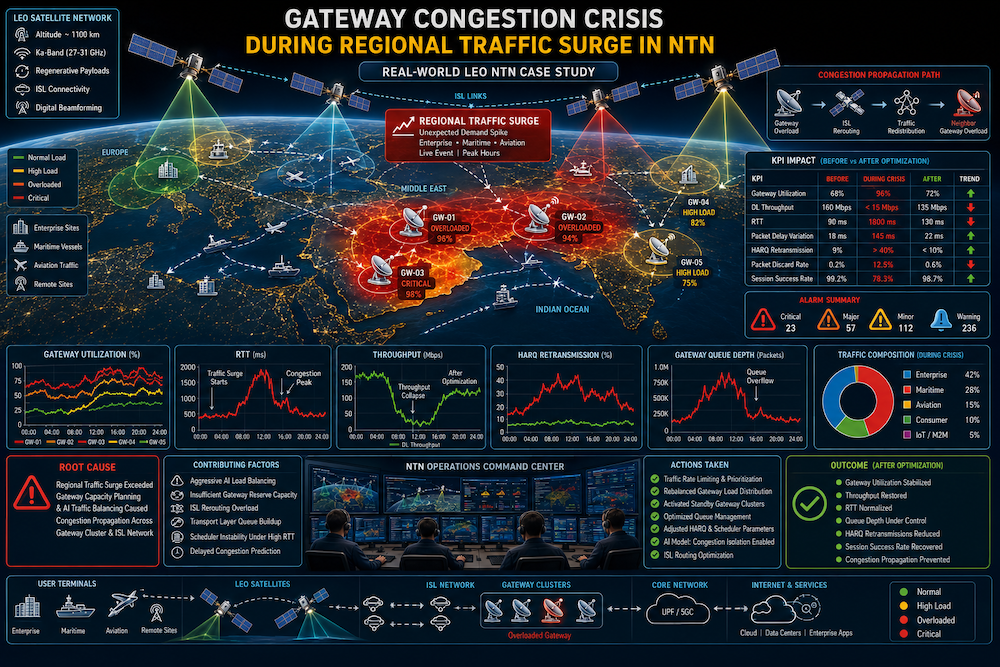
In this operator grade case study, we analyze a real world style NTN incident where a regional traffic surge triggered severe gateway congestion across a Ka-band LEO network, resulting in widespread throughput collapse, mobility instability, and cascading QoS degradation.
1. Network Background
The operator deployed a commercial LEO NTN system supporting:
- Enterprise broadband
- Maritime connectivity
- Remote industrial operations
- Aviation backhaul
- Government communication services
- Consumer satellite internet
Network architecture included:
- Regenerative LEO payloads
- Multi gateway distributed topology
- Dynamic gateway assignment
- Inter satellite links (ISL)
- AI assisted traffic engineering
- Cloud native 5G core integration
Technical deployment characteristics:
- Orbit altitude: ~1100 km
- Ka-band feeder and service links
- Digital beamforming
- Aggressive frequency reuse
- Distributed gateway clusters
- Dynamic traffic steering
Affected region:
- Gulf region and Arabian Sea corridor
Primary vendors involved:
- Satellite payload vendor
- NTN gateway vendor
- Telecom core vendor
- AI traffic optimization platform provider
2. Initial Customer Complaints
The incident began during a major regional event causing unexpected traffic growth.
Customers reported:
- Severe throughput degradation
- Long buffering times
- Video conference instability
- High latency spikes
- Cloud application timeouts
- Session drops during beam transitions
Enterprise customers observed:
- MPLS instability
- VPN packet loss
- Real time application degradation
Maritime users reported:
- Random throughput oscillation
- Intermittent connectivity freezes
Interesting observation:
- Complaints spread progressively across adjacent beams rather than remaining localized.
3. KPI Symptoms Observed
OSS dashboards showed large scale network instability.
Primary degraded KPIs:
- Gateway utilization exceeding 96%
- DL throughput collapse from 160 Mbps → below 15 Mbps
- RTT increase from 90 ms → 1800 ms
- Packet delay variation increase by 7x
- HARQ retransmissions > 40%
- CQI degradation across multiple beams
- Beam scheduler instability
- Queue buffer overflow events
Critical observation:
The degradation initially appeared only at selected gateways.
Within 40 minutes:
- Congestion propagated across multiple gateway clusters.
4. OSS/NOC Alarms Seen
The NOC war room observed multi domain alarm escalation.
Gateway alarms:
- Gateway CPU overload
- Transport interface saturation
- Queue latency threshold exceeded
- Packet discard rate critical
- Traffic scheduling instability
Satellite NMS alarms:
- Gateway assignment imbalance
- Feeder link congestion alerts
- ISL rerouting escalation
- Dynamic traffic steering overload
RAN side alarms:
- NTN scheduler overload
- HARQ retransmission storms
- Beam resource saturation
- Mobility retry increase
Core network alarms:
- UPF overload warnings
- QoS policy enforcement delays
- Session establishment timeout increase
AI analytics alerts:
- Regional traffic anomaly detected
- Gateway congestion prediction exceeded
- Cross beam load instability
5. RF Stats and Traffic Counter Analysis
Detailed traffic engineering analysis revealed severe congestion amplification.
Critical counters analyzed:
- Gateway queue depth
- Beam traffic distribution
- ISL routing utilization
- Scheduler latency
- Gateway packet discard ratio
- Feeder link loading
- Session establishment delay
- Traffic steering deviation
Important finding:
The congestion was not caused by RF degradation initially.
Instead:
Traffic routing instability triggered RF degradation later.
Observed operational behavior:
- Gateway overload increased packet buffering
- Buffer growth increased RTT
- High RTT destabilized HARQ timing
- Scheduler retransmissions surged
- Beam resource utilization spiked
- RF efficiency collapsed
This created a cascading feedback loop.
6. Geo/Beam Impact Analysis
Beam visualization platforms revealed clear congestion propagation patterns.
The most affected zones aligned with:
- High density enterprise traffic corridors
- Maritime traffic aggregation zones
- Aviation mobility routes
- Beams anchored to overloaded gateways
Operational heat maps showed:
- Severe throughput collapse near overloaded gateway coverage regions
- RTT escalation spreading across adjacent beams
- Dynamic traffic steering instability
A critical operational insight:
AI traffic balancing continuously redirected traffic toward neighboring gateways.
However:
Neighbor gateways rapidly became overloaded themselves.
This created congestion migration across the network.

ZigBee Human Motion Sensor 10G Radar Mmwave Temperature and Humidity Sensor
7. Root Cause Investigation
A multi vendor emergency investigation was launched.
Initial suspected causes:
- Satellite payload failure
- Feeder link degradation
- RF interference
- ISL routing failure
- Cybersecurity incident
- Weather attenuation
Telemetry disproved these hypotheses.
Root cause eventually identified:
A regional traffic surge exceeded gateway traffic engineering assumptions, triggering unstable dynamic gateway redistribution.
Contributing factors:
- Aggressive AI based load balancing
- Insufficient gateway reserve capacity
- Delayed congestion prediction response
- Excessive ISL rerouting
- Transport layer queue amplification
- NTN scheduler instability under high RTT conditions
Most critical engineering issue:
The AI optimization engine prioritized:
- Maximum traffic absorption
instead of: - Controlled congestion isolation
This caused congestion spreading rather than containment.
8. Vendor Analysis
Satellite vendor findings:
- Payload operation remained stable
- Beamforming worked normally
- ISL links became overloaded due to rerouting pressure
Gateway vendor findings:
- Gateway traffic steering algorithms reacted too aggressively
- Queue management thresholds were insufficient
- Transport layer congestion isolation was delayed
Telecom vendor findings:
- NTN schedulers became unstable under excessive RTT growth
- HARQ recovery loops amplified congestion
- QoS enforcement reacted too slowly
AI analytics vendor findings:
- Prediction models underestimated event driven traffic surges
- Regional mobility correlation logic was insufficient
Operational lesson:
In NTN systems, congestion can propagate across orbital routing architecture, not just local transport infrastructure.
9. Optimization Actions Taken
Optimization activities were performed in multiple stages.
1st Phase — Emergency Stabilization
- Limited non critical traffic classes
- Applied temporary rate limiting
- Reduced aggressive gateway redistribution
- Prioritized enterprise and maritime critical services
2nd Phase — Gateway Recovery
- Rebalanced gateway traffic allocation
- Activated standby gateway clusters
- Increased congestion isolation thresholds
- Optimized queue management policies
3rd Phase — NTN Scheduler Stabilization
- Tuned HARQ recovery parameters
- Reduced retransmission aggressiveness
- Improved QoS scheduler prioritization
- Stabilized RTT sensitive traffic flows
4th Phase — AI Optimization Improvements
- Added congestion containment logic
- Introduced predictive regional surge modeling
- Implemented gateway reserve capacity policies
- Enabled congestion aware ISL routing
Operational tools used:
- Satellite NMS
- Gateway telemetry systems
- NTN OSS dashboards
- AI traffic analytics platforms
- ISL routing visualization tools
- QoS analytics engines
- Real time congestion monitoring systems
10. Post Optimization KPI Improvement
After optimization:
- Gateway utilization stabilized below 72%
- DL throughput recovered above 135 Mbps
- RTT normalized below 130 ms
- Packet discard ratio reduced dramatically
- HARQ retransmissions reduced below 10%
- Scheduler stability restored
- Beam level congestion normalized
Customer impact:
- Enterprise VPN stability restored
- Maritime connectivity normalized
- Aviation backhaul stabilized
- Real time applications recovered
Most important operational result:
Congestion propagation across adjacent gateways was successfully prevented.
11. Operational Lessons Learned
This incident fundamentally changed the operator’s NTN traffic engineering philosophy.
Major lessons:
- NTN congestion behaves differently from terrestrial congestion
- Gateway overload can rapidly propagate through orbital routing systems
- AI optimization without containment logic can worsen outages
- ISL rerouting may amplify congestion spread
- RTT instability directly impacts scheduler behavior
- HARQ amplification loops can collapse RF efficiency
- Gateway reserve capacity is essential in large NTN systems
The operator later implemented:
- Predictive regional congestion analytics
- Dedicated gateway isolation policies
- AI congestion containment frameworks
- Real time ISL traffic heat maps
- Dynamic reserve gateway orchestration
12. How Engineers Explain This?
A strong knowledge base explanation would be:
“In NTN systems, gateway congestion is not only a transport problem. It becomes a multi domain issue involving traffic engineering, ISL routing, scheduler behavior, HARQ timing, and QoS orchestration. A regional traffic surge can propagate congestion across multiple beams and gateways if AI balancing and congestion isolation mechanisms are not properly controlled.”
A senior NTN engineer should explain:
- Why NTN gateway congestion behaves differently from terrestrial congestion
- How RTT impacts scheduler stability
- How HARQ retransmissions amplify congestion
- Why ISL routing can spread overload conditions
- How AI traffic steering may unintentionally destabilize the network
- Why congestion containment policies are critical
This demonstrates real operational NTN understanding.
13. Key Takeaways
- Gateway congestion is one of the most critical operational risks in NTN systems
- NTN congestion can propagate through ISL and beam routing architectures
- AI optimization engines require congestion containment logic
- Scheduler instability can amplify transport congestion
- HARQ behavior becomes highly sensitive during RTT escalation
- Gateway reserve capacity planning is essential
- Real time traffic engineering visibility is mandatory in NTN operations
- NTN troubleshooting requires integrated RF + transport + orbital routing analysis