Initial Scenario
In terrestrial mobile networks, Doppler shift is usually manageable.
Even in high speed train environments, mobility algorithms and synchronization loops are relatively stable because the radio infrastructure itself is stationary.
But in LEO based Non-Terrestrial Networks, both the user terminal and the satellite are moving simultaneously.
When maritime mobility enters the equation, the NTN environment becomes significantly more complex.
A moving ship, a fast moving LEO satellite, dynamic beam transitions, ocean reflected multi path, Ka-band propagation sensitivity, and imperfect prediction models can collectively create Doppler compensation instability severe enough to collapse synchronization, degrade throughput, and trigger mobility failure cascades.
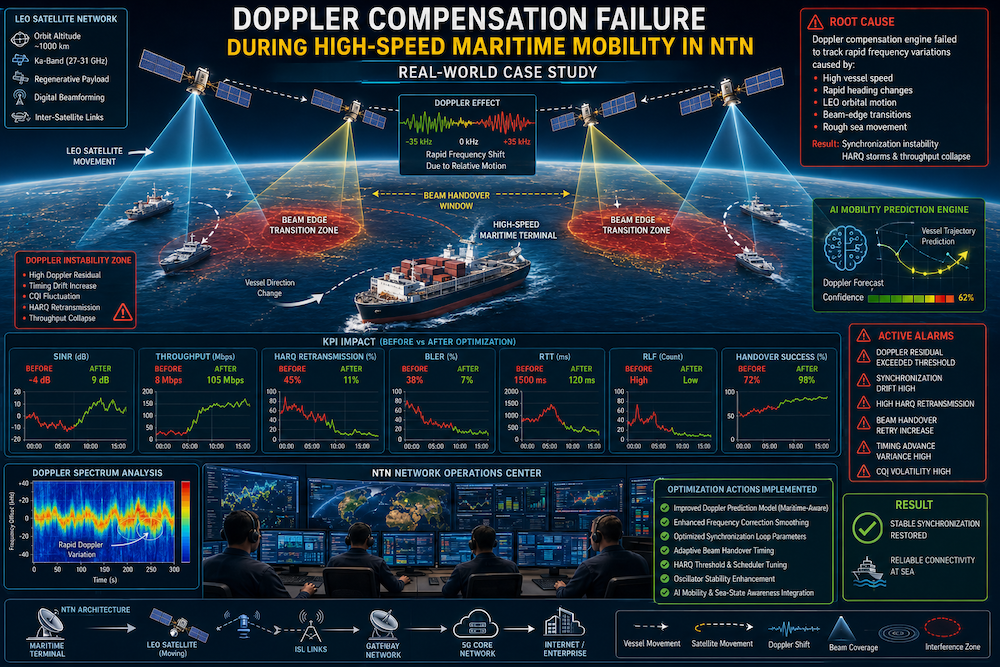
This case study analyzes a realistic operator grade NTN incident where Doppler compensation failure during high speed maritime mobility caused widespread service instability across a Ka-band LEO network serving commercial shipping lanes.
1. Network Background
The operator deployed a commercial Ka-band LEO NTN network supporting:
- Maritime broadband
- Offshore industrial operations
- Fleet management systems
- Real time vessel telemetry
- Video surveillance backhaul
- Crew internet connectivity
Network architecture included:
- Regenerative LEO payloads
- Digital beamforming
- AI assisted mobility optimization
- Multi gateway distributed topology
- Inter satellite routing
- NTN compatible 5G core
Deployment characteristics:
- Orbit altitude: ~1000 km
- Ka-band service links
- Aggressive frequency reuse
- Dynamic beam steering
- Beam overlap optimized for maritime continuity
Primary operating environment:
- Arabian Sea
- Indian Ocean shipping corridors
- High density vessel traffic routes
Terminal characteristics:
- Electronically steered maritime antennas
- Dynamic vessel stabilization systems
- NTN capable modem stacks
- Integrated Doppler prediction engines
2. Initial Customer Complaints
The issue first appeared as intermittent instability reports from commercial shipping fleets.
Users reported:
- Random throughput collapse
- Frozen VPN sessions
- Voice and video call interruptions
- High latency bursts
- Session instability during vessel turns
- Connectivity drops during rough sea conditions
Interesting operational observation:
The problem became significantly worse:
- During high vessel speed
- During rapid directional changes
- During beam edge transitions
- During adverse weather conditions
Some vessels experienced:
- Complete NTN session resets every few minutes
3. KPI Symptoms Observed
OSS dashboards revealed abnormal mobility and RF behavior.
Primary degraded KPIs:
- SINR fluctuation from 13 dB → -4 dB
- BLER increase above 38%
- HARQ retransmission spikes >45%
- RTT spikes reaching 1500 ms
- Throughput collapse from 120 Mbps → below 8 Mbps
- Handover success degradation
- Timing offset variance spikes
- CQI oscillation instability
Most important observation:
The degradation was highly dynamic rather than persistent.
This made troubleshooting significantly more difficult.
Mobility analytics showed:
- KPI degradation synchronized with vessel trajectory changes
4. OSS/NOC Alarms Seen
The NOC observed simultaneous alarms across multiple network layers.
Satellite side alarms:
- Doppler residual compensation exceeded threshold
- Beam tracking instability
- Mobility prediction mismatch
- Beam transition timing deviation
Gateway alarms:
- Excessive retransmission queue buildup
- Synchronization instability
- Traffic buffering increase
RAN side alarms:
- NTN timing drift alarms
- HARQ process instability
- RLF spikes
- Excessive CQI volatility
- Beam handover retry increase
AI optimization platform alerts:
- Maritime mobility anomaly detected
- Doppler prediction instability
- Synchronization drift escalation
5. RF Stats and Counter Analysis
RF engineers began deep counter level analysis.
Critical counters analyzed:
- Doppler offset residual error
- Frequency tracking loop deviation
- Timing advance instability
- HARQ retransmission distribution
- Beam transition timing offsets
- Synchronization drift counters
- Oscillator correction statistics
Important finding:
Doppler prediction accuracy deteriorated dramatically during:
- Vessel acceleration
- Sudden heading changes
- Beam edge mobility
- Rough sea movement
Observed RF behavior:
- Frequency correction loops continuously oscillated
- NTN synchronization repeatedly destabilized
- Modulation schemes downgraded aggressively
- Scheduler retransmission storms emerged
This created a classic instability amplification loop.
6. Geo/Beam Mobility Analysis
Mobility heat maps revealed clear correlation patterns.
The worst degradation zones aligned with:
- Beam overlap regions
- High vessel mobility corridors
- Areas with sharp maritime directional changes
Operational maps showed:
- Doppler residual spikes near beam boundaries
- Increased timing instability during satellite transition windows
- Severe CQI instability during combined mobility + beam switching
A critical operational insight:
The issue intensified when:
- Vessel motion vector opposed satellite movement vector
This produced extremely rapid Doppler shift variation.

7. Root Cause Investigation
A multi vendor war room investigation was initiated.
Initial suspected causes:
- Antenna stabilization malfunction
- Gateway congestion
- Beam steering errors
- Satellite ephemeris inaccuracies
- Weather-related attenuation
- Maritime antenna blockage
However, telemetry eliminated these hypotheses.
Root cause eventually identified:
The Doppler compensation engine could not properly track rapid frequency shift changes caused by simultaneous:
- High speed maritime motion
- Dynamic vessel heading variation
- LEO orbital movement
- Beam transition timing changes
Contributing factors included:
- Delayed Doppler prediction updates
- Excessively aggressive frequency correction loops
- Oscillator instability under vibration
- Beam edge synchronization sensitivity
- NTN scheduler retransmission amplification
Most critical engineering problem:
The mobility prediction engine assumed smoother vessel trajectories than real maritime behavior.
Real world sea movement invalidated prediction assumptions.
8. Vendor Analysis
Satellite vendor findings:
- Beam steering operated normally
- Orbit prediction accuracy remained acceptable
- Satellite payload timing remained stable
Telecom vendor findings:
- NTN synchronization loops were too sensitive
- Frequency correction damping was insufficient
- Scheduler retransmission logic amplified instability
Maritime terminal vendor findings:
- Antenna stabilization delays increased during rough sea conditions
- Oscillator drift sensitivity increased under vibration
- Doppler prediction smoothing algorithms were too slow
OSS analytics vendor findings:
- Existing dashboards averaged mobility KPIs too broadly
- Dynamic Doppler spikes remained hidden
Operational lesson:
NTN maritime mobility requires extremely granular time domain analysis.
Average KPI visualization is insufficient.
9. Optimization Actions Taken
Optimization was performed in multiple operational phases.
Phase 1 — Emergency Stabilization
- Reduced aggressive MCS upgrades
- Increased Doppler correction smoothing
- Relaxed synchronization thresholds
- Limited beam edge modulation aggressiveness
Phase 2 — Mobility Optimization
- Improved vessel trajectory prediction models
- Added real time heading correction feedback
- Enhanced beam transition hysteresis
- Tuned mobility timing windows
Phase 3 — RF Stabilization
- Improved oscillator correction filtering
- Reduced correction loop oscillation
- Enhanced synchronization recovery logic
- Tuned HARQ retransmission thresholds
Phase 4 — AI Optimization Enhancements
- Added maritime motion aware prediction models
- Introduced sea state compensation logic
- Enabled trajectory confidence weighting
- Added Doppler anomaly prediction analytics
Operational tools used:
- Satellite NMS
- Maritime mobility analytics systems
- Beam visualization tools
- Doppler spectrum analyzers
- NTN OSS KPI dashboards
- Synchronization monitoring systems
- AI mobility analytics engines
10. Post-Optimization KPI Improvement
After optimization:
- Doppler residual errors reduced by 72%
- SINR stabilized above 8–10 dB
- HARQ retransmissions reduced below 12%
- RTT normalized below 140 ms
- Throughput restored above 100 Mbps
- Beam handover stability improved significantly
- RLF events reduced dramatically
Customer impact:
- Maritime VPN sessions stabilized
- Video conferencing normalized
- Fleet telemetry recovered
- Crew internet reliability improved
- Mobility related disconnect complaints disappeared
Most important result:
Synchronization became predictable even during aggressive vessel mobility.
11. Operational Lessons Learned
This incident fundamentally changed the operator’s maritime NTN optimization strategy.
Major lessons:
- Maritime NTN mobility is significantly more complex than terrestrial mobility
- Real vessel movement is highly unpredictable
- Doppler instability can rapidly cascade into scheduler collapse
- Beam edge mobility amplifies synchronization sensitivity
- Oscillator stability matters significantly in maritime NTN terminals
- AI mobility models require real world sea state awareness
- Timing and frequency correction loops must avoid overreaction
The operator later implemented:
- Dedicated maritime NTN mobility dashboards
- Doppler residual heatmaps
- Beam edge mobility analytics
- Sea state correlated KPI analysis
- Predictive synchronization instability monitoring
12. How Engineers Explain This?
A strong knowledge base explanation would be:
“In LEO NTN maritime environments, Doppler compensation becomes extremely challenging because both the satellite and vessel are moving simultaneously. Rapid changes in vessel heading, speed, and sea state motion can create fast varying Doppler shifts that destabilize synchronization loops, increase HARQ retransmissions, and collapse throughput.”
A senior NTN engineer should explain:
- Why LEO Doppler is more severe than terrestrial mobility Doppler
- How maritime movement impacts synchronization
- Why beam edge mobility worsens instability
- How HARQ and scheduler behavior react during synchronization failure
- Why prediction engines can fail in real maritime environments
- How RF and mobility optimization interact in NTN
This demonstrates true operational NTN understanding.
13. Key Takeaways
- Doppler compensation failure is a major operational risk in maritime NTN systems
- Maritime mobility introduces unpredictable RF dynamics
- Beam edge mobility amplifies synchronization instability
- Scheduler behavior can worsen Doppler related degradation
- AI mobility prediction requires real world maritime awareness
- Oscillator stability and correction loop tuning are critical
- NTN troubleshooting requires combined RF + mobility + orbital analysis
- Fine grained time domain KPI analysis is essential for maritime NTN optimization