Using Light as a New Medium for Connectivity
📝 Introduction
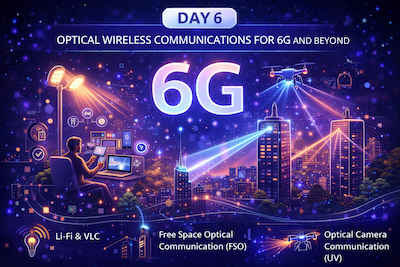
Day 6 marks the beginning of Module 3 in my 6G learning journey, focusing on Optical Wireless Communications (OWC). This was one of the most eye-opening sessions so far. The idea that light itself can be used to transmit data wirelessly—securely, efficiently, and at extremely high speeds—completely reshaped how I think about future networks.
What stood out most was how OWC technologies can complement traditional RF systems by offering cost-effective, secure, and spectrum-abundant solutions, especially in dense and indoor environments where spectrum scarcity is already a major concern.
💡 1️⃣ Introduction to Optical Wireless Communication (OWC)
🌈 What Is Optical Wireless Communication?
Optical Wireless Communication combines:
- Optics & photonics
- Wireless system design
- Communication theory
It uses the optical spectrum (infrared, visible light, ultraviolet) instead of radio frequencies to transmit data.
🚀 Why OWC Matters for 6G
- 📡 Uses unregulated spectrum, avoiding licensing complexity
- 🔁 Enables high spatial reuse, ideal for ultra-dense 6G networks
- 🏢 Signals remain confined, reducing interference between users
🔐 Security & Cost Benefits
- Light does not penetrate walls, making eavesdropping difficult
- Can reuse existing lighting infrastructure, lowering deployment costs
- Energy-efficient and environmentally friendly
OWC is not a replacement for RF — it is a powerful complement.
🔬 2️⃣ Emerging Optical Wireless Technologies
This session explored the main OWC technology families, each suited for different use cases.
🔦 Free Space Optical Communication (FSO)
📌 What it is
- Long-range, point-to-point communication using coherent light
✅ Strengths
- Extremely high data rates
- Narrow beams → high security
- Ideal for backhaul and temporary links
⚠️ Limitations
- Sensitive to:
- Fog, rain, dust
- Atmospheric turbulence
- Beam divergence causes geometric losses

SAVE 50% - POLVCDG Bone Conduction Headset IPX8 32GB Bluetooth 5.3 Wireless Swimming Headset with Microphone
☀️ Ultraviolet (UV) Communication
📌 Key Characteristics
- Operates in low solar background noise
- Strong scattering enables non-line-of-sight communication
✅ Best for
- Outdoor environments
- Reliable coverage in obstructed areas
📷 Optical Camera Communication (OCC)
📌 How it works
- Uses digital cameras as receivers
✅ Advantages
- Low-cost deployment
- Ideal for indoor navigation and screen-to-camera links
⚠️ Challenges
- Low data rates
- High attenuation
- Requires dense deployment
💡 Visible Light Communication (VLC) & Li-Fi
🔹 VLC
- Short-range communication using visible light
- Suitable for device-to-device links
- Limited networking capability
🔹 Li-Fi
- Full wireless networking solution
- Supports:
- Bidirectional links
- Multi-user access
- High-speed data transfer
Li-Fi stands out as the most mature OWC technology for practical deployment.
🔑 Key Takeaways – Day 6
- Optical Wireless Communication unlocks a massive, unused spectrum
- OWC enhances security due to signal confinement
- FSO is ideal for high-capacity backhaul links
- UV communication enables reliable outdoor and NLoS links
- OCC enables low-cost camera-based communication
- Li-Fi offers full, secure, high-speed wireless networking
- OWC will play a critical complementary role in 6G networks
Link for Day 5 post as below:
https://adeelkhan77.com/2026/01/17/blog-97-day-5-6g-ending-module-2-future-directions-challenges-of-ris/
Link for Day 7 post as below:
https://adeelkhan77.com/2026/01/19/blog-99-day-7-6g-module-3-optical-wireless-communications-for-6g-and-beyond/