📝 Introduction
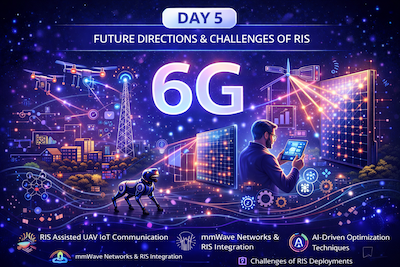
As the final day of Module 2 in the 6G learning journey, Day 5 focuses on the future directions and practical challenges of Reconfigurable Intelligent Surfaces (RIS). After building a strong foundation on RIS concepts, architectures, and machine learning integration in the earlier sessions, this module concludes by looking ahead—towards real-world deployment, scalability, and emerging research directions.
The discussions highlight how RIS, when combined with UAV-assisted IoT data collection, millimeter-wave communications, and AI-driven optimization, can address the limitations of traditional terrestrial networks. At the same time, the session sheds light on the open challenges that must be solved before RIS can become a mainstream technology in future 6G networks.
This concluding day not only ties together the technical learnings of Module 2 but also emphasizes the strategic importance of RIS as a core enabler of intelligent, adaptive, and sustainable wireless communication systems.
🚀 1️⃣ Future Directions of RIS in UAV-Assisted IoT
With an estimated 500 billion connected devices by 2030, traditional terrestrial networks face serious scalability challenges.
📡 Why UAVs Matter for IoT
- Extend coverage to dense and remote areas
- Improve energy efficiency
- Enable real-time data collection
⚠️ Key Challenges
- Dynamic environments
- Communication reliability
- Energy constraints
🪞 Role of RIS
RIS can reconfigure the wireless environment, enabling:
- Lower information age
- Improved urban IoT coverage
- Energy-efficient data collection
Strategic geographical clustering of IoT devices combined with RIS placement significantly reduces latency.
🧠 2️⃣ Optimization Techniques for RIS-Assisted UAV Networks
✈️ Simplified UAV Models
- Fixed-altitude UAVs reduce optimization complexity
🤖 AI-Driven Optimization
- Deep Reinforcement Learning (DRL) for UAV trajectory planning
- Codebook-based beamforming for RIS control
🔄 Joint Optimization Focus
Efficient data collection depends on:
- UAV mobility
- IoT device scheduling
- RIS phase reconfiguration
All optimized together with a strong focus on energy conservation.

Trimui Smart Pro Handheld Game Console 4.96''IPS Screen Linux - 50% OFF. CLICK to Buy
📶 3️⃣ Millimeter Wave (mmWave) Networks & RIS
⚡ Why mmWave Matters
- Extremely high data rates
- Enables AR, VR, holographic streaming
- Dense antenna deployments due to short wavelengths
🚧 Line-of-Sight (LoS) Challenge
- Easily blocked in urban and mobile environments
👁️ Vision-Aided Wireless Communication
- Uses cameras and LiDAR
- Detects blockages in real time
- Improves proactive decision-making
🪞 RIS as Virtual Line-of-Sight
- Reflects beams toward blocked regions
- Restores signal strength
- Enables continuous connectivity
🔑 Specific Key Takeaways of Day 5
- RIS is essential for scalable IoT and UAV communications
- Joint optimization of UAVs, RIS, and IoT devices is critical
- mmWave + RIS enables high-capacity future applications
- Vision-aided wireless communication complements RIS
- Module 2 establishes RIS as a core enabler of 6G intelligence
🎓 Module 2 – Short Summary (RIS)
🧩 Understanding RIS
- RIS reflects and steers signals without active transmission
- Enables fast adaptation to environmental changes
📊 Performance & Design
- Performance depends on:
- Number of RIS elements
- Channel characteristics
- Requires joint optimization with network performance
🤖 Machine Learning & the Road Ahead
- Deep learning enables:
- Beam focusing
- Programmable radio environments
- Future RIS research focuses on:
- Standardization
- Efficient channel estimation
- Multi-user access and routing
Link for Day 4 post as below:
https://adeelkhan77.com/2026/01/15/blog-96-6g-day-4-module-2-reconfigurable-intelligent-surfaces-ris/
Link for Day 6 post as below:
https://adeelkhan77.com/2026/01/18/blog-98-day-6-module-3-optical-wireless-communications-for-6g-and-beyond/