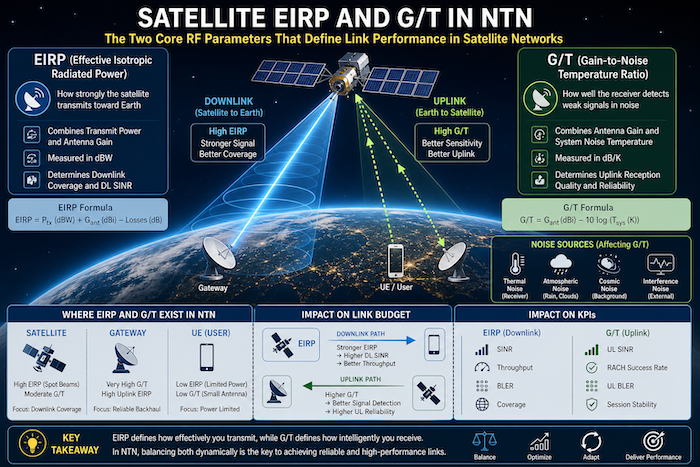
- Introduction to EIRP and G/T in Satellite NTN
In satellite based NTN systems, link performance is not just determined by transmit power or receiver sensitivity alone. Instead, two critical system level parameters define the overall RF performance: EIRP (Effective Isotropic Radiated Power) and G/T (Gain to Noise Temperature ratio).
EIRP represents how effectively a satellite transmits power toward the Earth, while G/T represents how well the receiver (satellite or gateway) can detect weak signals in the presence of noise. Together, they form the backbone of link budget design and directly impact coverage, capacity, and user experience in NTN.
- What is EIRP (Effective Isotropic Radiated Power)
EIRP defines the effective transmitted power in a specific direction, considering both transmitter power and antenna gain.
- It combines transmit power and antenna directivity
- Represents how strong the signal appears in space
- Measured in dBW
Mathematically:
- EIRP = Transmit Power (dBW) + Antenna Gain (dBi) – Losses (dB)
Practical understanding:
- Higher EIRP means stronger downlink signal toward the user
In NTN:
- Each satellite beam has its own EIRP
- EIRP varies dynamically with beam steering and power allocation
- What is G/T (Gain to Noise Temperature Ratio)
G/T defines receiver sensitivity by combining antenna gain and system noise temperature.
- Higher G/T means better ability to detect weak signals
- Measured in dB/K
Mathematically:
- G/T = Antenna Gain (dBi) – 10 log (System Noise Temperature)
Key components of noise temperature:
- Thermal noise from receiver hardware
- Atmospheric noise
- Cosmic noise
Practical understanding:
- A higher G/T improves uplink performance and overall link reliability
- Why EIRP and G/T Are Critical in NTN
In NTN, large distances and dynamic conditions make link budgets extremely sensitive.
EIRP importance:
- Determines downlink coverage footprint
- Impacts SINR at UE
G/T importance:
- Determines uplink reception quality
- Impacts decoding success at satellite/gateway
Key NTN challenge:
- Rapid variation due to satellite movement and beam changes
Knowledge tip:
- EIRP controls how well you transmit, G/T controls how well you receive
- Satellite vs UE vs Gateway Perspective
EIRP and G/T exist at multiple points in NTN architecture.
Satellite:
- High EIRP (especially in spot beams)
- Moderate G/T (depends on payload design)
Gateway:
- Very high G/T (large dish antennas)
- High uplink EIRP
UE (mobile device):
- Low EIRP (limited power)
- Low G/T (small antenna)
Practical implication:
- Uplink is usually the bottleneck due to UE limitations
- Vendor Implementation Perspective
Satellite vendors optimize EIRP and G/T through payload and antenna design.
Satellite vendor actions:
- Beam shaping (spot beams with high gain)
- Power allocation across beams
- Low noise amplifiers for better G/T
Telecom vendor actions:
- Link adaptation (MCS selection based on SINR)
- Power control algorithms
- Scheduling based on RF conditions
Key insight:
- Satellite defines RF capability, telecom stack optimizes usage

- Impact on Coverage and Beam Design
EIRP directly defines how far and how strongly a beam can serve users.
- Higher EIRP → larger or stronger coverage
- Lower EIRP → smaller or weaker coverage
G/T impacts uplink coverage:
- Higher G/T → better reception from edge users
- Lower G/T → uplink failures at cell edge
Practical behavior:
- Beam edges often limited by uplink (G/T), not downlink
- Impact on KPIs and Network Performance
EIRP and G/T influence multiple KPIs.
Downlink KPIs affected by EIRP:
- SINR
- Throughput
- BLER
Uplink KPIs affected by G/T:
- UL SINR
- RACH success rate
- UL BLER
Combined impact:
- End to end throughput
- Session stability
- Dynamic Behavior in LEO Constellations
Unlike GEO systems, LEO introduces continuous variation.
- Distance between satellite and UE changes
- Beam angles change
- Atmospheric effects vary
Result:
- EIRP appears dynamic due to beam steering
- Effective G/T varies with elevation angle
Practical observation:
- Users experience periodic signal variation as satellites pass
- How It Appears in Troubleshooting
EIRP and G/T issues show clear patterns in logs and KPIs.
Common symptoms:
- Sudden SINR drops (EIRP related)
- UL failures at cell edge (G/T limitation)
- RACH failures
Logs may show:
- Power control hitting limits
- MCS fallback
- Increased retransmissions
Troubleshooting approach:
- Check beam EIRP allocation
- Analyze elevation angle vs performance
- Correlate uplink failures with G/T limitations

- Practical Optimization Perspective
Engineers can indirectly optimize around EIRP and G/T.
- Adjust power allocation across beams
- Optimize scheduling for edge users
- Use repetition and robust MCS
Advanced techniques:
- Adaptive beamforming
- Dynamic resource allocation
Practical insight:
- You cannot change physics, but you can optimize around it
- EIRP vs G/T Comparison
| Parameter | EIRP | G/T |
|---|---|---|
| Function | Transmit strength | Receive sensitivity |
| Direction | Downlink focus | Uplink focus |
| Unit | dBW | dB/K |
| Controlled by | Power + antenna gain | Antenna gain + noise |
| Impact | Coverage, DL SINR | UL reliability |
| Limitation | Power budget | Noise floor |
- Key Takeaways
- EIRP defines how effectively a satellite transmits power toward Earth, directly impacting downlink performance
- G/T defines how well a receiver detects weak signals, making it critical for uplink reliability
- In NTN, both parameters are highly dynamic due to satellite movement and beam steering
- Uplink is often the limiting factor because of low UE transmit power and limited G/T
- Satellite vendors optimize EIRP and G/T through beam design and payload engineering, while telecom vendors optimize usage through scheduling and link adaptation
- Many NTN issues such as SINR drops, RACH failures, and throughput degradation are directly linked to EIRP and G/T behavior
- Effective troubleshooting requires correlating RF conditions with satellite position, beam configuration, and elevation angle