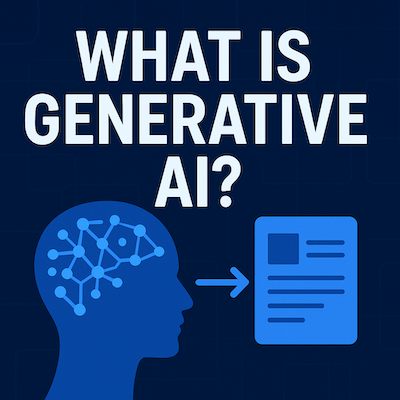
Recently, I completed a short but very insightful LinkedIn Learning course called “What Is Generative AI?” by Pinar Seyhan Demirdag. Since many of my friends and readers keep asking me “What exactly is Generative AI and why is everyone talking about it?”, I thought I’d share what I learned in very simple terms.
Generative AI in Plain Words
Generative AI is basically a type of artificial intelligence that doesn’t just analyze data—it actually creates new things.
For example:
- Writing an article or a poem
- Creating a picture from just a text prompt
- Composing music
- Even designing something completely new
Think of it like a very smart assistant that has read a huge library of books, seen millions of images, and listened to tons of examples—and now it can help you come up with something new, based on what it has learned.
How It’s Different from Other AI
Traditional AI usually classifies or predicts things. For example, AI might tell you whether a photo contains a cat or a dog.
But Generative AI goes a step further—it can actually draw the cat for you, or even invent a brand new kind of animal or new breed of cat if you ask!
How It Works (Without the Jargon)
The course explained a few model types that make this possible:
- Language Models → Tools like ChatGPT that generate text
- Image Generators → Tools like DALL·E or Stable Diffusion that create pictures
- GANs (Generative Adversarial Networks) → Two AI systems compete: one creates fake images, and the other checks if they look real, which makes the results better and better
- VAEs (Variational Autoencoders) → Used for things like finding unusual patterns in data or creating slightly new variations of something
Don’t worry if the names sound technical—the key idea is that these models “learn patterns” and then “recreate” something new from those patterns.

Why It Matters for Us
Generative AI isn’t just about fun tools—it’s already being used in:
- Film & Media → Creating scenes or editing faster
- Marketing → Designing ads or writing copy quickly
- Healthcare → Helping discover new drugs or medical designs
- Automotive & Real Estate → Simulating designs before they’re built
So it’s not just a buzzword—it’s shaping industries.
The Human Side: Ethics & Responsibility
One of the most important points Pinar stressed is that AI is a tool, not a replacement for humans.
We need to use it responsibly, keeping in mind:
- Possible biases in AI-generated results. Result could be wrong or deviated from actual fact.
- Ownership of AI-created content (who “owns” it?)
- The impact on jobs and society
So while AI can make life easier, it’s up to us to make sure it’s used fairly and ethically.
My Takeaway
The biggest thing I learned is: Generative AI is not here to replace creativity—it’s here to enhance it.
It’s like giving your imagination superpowers. You still decide what to create, but now you have a much more powerful tool to help bring those ideas to life.
People say that AI can replace human and giving example of making codes with a prompt. But only that person can write a successful prompt who knows something about coding as the result might not be the exact answer you dreamed of. A person with coding knowhow can alter and tune that code using AI as per the requirement later on.
If you’ve been hearing about AI but never really understood it, this course is a great starting point. It’s short, beginner-friendly, and gives you both the excitement and the caution you need when stepping into this new era.
👉 So, if you’re curious about AI or want to see how it might affect your work, I’d definitely recommend checking out this course.