🧠 Introduction
After completing AWS fundamentals last week, Today marks Day 1 of my learning journey in the new course
“Agentic AI Fundamentals: Architecture, Frameworks and Applications.”
In this session, the following topics were covered:
🔹 What is Agentic AI
🔹 Applications and use cases of Agentic AI
🔹 A healthcare implementation scenario inspired by Grey Sloan Medical Center
Below are my structured learnings from Day 1.
🤖 What is Agentic AI?
Agentic AI refers to AI systems composed of autonomous agents that can make decisions, take actions, and continuously learn without constant human supervision.
Unlike traditional AI models that only respond to inputs, Agentic AI systems are designed to pursue goals, understand context, and adapt over time.
🔑 Key Learnings
🟢 Autonomy
Agents operate independently and can execute tasks with minimal human intervention.
🎯 Goal-Oriented Behavior
Agents are capable of setting objectives and working toward achieving them.
📈 Learning & Evolution
Through machine learning and feedback loops, agents improve their performance continuously.
🧩 Contextual Understanding
Agents make informed decisions by understanding the surrounding context rather than following static rules.
🌍 Multi-Domain Applicability
Agentic AI can be applied across multiple domains such as:
- Customer Service
- Healthcare
- Retail
- Manufacturing
- Cybersecurity
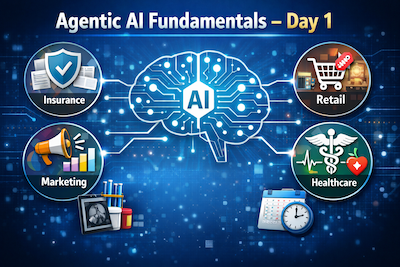
🏭 Applications & Use Cases of Agentic AI
Agentic AI is already being used to automate complex workflows and decision-making processes across industries.
🏦 Insurance
AI agents automate tasks such as claims processing and data management.
By validating documents and assessing risks autonomously, these agents improve efficiency and accuracy.
📢 Marketing
In marketing, agentic systems:
- Gather large volumes of customer data
- Perform sentiment analysis
- Optimize campaign strategies
This enables more data-driven and adaptive marketing decisions.
🛍️ Retail
Agentic AI enhances retail operations by:
- Personalizing customer recommendations
- Improving after-sales support
- Adapting to customer behavior over time
🏥 Healthcare
In healthcare, Agentic AI supports:
- Clinical decision-making
- Patient workflow optimization
- Administrative task automation
🏥 Healthcare Scenario: Grey Sloan Medical Center
A real-world healthcare scenario inspired by a Medical Center in US was discussed to demonstrate the impact of Agentic AI.
🧪 Diagnostic Support
AI agents analyze:
- Radiology images
- Lab results
- Patient medical histories
They provide real-time diagnostic recommendations, helping reduce errors and improve accuracy.
⏱️ Patient Management
Agents automate:
- Appointment scheduling
- Provider availability management
This leads to shorter wait times and better use of healthcare resources.
📋 Administrative Automation
AI agents handle:
- Data entry
- Billing
- Insurance claims processing
This significantly reduces administrative workload and allows healthcare staff to focus more on patient care.
🧾 Summary & Key Takeaways
🔹 Agentic AI introduces autonomy, adaptability, and goal-driven intelligence.
🔹 It is well-suited for environments with complex workflows and decisions.
🔹 Healthcare is a strong example of how agentic systems deliver real operational and clinical value.
🚀 What’s Next?
Upcoming sessions will explore Agentic AI architecture, frameworks, and implementation patterns.
I’ll continue sharing my daily learnings as part of my learning-in-public journey.
Link for Day 2 as below:
https://adeelkhan77.com/2025/12/30/blog-77-agentic-ai-fundamentals-day-2-agentic-behaviour-and-adaptation/