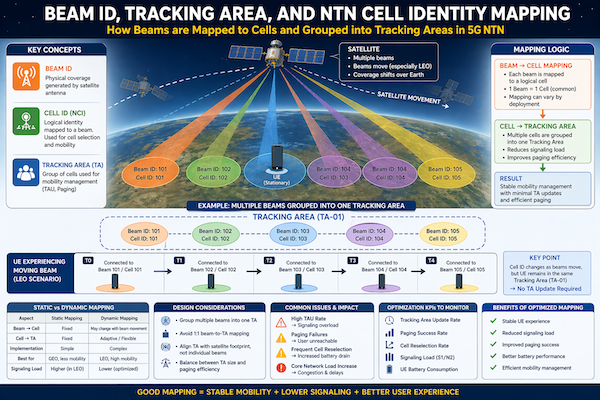
1. Introduction to NTN Identity Mapping Complexity
In terrestrial networks, cell identity and tracking areas are fixed and geographically stable. In NTN, everything changes because beams move, coverage shifts, and the concept of a “cell” becomes dynamic.
- A single satellite generates multiple beams
- Beams move (especially in LEO systems)
- UE remains stationary while coverage moves over it
This creates a new challenge: how to map Beam IDs, Cells, and Tracking Areas efficiently.
2. What is Beam ID in NTN
Beam ID represents a specific coverage beam generated by the satellite antenna.
- Each beam covers a footprint on Earth
- Beams are analogous to sectors in terrestrial networks
- Beam shapes can be circular or elliptical
Key characteristics:
- Dynamic in LEO systems
- Fixed in GEO systems
- Beam boundaries are not rigid like terrestrial cells
3. What is NTN Cell Identity (NCI)
In NTN, a “cell” is typically mapped to a beam.
- Each beam can represent a logical cell
- Cell Identity (NCI) is broadcast to the UE
- Used for:
- Cell selection
- Mobility decisions
- RRC signaling
Important nuance:
- One beam = one cell (common deployment)
- But mapping can vary depending on vendor design
4. Tracking Area (TA) in NTN
Tracking Area defines a group of cells used for mobility management.
- UE performs Tracking Area Update (TAU) when moving between TAs
- In NTN:
- TA design must consider beam movement
- Frequent TA updates can overload signaling
Challenge:
- If each beam = separate TA → excessive TAU
- If too large TA → paging inefficiency
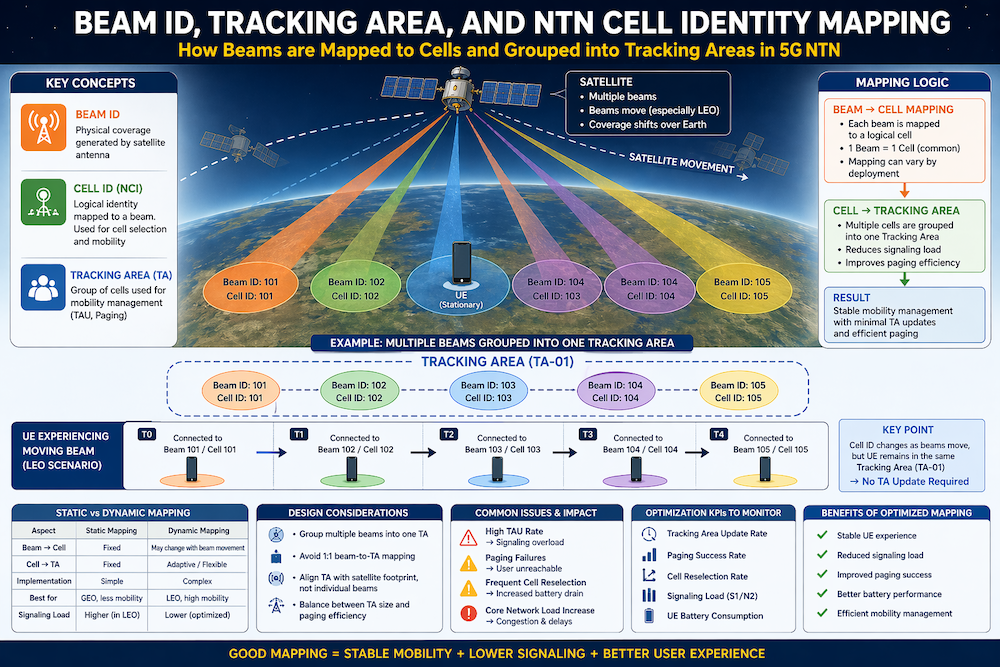
5. Beam vs Cell vs Tracking Area Mapping
| Concept | NTN Role | Key Behavior |
|---|---|---|
| Beam ID | Physical coverage | Moves with satellite |
| Cell ID | Logical identity | Mapped to beam |
| Tracking Area | Mobility grouping | Covers multiple cells/beams |
Practical mapping:
- Multiple beams → multiple cells
- Multiple cells → one Tracking Area
6. Static vs Dynamic Mapping Strategies
Two main approaches exist:
Static Mapping:
- Beam → fixed cell ID
- Cell → fixed TA
- Simpler implementation
- Less flexible for LEO movement
Dynamic Mapping:
- Cell ID may change with beam movement
- TA boundaries adapt
- Reduces signaling load
- More complex to manage

AJAZZ AK820 / AK820Pro Gaming Mechanical Keyboard 75% 82 Keys Wired Single Mode/Bluetooth Wireless
7. LEO Specific Challenge: Moving Beams
In LEO systems:
- Beams sweep across the earth
- UE may remain stationary but:
- Beam ID changes
- Cell ID changes
- Possibly TA changes
Impact:
- Frequent reselection or handover
- Increased signaling load
- Risk of paging inefficiency
8. Mobility Impact and Paging Strategy
Incorrect mapping leads to:
- Excessive Tracking Area Updates
- Paging failures
- Increased UE battery consumption
Optimization approach:
- Use large Tracking Areas
- Decouple beam movement from TA boundaries
- Align TA with satellite footprint instead of beams
9. Troubleshooting Scenarios
Common field issues:
High TAU Rate:
- Cause:
- Small TA size
- Beam based TA mapping
- Fix:
- Increase TA size
- Optimize TA grouping
Paging Failures:
- Cause:
- UE frequently changing TA
- Fix:
- Stable TA planning
- Reduce TA transitions
Frequent Cell Reselection:
- Cause:
- Beam movement
- Fix:
- Adjust mobility parameters (offsets, hysteresis)
10. Optimization Strategy from RF Perspective
Key actions:
- Analyze:
- TAU rate
- Paging success rate
- Cell reselection frequency
- Optimize:
- Tracking Area size
- Beam to cell mapping logic
- Mobility thresholds
- Validate:
- UE stability in moving beam scenarios
- Signaling load on core network
Real world insight:
- Over optimization of TA size can create paging storms
11. Practical Deployment Approaches
Operators typically:
- Avoid 1:1 mapping of beam to TA
- Group multiple beams into one TA
- Use predictive mobility models for LEO
Vendor specific enhancements:
- Beam aware mobility control
- Smart TA boundary shifting
- UE assisted positioning
12. Key Takeaways
- Beam is physical, cell is logical, TA is mobility grouping
- LEO movement breaks traditional static planning
- TA design is critical for signaling efficiency
- Poor mapping leads to TAU storms and paging failures