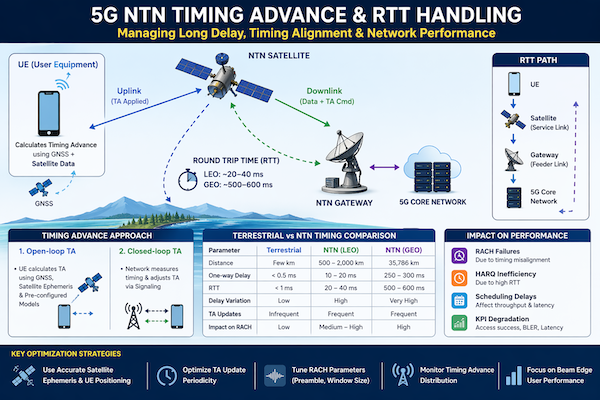
1. Introduction to NTN Timing Challenges
In terrestrial networks, timing alignment is relatively straightforward due to short distances between UE and base station. In NTN, the satellite introduces extremely large propagation delays, making timing control one of the most critical design and optimization aspects.
- LEO RTT: ~20–40 ms
- GEO RTT: ~500–600 ms
- Timing misalignment directly impacts uplink decoding, RACH success, and scheduling
2. What is Timing Advance (TA) in Terrestrial Networks
Timing Advance ensures that uplink transmissions from UE arrive aligned at the base station.
- UE adjusts transmission timing based on TA commands
- TA is proportional to distance
- Typical terrestrial TA range: a few microseconds
3. Why Timing Advance Becomes Complex in NTN
| Parameter | Terrestrial | NTN |
|---|---|---|
| Distance | Few km | Hundreds to thousands km |
| Delay | <1 ms | Up to 600 ms |
| Mobility | UE based | Satellite + UE |
| Variation | Low | High (especially LEO) |
Key issue:
- Satellite movement introduces dynamic delay variation
4. NTN Round Trip Time (RTT) Explained
RTT is the total time for a signal to travel:
- UE → Satellite → Gateway → Core → Back
- Includes feeder link + service link delays
Practical implication:
- Impacts HARQ, scheduling, and RACH timing windows
5. NTN Timing Advance Mechanism (How It Works)
Unlike terrestrial:
- TA is not only distance based
- It includes:
- Satellite ephemeris data
- UE location estimation
- Pre configured delay models
Two approaches:
- Open loop TA:
- UE calculates TA using GNSS + satellite data
- Closed loop TA:
- Network adjusts TA via signaling
6. Role of GNSS and UE Positioning
- GNSS enabled UE can estimate propagation delay
- Improves initial access success
- Reduces RACH retries
Key insight:
- GNSS assisted timing is a major differentiator in NTN

7. Timing Drift in LEO Systems
LEO satellites move rapidly and delay changes continuously
- Causes timing drift
- Requires frequent TA updates
- Impacts:
- Uplink alignment
- HARQ timing
- Scheduling accuracy
Optimization challenge:
- Balance TA update frequency vs signaling overhead
8. Impact on Random Access (RACH)
Improper TA leads to:
- RACH preamble miss detection
- Increased Msg3 failure
- High access delay
Troubleshooting signs:
- High RACH failure rate
- Increased access retries
- Timing related KPI degradation
9. Impact on HARQ and Scheduling
- HARQ feedback loop becomes inefficient due to high RTT
- Scheduling must account for delayed ACK/NACK
Practical adaptation:
- HARQ process reduction or disablement
- Use of repetition based reliability
10. NTN Timing Compensation Techniques
Operators use:
- Pre compensation using satellite trajectory
- Extended timing windows
- Adaptive TA updates
- Beam specific delay models
Real world insight:
- Beam edge users experience more timing errors
11. Practical Optimization Strategy
From RF optimization perspective:
- Monitor:
- RACH success rate
- Timing advance distribution
- Identify:
- Beam edge issues
- High mobility delay variations
- Optimize:
- TA update periodicity
- RACH configuration (preamble format, window size)
12. Key Takeaways
- NTN timing is delay aware, not just distance based
- RTT fundamentally changes MAC layer behavior
- GNSS plays a critical role
- Timing impacts RACH, HARQ, and scheduling directly