Introduction
As agentic AI systems scale from single agents to multi-agent ecosystems, communication becomes a critical capability. On Day 5 of my Agentic AI learning journey, the focus was on advanced communication frameworks that enable agents to cooperate, negotiate, and resolve conflicts effectively.
This session covered how intelligent agents coordinate actions, share information, and make strategic decisions together, similar to human teams.
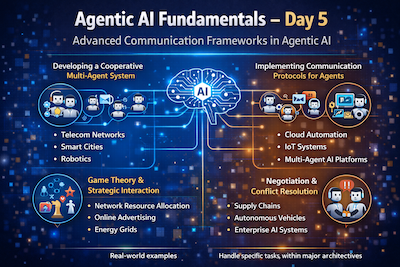
1. Developing a Cooperative Multi-Agent System
A cooperative multi-agent system consists of multiple agents working together toward shared or aligned goals.
How Cooperation Works
- Agents share state information
- Tasks are divided among agents
- Decisions are coordinated to avoid conflicts
Real-World Examples
- Telecom Networks: Multiple AI agents manage traffic, interference, and handovers collaboratively
- Smart Cities: Traffic lights and sensors cooperate to optimize traffic flow
- Robotics: Warehouse robots coordinate paths to avoid collisions
Cooperation allows systems to scale intelligence beyond a single agent.
2. Implementing Communication Protocols for Agents
For agents to collaborate effectively, they need standardized communication protocols.
What Are Communication Protocols?
Protocols define:
- Message formats
- Communication rules
- Timing and sequencing
They ensure agents understand what is being communicated and how to respond.
Real-World Examples
- Cloud Automation: Agents exchange status updates via APIs and message queues
- IoT Systems: Sensors and control agents communicate using structured protocols
- Multi-Agent AI Platforms: Agents coordinate actions using defined messaging standards
Without proper protocols, multi-agent systems become unpredictable and inefficient.

3. Game Theory and Strategic Interaction
When agents have different objectives, cooperation alone is not enough.
This is where game theory becomes important.
Role of Game Theory in Agentic AI
- Models competitive and cooperative behavior
- Helps agents predict outcomes of actions
- Enables strategic decision-making
Real-World Examples
- Network Resource Allocation: Agents compete for bandwidth while optimizing overall performance
- Online Advertising: AI agents bid strategically in real-time auctions
- Energy Grids: Agents balance supply and demand dynamically
Game theory helps agents make rational decisions in shared environments.
4. Negotiation and Conflict Resolution
In real-world systems, conflicts are unavoidable. Agentic AI systems must be able to negotiate and resolve disputes autonomously.
How Agents Negotiate
- Propose alternatives
- Evaluate trade-offs
- Reach mutually acceptable agreements
Real-World Examples
- Supply Chains: Agents negotiate delivery schedules and costs
- Autonomous Vehicles: Vehicles negotiate right-of-way at intersections
- Enterprise AI Systems: Agents resolve resource conflicts across departments
Effective negotiation ensures system stability and fairness.
Key Takeaways from Day 5
- Communication is foundational for multi-agent intelligence
- Cooperative systems enable scalability and resilience
- Protocols ensure reliable and structured interactions
- Game theory enables strategic decision-making
- Negotiation and conflict resolution make systems robust
Final Thoughts
Day 5 highlighted that agentic AI is not just about intelligence, it’s about interaction.
Advanced communication frameworks allow agents to function like coordinated teams, making them suitable for complex, real-world environments such as telecom, cloud systems, smart cities, and enterprise automation.
Link for Day 4 as follows:
https://adeelkhan77.com/2025/12/31/blog-79-day-4-agent-architectures-in-agentic-ai/
Link for Day 6 as follows:
https://adeelkhan77.com/2025/12/31/blog-81-day-6-agentic-ai-learning-course-conclusion-ethical-secure-future-ready-agentic-ai/