🚀 Introduction
This final day of my Agentic AI learning journey focused on the bigger picture — how agentic systems impact society, how they can be secured and made robust, and where they are heading in the future.
Unlike previous technical days, Day 6 emphasized responsibility, trust, and long-term vision for Agentic AI systems.
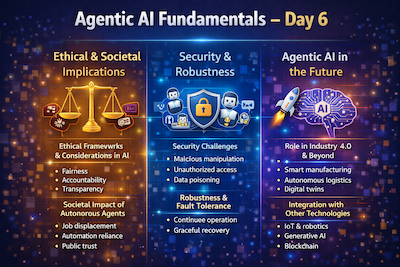
🧭 1️⃣ Ethical and Societal Implications
⚖️ Ethical Frameworks and Considerations in AI
Agentic AI systems operate with a high level of autonomy, making ethics a core requirement, not an afterthought.
Key considerations include:
- Transparency → Understanding how agents make decisions
- Accountability → Clear responsibility when agents act autonomously
- Fairness & Bias → Avoiding discrimination in AI-driven decisions
- Human Oversight → Keeping humans in the decision loop
📌 Example:
An AI agent approving bank loans must be transparent, unbiased, and auditable to avoid unfair rejections.
🌍 Societal Impact of Autonomous Agents
Autonomous agents influence how we:
- Work (automation & productivity)
- Communicate (AI assistants & copilots)
- Make decisions (recommendation & planning systems)
While Agentic AI can improve efficiency, it also raises concerns about:
- Job displacement
- Over-reliance on automation
- Trust in AI-driven outcomes
📌 Example:
Autonomous traffic management agents can reduce congestion but must ensure public safety and fairness across regions.
🔐 2️⃣ Security and Robustness
🛡️ Security Challenges
Agentic AI systems face unique security risks:
- Malicious manipulation of agent behavior
- Unauthorized access to agent communication
- Data poisoning affecting decision-making
📌 Example:
In a multi-agent supply chain system, a compromised agent could disrupt logistics across the network.
🧱 Robustness and Fault Tolerance
Robust agentic systems must:
- Continue operating despite partial failures
- Adapt to unexpected inputs or environments
- Recover gracefully from errors
📌 Example:
In smart factories, if one robotic agent fails, others should adapt instead of halting production.

🔮 3️⃣ Agentic AI in the Future
🏭 Role of Agentic AI in Industry 4.0 and Beyond
Agentic AI will play a critical role in:
- Smart manufacturing
- Autonomous logistics
- Self-optimizing networks
- Intelligent digital twins
These agents will not just automate tasks — they will reason, plan, and collaborate.
🔗 Integration with Other Technologies
The future of Agentic AI lies in integration with:
- 🌐 IoT (real-time sensing & action)
- ☁️ Cloud & Edge Computing
- 🤖 Robotics
- 🧠 Generative AI & LLMs
- 🔐 Blockchain for trust & auditability
📌 Example:
An AI agent coordinating energy usage by combining IoT sensors, edge AI, and predictive analytics.
🎓 Course Conclusion: Agentic AI Fundamentals
This course provided a comprehensive understanding of Agentic AI, starting from foundational concepts and agent behaviors to advanced communication frameworks, architectures, and real-world applications.
The final day emphasized a critical reality:
Powerful autonomous systems must be ethical, secure, and socially responsible.
Key takeaways from the overall journey include:
- Understanding how autonomous agents perceive, plan, communicate, and adapt
- Learning the importance of ethical frameworks, transparency, and accountability
- Recognizing security risks and robustness requirements in agentic systems
- Exploring how Agentic AI will integrate with Industry 4.0, IoT, robotics, digital twins, and generative AI
This learning journey reinforced that Agentic AI is not just about automation — it is about building trustworthy, resilient, and collaborative intelligent systems that can operate responsibly in complex real-world environments.
🏁 Final Thoughts
This course highlighted that Agentic AI is not just about intelligence, but about:
- Responsible autonomy
- Secure collaboration
- Human-aligned decision-making
A powerful reminder that how we design agents today defines how they shape tomorrow.
Link for Day 5 as follows:
https://adeelkhan77.com/2025/12/31/blog-80-day-5-agentic-ai-learning-advanced-communication-frameworks-in-agentic-ai/