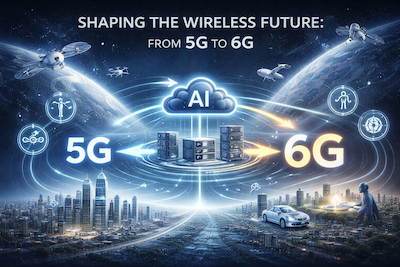
With the start of Module 5, the focus shifts from individual technologies to the bigger picture—how 6G is being shaped strategically, how it will be deployed in the real world, and how research transitions into impact.
This session explored not just what 6G could be, but how it must be built, governed, and delivered.
1. From 5G to 6G: Vision and Strategy
Unlike previous generations, 6G is not just an incremental upgrade.
Its vision emerged around 2020, driven by close collaboration between academia and industry.
Key strategic goals include:
- Moving beyond connecting people → connecting machines, environments, and intelligence
- Continuous industry consultation to identify gaps not fully addressed by 5G
- Designing systems that adapt to evolving societal and industrial needs
6G is envisioned as a long-term, flexible platform, not a fixed specification.
2. What Fundamentally Differentiates 6G from 5G
Several architectural shifts define 6G:
2.1 Ubiquitous and Seamless Coverage
- Integration of terrestrial, aerial (UAV), and space-based networks
- Users experience a single network, regardless of location
2.2 Intelligence-Native Networks
- AI embedded at the core of the network
- Self-learning systems managing:
- Quality of Service (QoS)
- User experience
- Network efficiency
2.3 Time as a First-Class Network Resource
- Ultra-precise time synchronization across devices
- Reduced dependency on GPS
- Critical for:
- Digital twins
- Cell-free architectures
- Coordinated multi-device systems
3. Enabling Technologies for 6G
Several technologies were highlighted as key enablers:
- Non-Orthogonal Multiple Access (NOMA)
- Promising for satellite communications and dense connectivity
- Supports massive device access with improved spectral efficiency
- AI–Sensing–Communication Convergence
- Sensing provides data → AI extracts intelligence → network adapts
- Enables context-aware and predictive communication
- Three-Dimensional Network Architecture
- Space + air + ground integration
- Essential for global and mission-critical coverage

50% OFF - Ajazz AK820/AK820Pro Gaming Mechanical Keyboard Bluetooth 5.1/Wireless/C-Wired
4. From Research to Reality: Rollouts and Deployment
Bringing technology from lab to deployment requires more than innovation.
4.1 Understanding System Impact
Researchers must understand:
- Legacy system constraints
- Standardization processes
- Intellectual property implications
A brilliant idea fails if it cannot coexist with real networks.
5. Academia–Industry–Regulator Collaboration
Successful innovation ecosystems depend on:
- Flexible academic–industry partnerships
- Joint publications and patents
- Early and evidence-based engagement with regulators
Regulatory alignment is especially critical for:
- Bandwidth expansion
- Ultra-low latency applications
- New spectrum usage models
6. Vendor Diversification and the UK Case Study
The UK addressed security and resilience by:
- Reducing reliance on a small number of vendors
- Promoting SMEs and startups through government-backed initiatives
This led to the creation of the UK Telecom Innovation Network (TIN):
- A central hub for investors, researchers, and industry
- Encouraging national and international collaboration
7. Advice for Researchers and PhD Students
Key guidance shared:
- Develop strong problem-solving logic
- Look beyond narrow research topics
- Understand real-world deployment challenges
- Be honest about both strengths and limitations of your work
Excellence and relevance remain the strongest drivers of long-term success.
8. Looking Ahead: Earth–Space Communication and Beyond
The future vision includes:
- Real-time Earth–space communication
- Lunar connectivity initiatives
- On-demand satellite services
More visionary ideas—like digital teleportation—will require breakthroughs in:
- AI
- Time synchronization
- Multisensory virtual interaction
Closing Reflection
6G is not only about higher data rates—it is about intelligent, synchronized, and immersive systems that blend physical and digital realities.
Module 5 sets the tone for understanding how this future can actually be built.
Link for Day 11 post as below:
https://adeelkhan77.com/2026/02/04/blog-115-day-11-radar-enabled-assisted-living-in-6g-applications-and-sensing-challenges/
Link for Day 13 post as below:
https://adeelkhan77.com/2026/02/06/blog-117-day-13-big-picture-of-6g-from-connectivity-to-connected-intelligence/