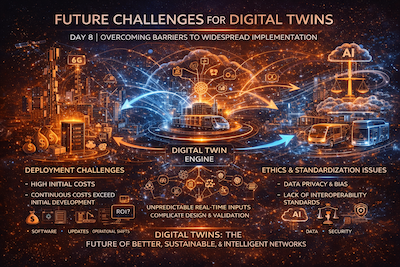
Completing the Module with study of Future Challenges of DT. Digital Twins are rapidly becoming the backbone of intelligent, adaptive, and sustainable networks. From transportation systems to telecom infrastructure and smart cities, their potential is transformative.
But widespread adoption is not without obstacles.
As organizations move from experimentation to large-scale deployment, critical challenges emerge that must be strategically addressed.
Let’s explore the major barriers — and what they mean for the future of Digital Twins.
1. Deployment & Cost Barriers
While the long-term ROI of Digital Twins is compelling, the initial investment can be substantial.
Key challenges:
- High infrastructure and integration costs
- Ongoing operational and maintenance expenses
- Continuous software updates and model recalibration
- Scaling simulation engines across distributed systems
Digital Twin ecosystems are not “set and forget” solutions. They require constant data synchronization, computational resources, and validation cycles.
The question organizations face is not “Do Digital Twins create value?”
It is “How do we scale them sustainably?”
2. Real-Time Complexity & Data Volatility
Digital Twins rely on real-time inputs from dynamic environments.
However:
- Data streams can be noisy, incomplete, or delayed
- Edge devices may introduce inconsistencies
- Environmental unpredictability complicates validation
- Model drift can reduce simulation accuracy over time
Designing resilient Digital Twin engines requires robust data governance, adaptive AI models, and continuous calibration pipelines.
Without this, simulation results risk becoming unreliable.
3. Ethics, Privacy & Standardization
As Digital Twins increasingly integrate AI-driven decision-making, ethical and regulatory considerations become central.
Critical concerns include:
- Data privacy and user consent
- Algorithmic bias
- Cybersecurity risks
- Lack of interoperability standards
- Regulatory fragmentation across regions
Without clear governance frameworks and shared industry standards, Digital Twins risk becoming siloed, incompatible, and vulnerable.
Standardization will be a key enabler of ecosystem-wide growth.

42 52 Inch Ceiling Fans No Light DC Motor Remote Control Cooling Fans Lamp Low Floor Ceiling Fan
4. Interoperability & Ecosystem Fragmentation
Many Digital Twin platforms are developed within proprietary ecosystems.
This creates:
- Limited cross-platform integration
- Data silos
- Reduced scalability across industries
Future-ready Digital Twin networks will require open architectures, API standardization, and collaborative frameworks across vendors and regulators.
The Road Ahead
The future of Digital Twins is not defined by their capabilities — but by how effectively we overcome these barriers.
To move from pilots to global-scale implementation, we need:
✔ Cost-efficient infrastructure strategies
✔ Adaptive, AI-driven model governance
✔ Ethical-by-design development principles
✔ Standardization and interoperability frameworks
✔ Cross-industry collaboration
Digital Twins are foundational to sustainable, intelligent networks — but success depends on responsible, scalable implementation.
The next phase of innovation is not just technical.
It’s structural.
If you’ve been exploring Digital Twin deployment in your organization, what challenges are you encountering?
Let’s discuss.
Blog post for Day 7 as below:
https://adeelkhan77.com/2026/02/13/blog-124-day-7-digital-twins-across-telecom-energy-transport/
Blog post for Day 9 as below:
https://adeelkhan77.com/2026/02/15/blog-126-day-9-the-road-to-6g-beyond-connectivity/