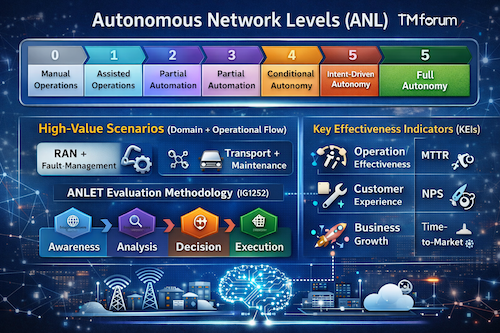
Digital transformation in telecom is no longer optional, it is a survival requirement. As networks evolve toward 5G Advanced, Open RAN, Cloud native Core, and eventually 6G, the industry needs a standardized way to measure automation maturity.
This is where the TM Forum Autonomous Network Levels (ANL) – Fundamentals Level framework becomes essential.
ANL does not just describe automation, it quantifies it.
This blog post explains how ANL provides a structured 0–5 maturity scale, how assessments are performed using High Value Scenarios (HVS), how evaluation is standardized through ANLET (IG1252), and how business success is measured through Key Effectiveness Indicators (KEIs).
1 - The Quantized Maturity Scale (Level 0–5)
The Autonomous Network Levels framework introduces a standardized six stage maturity model, ranging from fully manual operations to full autonomy.
Instead of subjective claims like “we are highly automated,” ANL provides measurable levels.
🔹 Level 0 – Manual Operations
- Human driven workflows
- Reactive troubleshooting
- No closed loop automation
🔹 Level 1 – Assisted Operations
- Basic scripts
- Dashboard driven monitoring
- Human decision remains central
🔹 Level 2 – Partial Automation
- Rule based automation
- Closed loop in limited scenarios
- Domain level automation (e.g., RAN only)
🔹 Level 3 – Conditional Autonomy
- AI-assisted decision making
- Predictive analytics
- Cross domain data awareness
- Human supervision still required
🔹 Level 4 – Intent Driven / Cross-Domain Autonomy
- Intent based management
- Cross domain orchestration (RAN, Core, Transport)
- End to end closed loops
- Minimal human intervention
🔹 Level 5 – Full Autonomy
- Self learning systems
- Self evolving optimization
- Fully automated lifecycle management
- Human oversight only for governance
Why This Matters
ANL provides:
- A common language across operators and vendors
- A benchmarking mechanism
- A roadmap for transformation
- Alignment between technical automation and business objectives
For engineers transitioning toward automation strategy (instead of repetitive configuration tasks), ANL helps answer:
Where are we today, and what must we improve to reach the next level?
2 - High Value Scenarios (HVS): Focused Assessment
One of the most practical aspects of ANL is that it does not evaluate the entire network at once.
Instead, assessment is performed using High Value Scenarios (HVS).
What is a High Value Scenario?
An HVS is a combination of:
- A network domain (e.g., RAN, Core, Transport, Cloud)
- An operational flow (e.g., Fault Management, Maintenance, Provisioning, Optimization)
Example HVS:
- RAN + Fault Management
- Core + Service Provisioning
- Transport + Performance Optimization
This approach ensures:
- Focused evaluation
- Measurable improvement
- Clear investment prioritization
Rather than claiming “our RAN is Level 3,” ANL would state:
“RAN Fault Management is Level 2, while RAN Optimization is Level 3.”
This precision drives meaningful transformation.

3 - The ANLET Evaluation Methodology (IG1252)
To standardize evaluation, TM Forum introduced the Autonomous Network Level Evaluation Tool (ANLET) under IG1252.
ANLET ensures objectivity.
Assessment is conducted through structured questionnaires defined in the GB1059 series.
The Four Evaluation Dimensions
Every HVS is evaluated across four core dimensions:
i - Awareness
- Does the system perceive network state accurately?
- Does it collect and correlate multi domain data?
- Does it detect anomalies automatically?
ii - Analysis
- Can the system identify root causes?
- Does it use predictive or AI driven analytics?
- Is cross domain data correlation available?
iii - Decision
- Can the system recommend corrective actions?
- Can it autonomously select optimal strategies?
- Are policies and intents applied?
iv -Execution
- Can it automatically implement changes?
- Are closed loops validated?
- Is rollback capability available?
Why the Four Dimension Model is Powerful
Many systems claim automation but fail in execution or decision layers.
For example:
- A system may detect alarms (Awareness)
- Analyze root cause (Analysis)
- But still require engineers to implement fixes
That system cannot be Level 4 or 5.
ANLET ensures maturity is evaluated holistically, not partially.
4 - Key Effectiveness Indicators (KEIs): Measuring Business Impact
While ANL measures capability, KEIs measure value.
This is extremely important.
Automation without business benefit is just technical complexity.
KEIs are grouped into three major domains:
- Operation Effectiveness
Measures operational efficiency improvements such as:
- MTTR (Mean Time To Repair)
- Ticket resolution time
- Fault recurrence rate
- Automation ratio
Improvement in these metrics directly reduces OPEX.
- Customer Experience
Measures service quality impact:
- NPS (Net Promoter Score)
- Service availability
- Latency compliance
- Complaint rate
Higher autonomy should improve customer satisfaction.
- Business Growth
Measures revenue and agility:
- Time to Market for new services
- SLA fulfillment rates
- New service provisioning speed
- Resource utilization efficiency
This dimension connects network automation directly to revenue generation.
The Strategic Importance of ANL
As networks become:
- Cloud native
- Multi vendor
- AI integrated
- Slice based
- Edge enabled
Manual and siloed operations cannot scale.
ANL provides:
- A transformation roadmap
- A maturity benchmarking system
- Cross industry comparability
- Structured investment prioritization
For operators, it clarifies:
Which domain and operational flow should we automate first?
For vendors, it clarifies:
What capabilities must our solution provide to reach higher autonomy levels?
From Technical Optimization to Strategic Automation
For professionals with deep experience in network optimization and operations, ANL represents a career level shift.
Instead of focusing only on:
- Parameter tuning
- Alarm handling
- Performance reports
The focus moves to:
- Closed loop system design
- AI driven orchestration
- Cross domain automation
- Business KPI alignment
It’s no longer just about fixing cells, it’s about engineering intelligent systems.
Final Thoughts
The TM Forum Autonomous Network Levels (ANL) Fundamentals course establishes a measurable pathway toward full autonomy.
Key takeaways:
- A standardized 0–5 maturity model
- Scenario based evaluation via High Value Scenarios
- Structured scoring using ANLET (IG1252)
- Holistic measurement across Awareness, Analysis, Decision, Execution
- Business validation through Key Effectiveness Indicators
Autonomy is not achieved overnight.
It is engineered, measured, validated, and continuously improved.
The real transformation begins when operators stop asking:
“How automated are we?”
And start asking:
“What level of autonomy have we objectively achieved, and what is our next High Value Scenario to elevate?”
That is the power of ANL.
Blog post for Tm-Forum IDAN Automation as below:
https://adeelkhan77.com/2026/02/26/blog-139-tm-forum-intent-driven-autonomous-networks-idan-from-automation-scripts-to-business-driven-intelligence/