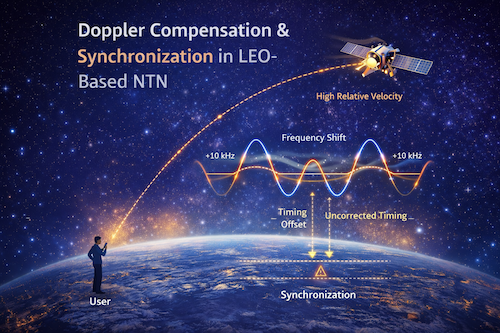
Unlike terrestrial 5G systems, where base stations are fixed and frequency offsets are relatively stable, LEO based Non Terrestrial Networks operate in a highly dynamic radio environment.
Satellites move at approximately 7–8 km/s relative to Earth. This high relative velocity introduces significant Doppler shifts and timing variations that must be compensated to maintain reliable 5G NR operation.
Doppler management and synchronization are therefore foundational engineering challenges in NTN design.
1. Understanding Doppler in LEO Systems
Doppler shift occurs when there is relative motion between transmitter and receiver.
In LEO NTN:
- Satellite velocity is very high relative to a stationary user.
- Doppler shift can reach tens of kHz depending on carrier frequency.
- At higher frequencies (e.g., S-band, Ku-band, Ka-band), Doppler effects increase proportionally.
This directly impacts:
- Carrier frequency stability
- OFDM subcarrier orthogonality
- Demodulation accuracy
- Timing alignment
Without compensation, 5G NR waveforms would experience inter carrier interference and degraded performance.
2. Doppler in 5G NR Context
5G NR relies on:
- Orthogonal Frequency Division Multiplexing (OFDM)
- Strict subcarrier spacing
- Accurate time and frequency synchronization
In terrestrial networks, Doppler is typically limited to user mobility (e.g., vehicles). In NTN, Doppler is dominated by satellite motion.
3GPP Release 17 introduced NTN specific adaptations including:
- Frequency pre compensation
- UE-assisted Doppler estimation
- Timing advance extensions
- GNSS based position assistance
These mechanisms allow NR to function despite large frequency offsets.
3. Frequency Pre Compensation
One primary method of managing Doppler is frequency pre compensation.
This may occur at:
- The satellite (downlink pre adjustment)
- The gateway (uplink correction)
- The UE (fine tracking and residual correction)
Because satellite trajectories are predictable, Doppler profiles can be estimated in advance.
However, residual errors must still be handled dynamically.
4. Timing Advance in NTN
Propagation delay in LEO is significantly larger than in terrestrial systems.
In terrestrial 5G:
- Typical propagation delay is microseconds.
In LEO NTN:
- One way delay can be several milliseconds depending on elevation angle.
3GPP extended timing advance mechanisms to accommodate these larger delays.
Accurate timing alignment is required to:
- Maintain uplink orthogonality
- Prevent inter symbol interference
- Support HARQ processes

QuickFit 22mm 26mm Watch Band For Garmin Fenix E 8 47mm 51mm 7 7X 6 6X 5X/Epix Pro/Enduro 3
5. Synchronization Sources
Synchronization in NTN may rely on:
- GNSS timing onboard satellites
- High stability onboard oscillators
- Gateway based timing distribution
- Network based synchronization protocols
Loss of synchronization can result in:
- Frequency drift
- Frame misalignment
- Increased error rates
Therefore, oscillator stability and redundancy are critical.
6. Impact on UE Design
NTN compatible user equipment must support:
- Larger frequency offset tolerance
- Enhanced frequency tracking loops
- Extended timing advance range
- Position assisted correction (optional)
This is why NTN support requires chipset level adaptation aligned with 3GPP NTN specifications.
7. Combined Mobility Scenario
In NTN, Doppler complexity increases when:
- Satellite is moving
- User is moving (e.g., maritime, aviation, automotive)
In such cases:
- Doppler components add vectorially
- Rapid variation may occur near satellite rise/set
- Compensation algorithms must respond quickly
This is especially critical for high frequency bands.
8. Engineering Trade offs
Design trade offs include:
- Wider subcarrier spacing to tolerate Doppler
- Increased guard intervals
- Higher oscillator stability (cost impact)
- More complex tracking algorithms
System designers must balance robustness and spectral efficiency.
9. Why This Matters for 5G Advanced and Beyond
As NTN evolves:
- Higher frequency bands increase Doppler sensitivity
- ISL integration increases synchronization complexity
- Edge computing in space requires tighter timing control
- Integrated terrestrial NTN handover requires frequency continuity
Doppler and synchronization are not secondary challenges, they are enabling foundations of reliable NTN operation.
Conclusion
LEO based NTN introduces radio conditions fundamentally different from terrestrial networks.
High relative velocity creates significant Doppler shift, while extended propagation delays challenge traditional timing mechanisms.
Through frequency pre compensation, enhanced timing advance, and synchronization architecture, 3GPP NTN adaptations allow 5G NR to operate in space based environments.
As NTN scales globally, Doppler and synchronization engineering will remain central to performance, reliability, and service continuity.
Link for NTN Orbital routing as below:
https://adeelkhan77.com/2026/03/01/blog-143-ntn-orbital-routing-and-qos-strategy-in-leo-based-non-terrestrial-networks/
Link for NTN QoS and slicing as below:
https://adeelkhan77.com/2026/03/03/blog-145-ntn-ntn-qos-and-network-slicing-challenges-in-5g-release-17/