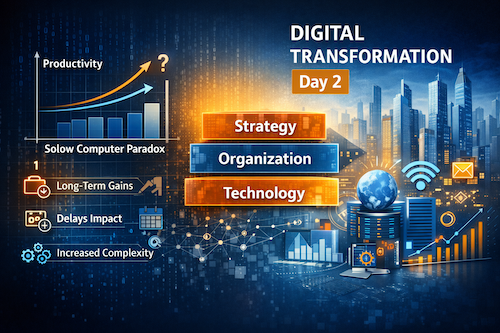
One of the most interesting learning in Day 2 of my Digital Transformation course focused on a question that has puzzled economists and business leaders for decades:
If companies invest billions in technology, why does productivity not always increase at the same rate?
This question is often referred to as the Solow Computer Paradox, famously summarized by economist Robert Solow, who stated that computers were visible everywhere except in productivity statistics.
Understanding this paradox provides valuable insight into how technology truly impacts business performance.
- The Solow Computer Paradox
The paradox suggests that despite massive investments in information technology, measurable productivity growth did not initially reflect the expected improvements.
Several explanations have been proposed to understand this phenomenon.
First, technology may produce benefits that are not immediately captured in productivity metrics. Improvements in customer experience, communication, and quality of service often create long term value that traditional statistics fail to measure.
Second, technology benefits take time to materialize. Organizations need to redesign processes, retrain employees, and adapt business models before the full impact of technology investments becomes visible.
Third, increased technological capability can also introduce complexity. As digital systems expand, companies face new operational challenges that may temporarily offset productivity gains.
- Empirical Evidence of Technology’s Value
Despite the paradox, modern research clearly demonstrates that technology investments contribute positively to business performance.
Studies consistently show that companies with higher digital intensity tend to outperform competitors in several areas:
- Revenue growth
- Customer loyalty
- Operational efficiency
- Market adaptability
Digital leaders are significantly more capable of responding to changing customer expectations and competitive pressures. The gap between technology leaders and laggards continues to widen as digital capabilities become a core strategic asset.
- Technology and the Evolution of Business Strategy
The transformation of Pitney Bowes provides a compelling example of how companies can successfully adapt to technological disruption.
Originally known for its leadership in mailing solutions, the company faced a major challenge as digital communication began to reduce traditional mail volumes.
Recognizing the shift early, Pitney Bowes began transforming its business through strategic acquisitions and investments in emerging digital capabilities.
The company expanded into areas such as:
- Global e-commerce logistics
- Location intelligence
- Customer information management
Over time, these new capabilities became major revenue drivers, demonstrating how companies can reinvent themselves through strategic technology adoption.
- From Mailing to the E-Commerce Economy
As digital communication replaced traditional mail, Pitney Bowes shifted its focus toward shipping and e-commerce infrastructure.
The growth of online retail created new opportunities in logistics, tracking systems, and cross border shipping. By leveraging its expertise in managing complex mailing systems, the company was able to apply similar capabilities to simplify the complexities of modern shipping.
This shift also reflects the rising expectations of consumers, who now demand:
- Fast delivery
- Free shipping options
- Real time tracking
Businesses must continuously innovate to meet these expectations in a highly competitive digital marketplace.

- Organizational Transformation and Leadership
Technology transformation is not only about tools and systems. It also requires deep organizational change.
To accelerate innovation and responsiveness, Pitney Bowes reorganized its teams into integrated “pods” that combine product management, engineering, and IT expertise. This collaborative structure improves accountability and speeds up product development in a fast moving digital environment.
However, such transformations require strong leadership and cultural adaptation.
Leaders must balance two critical responsibilities:
- Clearly defining the reality of disruption
- Providing hope and direction during uncertainty
Successful digital transformation requires resilience, patience, and a collective commitment across the organization.
- Key Strategic Insight
The lesson from Day 2 is clear.
Technology alone does not create value. Value emerges when technology is combined with new business models, organizational structures, and cultural change.
Companies that successfully integrate these elements are able to convert digital investments into long-term competitive advantage.
As I continue exploring digital transformation, it becomes increasingly clear that the challenge is not technological capability, but the strategic ability to harness it effectively.
Day 1 Blog post of Digital Transformation understanding as below:
https://adeelkhan77.com/2026/03/05/blog-147-day-1-digital-transformation-understanding-the-exponential-shift-reshaping-business-architecture/
Day 3 Blog Post of Mechanics of Disruption as below:
https://adeelkhan77.com/2026/03/07/blog-149-day-3-digital-transformation-mechanics-of-disruption-and-the-economics-of-innovation/