1. Introduction
Waveform design and physical layer behavior are at the core of any wireless communication system. In 5G NR, the waveform (CP-OFDM and DFT-s-OFDM) is optimized for terrestrial environments with low latency, limited Doppler, and relatively stable channels.
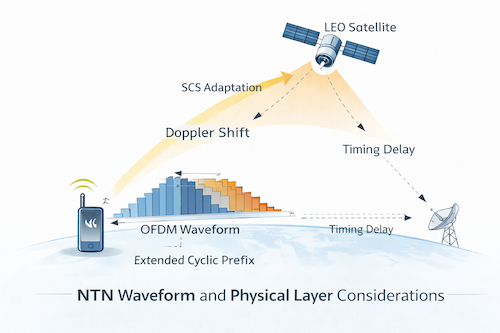
In Non Terrestrial Networks (NTN), the physical layer must operate under fundamentally different conditions, including:
- High Doppler shifts
- Large delay spreads
- Long propagation delays
- Rapidly varying channel conditions
This requires careful adaptation of waveform parameters and PHY layer procedures as defined in 3GPP Release 17.
2. 5G NR Waveforms Overview
5G NR supports two primary waveforms:
- CP-OFDM (Cyclic Prefix Orthogonal Frequency Division Multiplexing)
- Used in downlink and uplink
- Flexible numerology
- DFT-s-OFDM (Discrete Fourier Transform spread OFDM)
- Used in uplink
- Lower Peak to Average Power Ratio (PAPR)
Key PHY features:
- Scalable subcarrier spacing (SCS)
- Slot-based transmission structure
- Advanced channel coding (LDPC, Polar codes)
3. NTN Specific Physical Layer Challenges
3.1 High Doppler Shift
- Caused by high speed satellite movement
- Results in:
- Frequency offset
- Inter carrier interference (ICI)
Impact:
- Degrades OFDM orthogonality
- Reduces decoding performance
3.2 Large Delay Spread
- Due to large coverage areas and varying distances
- Leads to:
- Inter symbol interference (ISI)
- Timing misalignment
3.3 Long Propagation Delay
- LEO: 20–50 ms
- GEO: >500 ms
Impact:
- Affects HARQ timing
- Impacts synchronization procedures
3.4 Channel Variability
- Beam movement causes time varying channel conditions
- Link quality changes during transmission
4. Waveform Adaptations for NTN (3GPP Release 17)
4.1 Subcarrier Spacing (SCS) Optimization
- Larger SCS helps mitigate Doppler effects
- Trade off:
- Higher SCS → reduced coverage
- Lower SCS → more Doppler sensitivity
4.2 Extended Cyclic Prefix (CP)
- Supports larger delay spread
- Reduces ISI impact
4.3 Doppler Pre Compensation
- Applied at UE or satellite
- Uses GNSS based estimation
Benefits:
- Maintains OFDM orthogonality
- Improves demodulation performance
4.4 Timing Advance Enhancements
- Supports wider timing range
- Aligns uplink transmissions despite long delays
4.5 Flexible Numerology
- Adapts SCS and slot duration based on NTN scenario
- Enables optimization for:
- Coverage
- Capacity
- Mobility
5. Physical Layer Signal Flow in NTN
- UE estimates Doppler and timing offset
- Applies pre compensation
- Transmits OFDM signal
- Satellite relays signal to gateway
- Receiver performs:
- Frequency correction
- Channel estimation
- Decoding

Lenovo GM2 Pro Bluetooth 5.3 Earphones Sports Headset Wireless In-Ear Gaming Low Latency Dual Mode Music Headphones
6. Comparison: Terrestrial vs NTN PHY Layer
| Feature | Terrestrial NR | NTN NR (Rel-17) |
|---|---|---|
| Doppler Impact | Low | High |
| Delay Spread | Limited | Large |
| SCS Optimization | Standard | Adaptive |
| CP Length | Normal | Extended |
| Synchronization | Easier | Complex |
| Channel Stability | Moderate | Dynamic |
7. Practical Deployment Insights
7.1 Trade off Between Coverage and Robustness
- Lower SCS improves coverage
- Higher SCS improves Doppler resilience
7.2 Importance of Accurate Doppler Estimation
- Critical for maintaining signal quality
- GNSS plays a key role
7.3 Impact on UE Complexity
- Additional processing for:
- Frequency correction
- Timing alignment
7.4 Satellite Payload Considerations
- Transparent vs regenerative payload impacts PHY processing
- Some compensation can be offloaded to satellite
8. Future Enhancements (Release 18 and Beyond)
- Advanced Doppler resilient waveforms
- AI based channel estimation
- Adaptive numerology switching
- Improved interference mitigation techniques
9. Conclusion
Waveform and physical layer design in NTN must address challenges that are not present in terrestrial networks.
Key adaptations include:
- Flexible numerology
- Doppler pre compensation
- Extended cyclic prefix
- Enhanced timing mechanisms
These changes ensure that 5G NR waveforms remain robust even in highly dynamic satellite environments.
Link for UE Design Challenges for NTN blog post as below:
https://adeelkhan77.com/2026/03/27/blog-166-ntn-ue-design-challenges-for-ntn/
Link for NTN Positioning and Location Management blog post as below:
https://adeelkhan77.com/2026/03/29/blog-168-ntn-ntn-positioning-and-location-management/