1. Introduction
User Equipment (UE) design for 5G Non Terrestrial Networks (NTN) introduces a completely new set of challenges compared to terrestrial devices. Traditional smartphones and IoT devices are optimized for low latency, stable channel conditions, and relatively small cell coverage.
In NTN, UE must operate under:
- Long propagation delays
- High Doppler shifts
- Large coverage areas
- Power and hardware constraints
This article explores the key UE design challenges and how 3GPP Release 17 addresses them.
2. Key Differences Between Terrestrial UE and NTN UE
| Feature | Terrestrial UE | NTN UE |
|---|---|---|
| Propagation Delay | Very Low | Very High |
| Doppler Impact | Minimal | Significant |
| Coverage Area | Small Cells | Large Beams |
| Timing Accuracy | Moderate | Critical |
| Power Requirements | Optimized | Challenging |
3. Major UE Design Challenges in NTN
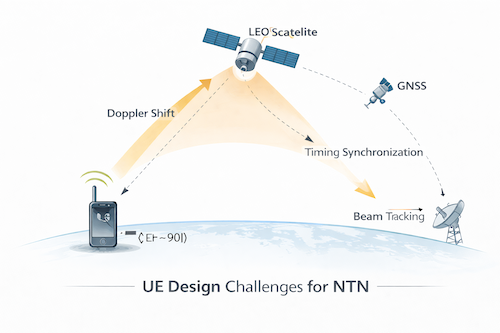
3.1 Doppler Shift Compensation
- LEO satellites move at high speed relative to UE
- Doppler shifts can be several kHz
Impact:
- Frequency synchronization becomes difficult
- Signal detection and decoding are affected
Mitigation:
- GNSS based Doppler estimation
- Pre compensation at UE side
3.2 Timing Synchronization
- Large and variable propagation delay
- UE must align uplink timing accurately
Challenges:
- Wide timing uncertainty window
- Increased timing advance requirements
3.3 GNSS Dependency
- NTN UE often relies on GNSS (e.g., GPS)
Usage:
- Position estimation
- Timing synchronization
- Doppler compensation
Limitation:
- GNSS may not be available indoors or in obstructed environments
3.4 Power Consumption Constraints
- Long distance communication requires higher transmit power
- Frequent synchronization updates increase energy usage
Impact:
- Reduced battery life
- Critical for IoT and handheld devices
3.5 Antenna Design Constraints
- Need for wider coverage and better gain
- Orientation of UE affects signal quality
Challenges:
- Compact form factor vs performance
- Beam alignment sensitivity
3.6 Mobility and Beam Tracking
- Satellite beams move continuously
- UE must track beam transitions
Impact:
- Frequent re synchronization
- Increased signaling overhead
3.7 Hardware Complexity and Cost
- Additional processing for:
- Doppler compensation
- Timing correction
- Increased cost for NTN capable devices
4. 3GPP Release 17 NTN UE Enhancements
4.1 GNSS Assisted Operation
- Improves timing and frequency accuracy
- Reduces access delay
4.2 Relaxed Synchronization Requirements
- Wider timing windows supported
- Adapted for long delays
4.3 Enhanced PRACH and Initial Access Support
- UE configured for extended RACH formats
- Improved detection under delay and Doppler
4.4 Power Control Adjustments
- UE transmit power adapted for satellite link
- Efficient uplink resource usage
4.5 Support for NTN Bands and Frequencies
- Specific frequency bands allocated for NTN
- UE must support these bands
5. Simplified UE Operation in NTN
- UE determines location via GNSS
- Estimates Doppler shift and timing offset
- Applies pre compensation
- Performs random access
- Maintains synchronization with moving satellite beam
- Adapts transmission based on network configuration

6. Comparison: Terrestrial vs NTN UE Design
| Aspect | Terrestrial UE | NTN UE |
|---|---|---|
| Synchronization | Network driven | GNSS assisted |
| Power Consumption | Moderate | High |
| Hardware Complexity | Standard | Enhanced |
| Mobility Handling | Cell based | Beam based |
| Reliability Mechanisms | HARQ driven | FEC driven |
7. Practical Deployment Insights
7.1 Smartphone vs IoT Devices
- Smartphones:
- Better processing capability
- More suitable for NTN evolution
- IoT Devices:
- Power limited
- Require simplified NTN modes
7.2 Indoor Coverage Challenges
- Satellite signals are weaker indoors
- Limits NTN usability in urban environments
7.3 Hybrid NTN TN Devices
- Devices must seamlessly switch between:
- Terrestrial networks
- Satellite networks
7.4 Cost vs Capability Trade off
- Advanced NTN features increase device cost
- Market adoption depends on cost optimization
8. Future Enhancements (Release 18 and Beyond)
- Reduced GNSS dependency through network assistance
- AI based Doppler and timing prediction
- Energy efficient NTN UE designs
- Integrated NTN TN chipset solutions
9. Conclusion
UE design is one of the most critical aspects of enabling NTN at scale. Unlike terrestrial devices, NTN capable UEs must handle:
- High Doppler shifts
- Long delays
- Moving beams
- Power constraints
3GPP Release 17 provides the foundation, but further innovation in chipset design, power efficiency, and intelligent synchronization will be key to making NTN commercially viable.
Link for NTN Scheduling and Resource allocation blog post as below:
https://adeelkhan77.com/2026/03/26/blog-165-ntn-ntn-scheduling-and-resource-allocation-challenges/
Link for NTN Waveform and Physical Layer Considerations blog post as below:
https://adeelkhan77.com/2026/03/28/blog-167-ntn-ntn-waveform-and-physical-layer-considerations/