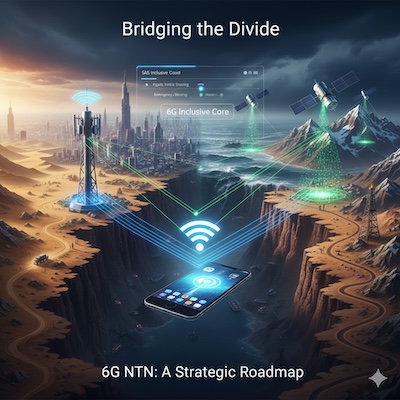
As I currently explore new opportunities and delve into emerging technologies, a close friend recommended I study Non-Terrestrial Networks (NTN). While studying a white paper from a popular vendor, I found it incredibly interesting. The concept of using satellites to directly connect with standard mobile phones promises to redefine what "coverage" truly means. Not everyone can afford Satellite phones for emergency calls. NTN can be the solution to provide the coverage in those areas where people take Satellite phones to connect with the world. This journey has led me to articulate a strategic roadmap for integrating NTN into an operator's existing infrastructure, balancing cutting-edge technology with pragmatic business decisions.
The Foundational Challenge: Spectrum and Bandwidth
My initial thought, coming from a background managing diverse spectrum bands (900, 800, 1800, 2100, 2300, 3500 MHz), was immediately about spectrum availability. For Direct-to-Device (D2D) satellite communication, the lower frequencies are king. Bands like 800 MHz and 900 MHz are ideal due to their superior propagation, better indoor penetration (relatively, as we'll discuss), and widespread support in existing handsets.
However, these bands are often heavily utilized. My experience with GL 900 (GSM-LTE sharing on 10 MHz)highlighted the challenge of squeezing multiple technologies into limited bandwidth. For NTN, the bandwidth requirements are surprisingly lean for emergency services (1.4-3 MHz even less than these) but still require careful planning to avoid interference with terrestrial networks. This led to the concept of Geographical Spectrum Sharing – using these bands for satellite connectivity only where terrestrial coverage doesn't exist.
A Phase by Phase Strategic Roadmap for NTN Integration:
Here's how I envision a phased rollout, balancing technological evolution with customer needs and cost efficiency:
Phase 1: The "Gap-Filler" & Emergency Phase (Coverage Dominance) Our immediate focus would be on addressing "white spots" – deep deserts, mountainous and hiking regions, and offshore areas.
- Service: Launch Emergency SOS and SMS. These low-bandwidth services provide immense value for safety and require minimal spectrum (under 3 MHz).
- Spectrum Strategy: Implement geographical sharing on the 900 MHz or 800 MHz band. Terrestrial networks retain priority in urban/suburban areas, while satellites provide a "safety net" in remote zones.
- Marketing: Position NTN as a crucial "emergency service layer" – a guarantee that users can always connect for help, even far beyond traditional tower reach in open areas. This sets realistic customer expectations from day one.
Phase 2: The "Refarming & Voice" Phase (Expanding Capabilities) As the initial phase proves value and network infrastructure matures, we expand services.
- User Migration: Aggressively drive VoLTE migration by promoting low-cost, VoLTE-locked handsets. This shifts voice traffic off legacy 2G/3G (often on 900 MHz) to other LTE bands (like 800/1800 MHz).
- Spectrum Refarming: Once a significant portion of users are on VoLTE, the 900 MHz band can be gradually refarmed, dedicating more spectrum to satellite communication for basic voice calls and low-rate data.
- Complementary Strategy: NTN becomes the primary solution for truly unserved areas, while existing VSAT/RRN sites continue to serve high-demand villages where higher throughput is essential.

Phase 3: The "6G Unified Network" Phase (Seamless Resilience) The ultimate goal is a fully integrated, resilient network where users experience seamless connectivity.
- Unified Core Integration: Upgrade the network core to an "Inclusive Core" (as envisioned in 6G). This treats satellites, terrestrial towers, and even potential High-Altitude Platform Stations (HAPS) as a single pool of resources.
- Automated Failover & Traffic Steering: The 6G core intelligently routes traffic. If a terrestrial site goes down due to a power outage or congestion, the satellite link provides immediate backup. High-priority traffic can be steered to the most suitable path (e.g., local tower for heavy data, satellite for remote voice).
- Optimized Handover: Advanced "Make-Before-Break" handover techniques, combined with intelligent Doppler shift compensation, ensure voice calls remain clear and uninterrupted even as satellites zoom across the sky.
Addressing the Technical Hurdles: Realistic Expectations
My experience with VSAT, which also faced early issues with jitter and delay, informs my perspective on NTN. While the technology is rapidly advancing, some fundamental physics dictate current limitations:
- The "Indoor Problem": Satellite signals from 550 km away are very faint. Even simple walls or roofs cause significant signal loss. Currently, NTN is an outdoor-only service. Marketing must clearly communicate this; it's a "flashlight from the sky" that needs an open view.
- The "Jitter Problem": LEO satellites move at 27,000 km/h, causing constant changes in signal path and frequency (Doppler shift). This can introduce jitter and delay in voice calls. While 6G will mitigate this with advanced buffering and handover, it's a complex challenge.
- The "Capacity Problem": A single satellite beam covers an enormous area. Unlike a dense urban cell tower, a satellite cannot provide high-capacity data to thousands of users simultaneously. It's best suited for low-to-medium data rates spread across vast geographies. VLEO satellite can reduce the cover area of satellite beam in future and can improve the capacity problem for a bit but it will still be very high than traditional fixed site.
Why NTN Complements, Not Replaces (Initially):
Ultimately, the decision to deploy or integrate NTN is a balance of cost vs. performance vs. demand.
- VSAT/RRN remain superior for dense local capacity, especially for indoor usage within established communities. They offer higher throughput and lower latency for concentrated demand.
- NTN is preferred where physical sites are impossible or prohibitively expensive (deep deserts, oceans, unpopulated mountains). It provides the critical "first layer" of coverage, meeting regulatory mandates and enhancing safety.
- The 6G Inclusive Core is the game-changer. It allows us to seamlessly leverage the strengths of both – keeping high-capacity services on terrestrial sites while using satellites as an expansive, resilient blanket of connectivity. This means we're not replacing towers; we're giving them a crucial, intelligent backup and extending their reach exponentially.
This exploration has reinforced my belief that the future of connectivity lies in a harmonized, multi-layered network. NTN isn't just a novelty; it's a vital component of a resilient, truly ubiquitous 6G landscape.