1. Introduction
Positioning and location management are critical functions in mobile networks, supporting services such as mobility management, emergency services, and resource optimization. In terrestrial 5G networks, positioning relies on well defined cell structures, dense base station deployments, and relatively stable propagation conditions.
In Non Terrestrial Networks (NTN), positioning becomes significantly more complex due to:
- Large satellite coverage areas
- Moving cells (satellite beams)
- Long propagation delays
- Limited terrestrial reference points
This article explores positioning techniques, challenges, and 3GPP Release 17 adaptations for NTN.
2. Role of Positioning in 5G Networks
Positioning supports multiple network functions:
- Mobility and handover decisions
- Emergency location services
- Timing synchronization
- Beam management and tracking
- Location based services (LBS)
In NTN, positioning is even more critical due to dynamic satellite movement.
3. Positioning Techniques in 5G NR
Standard positioning methods include:
- GNSS based positioning
- Network based positioning
- Hybrid positioning methods
3.1 GNSS-Based Positioning
- Uses satellite navigation systems such as GPS
- Provides high accuracy outdoors
Limitations:
- Poor indoor performance
- Dependency on external systems
3.2 Network Based Positioning
- Based on measurements like:
- Time of Arrival (ToA)
- Time Difference of Arrival (TDoA)
- Angle of Arrival (AoA)
Challenges in NTN:
- Sparse infrastructure
- Large distances reduce accuracy
3.3 Hybrid Positioning
- Combines GNSS and network measurements
- Improves reliability and accuracy
4. NTN Specific Positioning Challenges
4.1 Large Coverage Areas
- Satellite beams cover hundreds of kilometers
- Reduces spatial resolution
4.2 Satellite Mobility
- Satellites move at high speed
- UE location relative to beam continuously changes
Impact:
- Frequent updates required
- Increased signaling overhead
4.3 Long Propagation Delay
- Impacts timing based positioning methods
- Reduces accuracy of ToA and TDoA
4.4 Limited Reference Points
- Fewer anchors compared to terrestrial networks
- Makes triangulation difficult
4.5 GNSS Dependency
- NTN heavily relies on GNSS for:
- Position estimation
- Timing synchronization
Limitation:
- GNSS unavailable in indoor or obstructed environments
5. 3GPP Release 17 NTN Positioning Enhancements
5.1 GNSS Assisted UE Positioning
- UE uses GNSS as primary positioning source
- Provides:
- Location
- Timing reference
5.2 Ephemeris Based Assistance
- Network provides satellite orbit information
- UE can estimate relative position
5.3 Timing Based Enhancements
- Adaptation of timing measurements for long delays
- Improved synchronization support
5.4 Beam Based Location Estimation
- UE location approximated based on serving beam
- Useful for:
- Initial access
- Low accuracy applications
5.5 Support for Location Management in Mobility
- Tracking of UE across moving beams
- Location updates triggered by beam transitions

6. Location Management in NTN
Location management ensures the network can track UE efficiently.
Key Functions:
- Tracking Area Management
- NTN uses larger tracking areas
- Paging Optimization
- Based on beam coverage
- Location Update Procedures
- Triggered by:
- Beam movement
- UE mobility
- Triggered by:
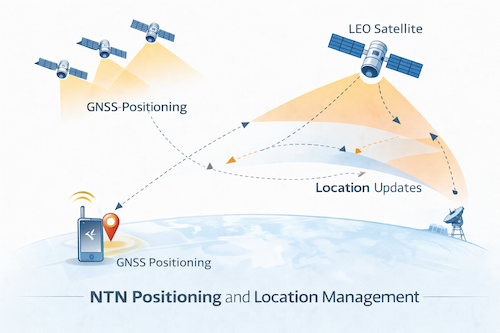
7. NTN Positioning and Location Flow (Simplified)
- UE obtains position via GNSS
- Network provides satellite ephemeris data
- UE estimates relative position and timing
- Location updated in core network
- Beam tracking and mobility management performed
- Paging and service delivery optimized based on location
8. Comparison: Terrestrial vs NTN Positioning
| Feature | Terrestrial NR | NTN NR (Rel-17) |
|---|---|---|
| Positioning Accuracy | High | Moderate |
| GNSS Dependency | Optional | High |
| Infrastructure Support | Dense | Sparse |
| Mobility Impact | Moderate | High |
| Delay Impact | Low | Significant |
9. Practical Deployment Insights
9.1 Importance of GNSS Integration
- Essential for most NTN use cases
- Critical for timing and synchronization
9.2 Trade off Between Accuracy and Complexity
- High accuracy requires:
- More signaling
- Advanced processing
9.3 Impact on Emergency Services
- Position accuracy is critical
- NTN must ensure regulatory compliance
9.4 Beam Based Location Optimization
- Efficient for:
- IoT devices
- Low power applications
10. Future Enhancements (Release 18 and Beyond)
- Reduced GNSS dependency using network assistance
- AI-based positioning algorithms
- Multi-satellite positioning techniques
- Integration with terrestrial positioning systems
11. Conclusion
Positioning and location management in NTN are fundamentally different from terrestrial networks due to:
- Large coverage areas
- Moving satellite beams
- Long delays
- Limited infrastructure
3GPP Release 17 introduces GNSS assisted and beam based approaches, but further innovation will be required to achieve high accuracy and efficiency in global satellite networks.
Link for NTN Waveform and Physical Layer Considerations blog post as below:
https://adeelkhan77.com/2026/03/28/blog-167-ntn-ntn-waveform-and-physical-layer-considerations/
Link for Paging and Idle Mode Behavior in NTN as below:
https://adeelkhan77.com/2026/03/30/blog-169-ntn-paging-and-idle-mode-behavior-in-ntn/