1. Introduction to HARQ in NTN
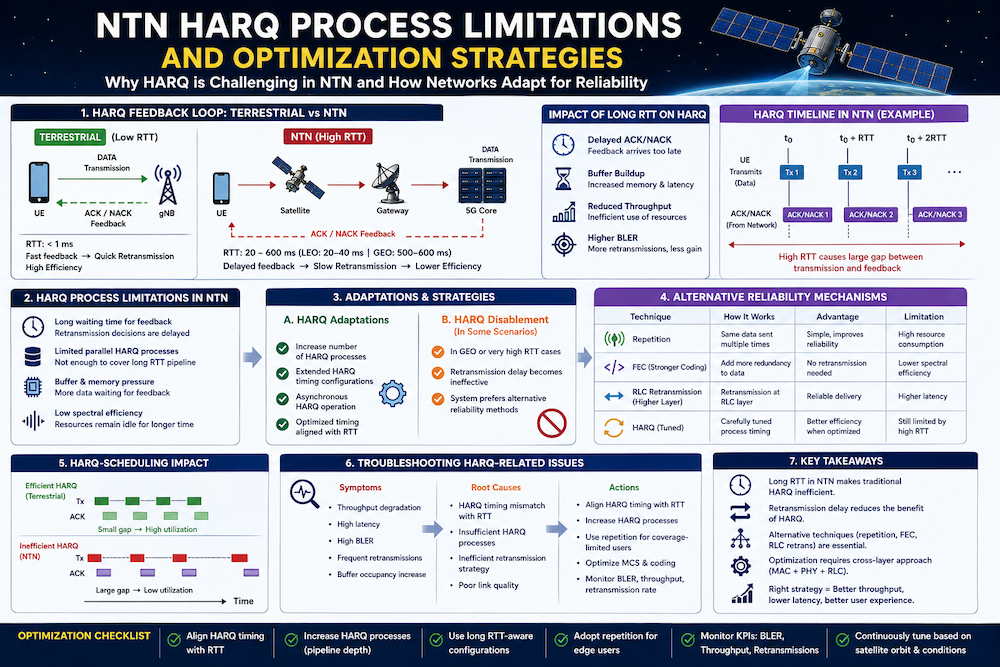
Hybrid Automatic Repeat reQuest (HARQ) is a fundamental mechanism in LTE and 5G that improves reliability through fast retransmissions based on ACK/NACK feedback.
In NTN, HARQ faces a fundamental challenge:
- Extremely long Round Trip Time (RTT)
- Delayed feedback loop
- Inefficient retransmission cycles
This forces a rethink of how HARQ is used and optimized.
2. HARQ in Terrestrial Networks (Baseline Behavior)
HARQ operates with tight timing loops:
- UE sends data
- gNB responds with ACK/NACK within a few milliseconds
- Retransmission occurs quickly if needed
Key characteristics:
- Low latency feedback
- Multiple parallel HARQ processes
- High spectral efficiency
3. Why HARQ Becomes Inefficient in NTN
| Parameter | Terrestrial | NTN |
|---|---|---|
| RTT | <1 ms | 20–600 ms |
| Feedback Delay | Immediate | Highly delayed |
| Retransmission Speed | Fast | Very slow |
| Resource Utilization | Efficient | Idle gaps increase |
Core issue:
- By the time ACK/NACK is received, the system has already moved forward significantly
4. Impact of RTT on HARQ Timing
In NTN:
- HARQ feedback loop is stretched
- Retransmission decisions are delayed
- Buffer occupancy increases
Practical effect:
- Reduced throughput
- Increased latency
- Scheduling inefficiency
5. HARQ Process Limitations in NTN
Key limitations:
- Limited number of HARQ processes becomes insufficient
- Long waiting time between transmission and feedback
- Increased memory requirements (buffering data)
Result:
- HARQ loses its “fast recovery” advantage
6. Typical HARQ Adaptations in NTN
Operators and vendors adopt:
- Increase in number of HARQ processes
- Extended timing configurations
- Flexible HARQ timing (asynchronous behavior)
However:
- These are partial fixes, not complete solutions

7. HARQ Disablement Strategy (When and Why)
In some NTN deployments:
- HARQ is partially or fully disabled
Reason:
- Retransmission delay becomes too large to be useful
- System prefers alternative reliability methods
This is a major shift from terrestrial design.
8. Alternative Reliability Mechanisms
Instead of relying heavily on HARQ:
- Repetition based transmission
- Forward Error Correction (FEC) enhancements
- Higher layer retransmissions (RLC level)
Comparison:
| Method | Advantage | Limitation |
|---|---|---|
| HARQ | Fast recovery | Inefficient in high RTT |
| Repetition | Simple reliability | Resource heavy |
| FEC | No retransmission needed | Coding overhead |
| RLC Retransmission | Reliable | Higher latency |
9. Scheduling Impact Due to HARQ Constraints
HARQ inefficiency affects scheduler behavior:
- More conservative scheduling
- Reduced parallelism
- Increased buffering
Optimization challenge:
- Balance reliability vs resource usage
10. Troubleshooting HARQ-Related Issues
Common symptoms:
- Throughput degradation
- Increased latency
- High BLER despite good coverage
Root causes:
- HARQ timing mismatch with RTT
- Insufficient HARQ processes
- Inefficient retransmission strategy
11. Optimization Strategy from RF Perspective
Key actions:
- Align HARQ timing with RTT
- Increase HARQ processes where supported
- Use repetition schemes for coverage limited users
- Optimize coding schemes (MCS adaptation)
Monitor:
- BLER
- Throughput
- Retransmission rate
12. Real World Deployment Insight
- HARQ works well in LEO only with careful tuning
- In GEO, HARQ becomes significantly less effective
- Vendors often implement hybrid approaches combining HARQ + repetition
Important observation:
- Over reliance on HARQ in NTN leads to poor performance
13. Key Takeaways
- HARQ is fundamentally impacted by long RTT in NTN
- Feedback delay reduces its effectiveness
- Alternative reliability mechanisms become critical
- Optimization requires a cross layer approach (MAC + PHY + RLC)