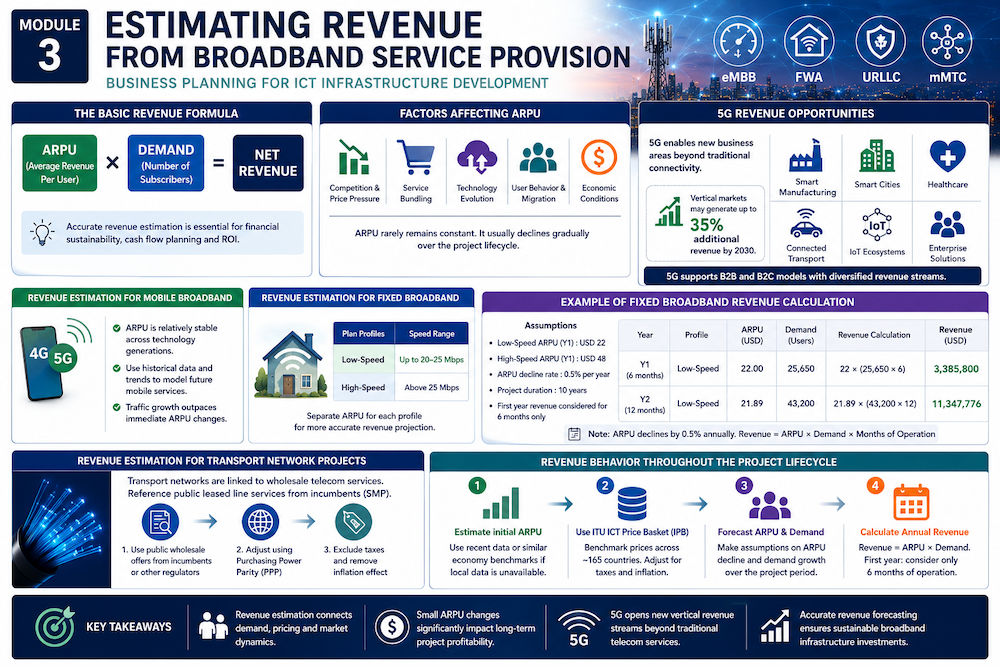
1. Importance of Revenue Estimation
After estimating demand, the next critical step is estimating revenue generated from the projected broadband services.
Revenue estimation is important because it determines:
- Financial sustainability
- Investment recovery timeline
- Cash flow availability
- Long term project feasibility
In broadband projects, inaccurate revenue forecasting can heavily impact business viability.
2. Basic Revenue Estimation Principle
The simplest approach uses ARPU.
Revenue Formula:
Net Revenue = ARPU x Demand
Where:
- ARPU = Average Revenue Per User
- Demand = Number of subscribers/users
Practical telecom observation:
- ARPU rarely remains constant throughout a project lifecycle.
3. Understanding ARPU Behaviour
ARPU trends usually evolve because of:
- Market competition
- Price reductions
- Service bundling
- Technology evolution
- Customer migration to higher plans
If local ARPU data is unavailable:
- Similar market benchmarks can be used.
Useful data sources:
- Telecom regulators
- Investment banks
- ITU databases
4. Revenue Estimation for Mobile Broadband
For mobile broadband projects:
- ARPU generally remains relatively stable across technology generations.
Operators usually:
- Use historical mobile revenue trends
- Forecast future subscriber growth
- Apply gradual ARPU adjustments
Practical observation:
- 4G and 5G evolution often changes traffic usage more than immediate ARPU.
5. Revenue Estimation for Fixed Broadband
Fixed broadband revenue estimation usually separates:
- Low-speed plans
- High-speed plans
Typical segmentation:
| Profile | Speed Range |
|---|---|
| Low-speed | Up to 20–25 Mbps |
| High-speed | Above 25 Mbps |
This segmentation improves forecasting precision.
6. Fixed Broadband Revenue Example
Suppose:
- Low-speed ARPU = USD 22
- Demand = 25,650 users
- First operational year = 6 months only
Revenue calculation:
Revenue = 22 x (25650 x 6) = 3,385,800
For Year 2:
- ARPU declines by 0.5%
- New ARPU ≈ 21.89
- Demand = 43,200 users
Calculation:
Revenue = 21.89 x (43200 x 12) = 11,347,776
and so on for next years including 0.5% decline in ARPU every year ...
Practical lesson:
- Even small ARPU decline assumptions significantly impact long-term project revenue.

Heltec LoRa32 V4 ESP32-S3 SX1262 LoRaWAN 868MHz 915MHz Development Board with 0.96 Inch OLED, WiFi & BLE Mesh Network for IoT
7. Revenue Estimation for 5G Projects
5G introduces new revenue forecasting challenges because revenue is no longer limited to traditional telecom services.
New 5G business areas include:
- eMBB
- FWA
- URLLC
- mMTC
- Industrial digitalization
- Enterprise connectivity
Unlike previous generations:
- 5G supports both B2C and B2B business models.
8. Vertical Market Impact in 5G
Industry analysts estimate that:
- 5G vertical markets may generate up to 35% additional revenue by 2030.
Major verticals include:
- Smart manufacturing
- Autonomous transport
- Smart cities
- Healthcare
- IoT ecosystems
Practical challenge:
- Revenue forecasting for these sectors remains uncertain because large-scale commercial maturity is still evolving.
9. Revenue Estimation for Transport Networks
Transport network projects are usually linked with wholesale telecom services.
Revenue estimation references:
- Public leased line pricing
- SMP operator wholesale offers
- International regulatory benchmarks
Important adjustments:
- Purchasing Power Parity (PPP)
- Currency normalization
- Inflation removal
- Tax exclusion
10. Revenue Behavior Throughout the Project
Revenue does not remain static throughout the project lifecycle.
Key planning considerations:
- Initial ARPU estimation
- Future ARPU decline assumptions
- Inflation adjustments
- Demand growth trends
- Delayed commercial launch
Important practical rule:
- First operational year revenues should generally consider only six months of service commercialization.
11. Using ITU ICT Price Basket (IPB)
The ITU ICT Price Basket (IPB) is useful for:
- Telecom price benchmarking
- Cross country comparison
- Broadband affordability analysis
The database contains telecom pricing data from:
- Approximately 165 countries
Useful for regulators and policy-makers lacking local pricing datasets.
12. Practical Learning from This Module
This module highlighted that revenue forecasting is not simply multiplying subscribers by price.
Accurate broadband revenue modelling requires understanding:
- Market behaviour
- ARPU evolution
- Competition intensity
- Technology migration
- Economic conditions
- 5G business transformation
For telecom professionals, revenue estimation directly influences:
- Investment decisions
- ROI expectations
- Business sustainability
- Infrastructure rollout strategy