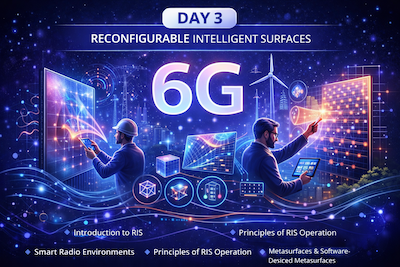
🔹 Introduction to Reconfigurable Intelligent Surfaces (RIS)
Day 3 marks the start of Module 2, focused on Reconfigurable Intelligent Surfaces (RIS)—a technology that fundamentally changes how wireless networks are designed and optimized.
Unlike traditional systems that adapt transmitters and receivers, RIS introduces the concept of controlling the wireless environment itself.
📡 Current Wireless Network Challenges
Modern wireless networks face several structural limitations:
- Achieving high spatial resolution requires complex and expensive hardware
- Fixed access points lack flexibility to adapt to changing user locations and demands
- Coverage gaps and inefficiencies persist in dense or obstructed environments
These challenges motivate the need for lighter, smarter, and more adaptive solutions.
🧱 What Are Reconfigurable Intelligent Surfaces (RIS)?
RIS are passive or semi-passive surfaces that can:
- Reflect, steer, and shape electromagnetic waves
- Operate with minimal power consumption
- Adapt dynamically to environmental changes
They improve both communication and sensing performance without relying on active radio transmission.
🚀 RIS and the Future of Wireless Technologies
RIS aligns closely with 6G objectives by offering:
- A low-power, lightweight alternative to dense base station deployment
- Improved coverage without additional spectrum or transmit power
- Environment-aware adaptability
By embedding intelligence into the physical environment, RIS enables smart and adaptive wireless networks.
🌐 Smart Radio Environments
Traditional Wireless Paradigm
- Wireless channels are fixed and unpredictable
- Optimization is limited to endpoints (transmitters and receivers)
Programmable Radio Environment Vision
- The wireless channel itself becomes programmable
- RIS enables optimization of:
- Coverage
- Reliability
- Spectral and energy efficiency
This shift represents a paradigm change in wireless system design.
⚙️ Principles of Reconfigurable Intelligent Surfaces
- RIS manipulates electromagnetic waves passively
- No new signal generation → minimal energy consumption
- Control over:
- Signal direction
- Phase
- Amplitude
The evolution from passive reflectors to intelligent surfaces enables fine-grained wireless control.
🧩 Applications and Future Potential of RIS
RIS can support:
- Multi-user communication
- Wireless power transfer
- Coverage enhancement in non-line-of-sight and hard-to-reach areas
Beyond 6G, RIS has applications in:
- Smart cities
- IoT networks
- Mobile edge computing
- Intelligent sensing systems

CarlinKit Wireless Carplay Android Auto TV Box Android 13 Wireless Adapter - Save 50%
🔬 Fundamental Working Principles of RIS
🧪 Metasurfaces and Software-Defined Metasurfaces (SDMs)
- Metasurfaces are composed of meta-atoms
- Meta-atoms manipulate electromagnetic waves without generating signals
- SDMs enable real-time software control, allowing:
- Dynamic phase shifting
- Amplitude control
- Adaptive wave shaping
🔁 Core Principles of RIS Operation
- ReconfigurabilityAchieved via switching elements that modify EM properties in real time
- ProgrammabilityCentral controllers receive software instructions to coordinate surface behavior
This enables multi-functionality and intelligent adaptation.
🎛️ Control Mechanisms and Tuning Types
RIS tuning can be achieved through:
🔧 Circuit Tuning
- Fast response time
- Easy integration
- Most practical and widely adopted
📐 Geometric Tuning
- Structural modification of surface elements
- More complex and less dynamic
🧬 Material Tuning
- Uses tunable materials
- Offers flexibility but increases complexity
Among these, circuit tuning is currently the most feasible for real-world deployment.
✅ Key Takeaways
- RIS introduces a new paradigm by making the wireless environment programmable
- It addresses cost, energy, and adaptability challenges of traditional networks
- RIS operates passively, enabling major energy savings
- Metasurfaces and SDMs allow real-time control of electromagnetic waves
- Circuit-based tuning is the most practical approach today
- RIS plays a critical role in enabling intelligent, adaptive, and sustainable 6G networks
Link for Day 2 post as below:
https://adeelkhan77.com/2026/01/13/blog-94-6g-vision-ubiquitous-coverage-ai-energy-efficient-networks-day-2/
Link for Day 4 post as below:
https://adeelkhan77.com/2026/01/15/blog-96-6g-day-4-module-2-reconfigurable-intelligent-surfaces-ris/