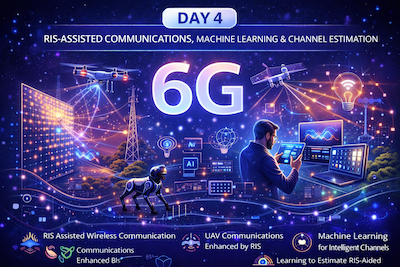
📘RIS-Assisted Communications, Machine Learning & Channel Estimation
🌐 1️⃣ RIS-Assisted Wireless Communication
This session dives deep into how Reconfigurable Intelligent Surfaces (RIS) enhance wireless performance, especially for 6G-era networks.
🧱 Types of Intelligent Surfaces
- 🟦 SmartSkin
- Passive reflective surface
- Low cost and easy to deploy
- Limited flexibility and control
- 🟩 Dynamic Intelligent Surfaces
- Phase-controllable elements
- Enable intelligent signal steering
- Higher performance with added control complexity
📊 Performance Analysis Framework
To evaluate RIS performance, researchers focus on:
- System Modeling 📐Defining base station placement, RIS configuration, and network architecture
- Channel Modeling 📡Near-field vs far-field propagation and cascaded channels (BS → RIS → UE)
RIS shifts the paradigm from optimizing endpoints to optimizing the wireless channel itself.
🚁 2️⃣ UAV Communications Enhanced by RIS
✅ Why UAVs Matter
- Extend coverage to remote or temporary locations
- Ideal for IoT, emergency response, and rural connectivity
⚠️ Key Challenges
- Signal blockages
- Rapid channel variations
- Reliability issues
🪞 RIS to the Rescue
RIS acts as a smart reflector, dynamically redirecting signals toward UAVs, improving:
- Coverage
- Reliability
- Capacity
🤖 3️⃣ Interplay of Machine Learning and RIS
💡 RIS in Li-Fi Systems
Li-Fi faces:
- Limited LED modulation bandwidth
- Strong dependency on Line-of-Sight
🔁 How RIS Helps
- Creates virtual LoS paths
- Enables adaptive beam steering
- Improves robustness in dynamic indoor environments
🧠 4️⃣ Machine Learning Techniques for RIS
🎯 Reinforcement Learning (RL)
- Learns via exploration and exploitation
- ❌ Slow convergence
- ❌ Not ideal for ultra-low latency 6G use cases
⚡ Deep Learning (DL)
Applied to:
- Channel estimation
- Synchronization
- Localization
- Real-time RIS phase tuning
DL enables instant adaptation of metasurfaces based on user location and channel conditions.
🌱 Emerging Learning Paradigms
- Federated Learning → reduced data sharing
- Transfer Learning → faster adaptation
- Quantum ML → future acceleration for complex wireless environments

360° Steering Industrial Endoscope Camera 8mm 5"IPS Screen - Buy Now Almost 50% off
📡 5️⃣ Learning to Estimate RIS-Aided mmWave Channels
Based on a research paper and Python implementation, this session explored model-driven deep unfolding neural networks for RIS-aided mmWave systems.
🔍 Problem
- mmWave channels are sparse
- RIS introduces cascaded channels
- Traditional Least Squares (LS) requires high training overhead
🧩 Solution
- Combine signal processing models with deep learning
- Exploit inherent sparsity of mmWave channels
- Achieve:
- Better estimation accuracy
- Lower computational complexity
- Reduced training overhead
📌 The provided Python code demonstrates how optimization algorithms can be unfolded into trainable neural networks, bridging theory and AI.
🔑 Key Takeaways (Day 4)
- RIS fundamentally reshapes wireless channel behavior
- Performance analysis requires accurate system and channel modeling
- RIS significantly improves UAV and Li-Fi communications
- Deep learning enables real-time, adaptive RIS control
- Model-driven deep unfolding is a powerful approach for channel estimation
- Day 4 marks a shift from conceptual understanding to research-level depth
Link for Day 3 post as below:
https://adeelkhan77.com/2026/01/14/blog-95-day-3-6g-vision-reconfigurable-intelligent-surfaces-ris-foundations/
Link for Day 5 post as below:
https://adeelkhan77.com/2026/01/17/blog-97-day-5-6g-ending-module-2-future-directions-challenges-of-ris/