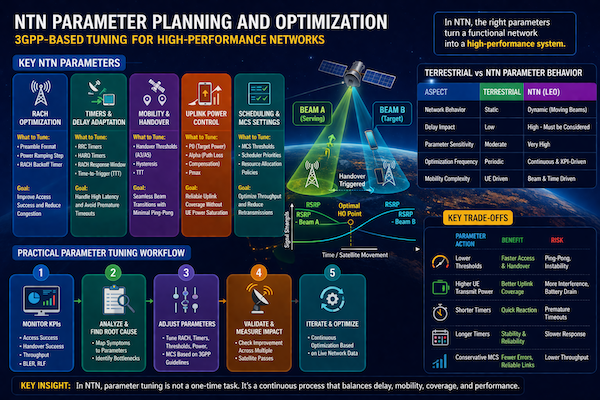
1. Introduction: Why Parameter Planning is Critical in NTN
In terrestrial networks, parameter tuning is important but relatively stable due to fixed cell locations and predictable behavior.
In Non Terrestrial Networks (NTN), parameter planning becomes significantly more critical because:
- Beams are moving continuously
- Coverage is time dependent
- Latency is high
- RF conditions change rapidly
As a result, incorrect parameter settings can lead to:
- Frequent call drops
- Access failures
- Poor throughput
- Unstable mobility
NTN requires carefully tuned, delay aware, and beam aware parameters based on 3GPP guidelines.
2. Role of 3GPP in NTN Parameter Definition
3GPP Release 17 and Release 18 define NTN-specific adaptations for:
- RACH procedures
- Timing advance
- Mobility management
- HARQ processes
- Power control
These standards provide the framework, but real performance depends on operator level parameter tuning.
3. Key Differences: Terrestrial vs NTN Parameter Behavior
| Aspect | Terrestrial Networks | NTN (LEO-Based) |
|---|---|---|
| Network Behavior | Static | Dynamic |
| Delay Impact | Low | High |
| Parameter Sensitivity | Moderate | Very High |
| Optimization Frequency | Low | Continuous |
| Mobility Complexity | Medium | Very High |
4. Parameter Categories in NTN Optimization
NTN parameters can be grouped into:
- Access parameters (RACH, power ramping)
- Mobility parameters (handover thresholds, TTT)
- Radio parameters (MCS, SINR thresholds)
- Timing parameters (timers, delays)
- Load management parameters
Each category must be tuned with beam dynamics and latency in mind.
5. RACH Parameter Optimization
RACH is the first step in network access and is highly sensitive in NTN.
Key Parameters:
- Preamble format
- Power ramping step
- RACH backoff timer
Optimization Considerations:
- Increase power ramping due to high path loss
- Adjust preamble format for long delay
- Optimize backoff to avoid congestion

6. Timing and Timer Configuration
Latency significantly impacts timer configuration.
| Parameter | Terrestrial Setting | NTN Requirement |
|---|---|---|
| RRC Timers | Short | Extended |
| HARQ Timers | Low RTT | High RTT aware |
| RACH Response Window | Small | Increased |
| TTT | Moderate | Carefully tuned |
Incorrect timer settings can lead to:
- Premature timeouts
- Failed procedures
- Increased retransmissions
7. Mobility Parameter Optimization
Mobility in NTN is beam driven and requires precise tuning.
Key Parameters:
- Handover thresholds (A3/A5)
- Hysteresis
- Time to Trigger (TTT)
Optimization Strategy:
- Reduce TTT to react faster to beam movement
- Balance hysteresis to avoid ping pong
- Trigger handover based on beam lifecycle, not just signal
8. Uplink Power Control Parameters
Uplink is often the limiting factor in NTN.
Key Parameters:
- P0 (target power)
- Alpha (path loss compensation)
- Pmax
Optimization Considerations:
- Avoid UE power saturation
- Ensure sufficient coverage at beam edges
- Balance interference vs accessibility
9. Scheduling and MCS Parameters
Throughput optimization depends heavily on these parameters.
Key Elements:
- MCS thresholds
- Scheduler priorities
- Resource allocation policies
NTN Specific Considerations:
- Delay aware scheduling
- Conservative MCS to avoid retransmissions
- Beam load aware resource allocation
10. Load Management and Reselection Parameters
Efficient load distribution is essential.
Key Parameters:
- Reselection offsets
- Load balancing thresholds
- Admission control settings
Optimization Goals:
- Avoid beam congestion
- Distribute users across beams
- Maintain consistent QoS
11. Trade Offs in Parameter Optimization
| Parameter Adjustment | Benefit | Risk |
|---|---|---|
| Lower thresholds | Faster access | Lower quality |
| Higher power | Better coverage | More interference |
| Short timers | Faster response | Instability |
| Long timers | Stability | Delays |
Balancing these trade offs is critical for optimal NTN performance.
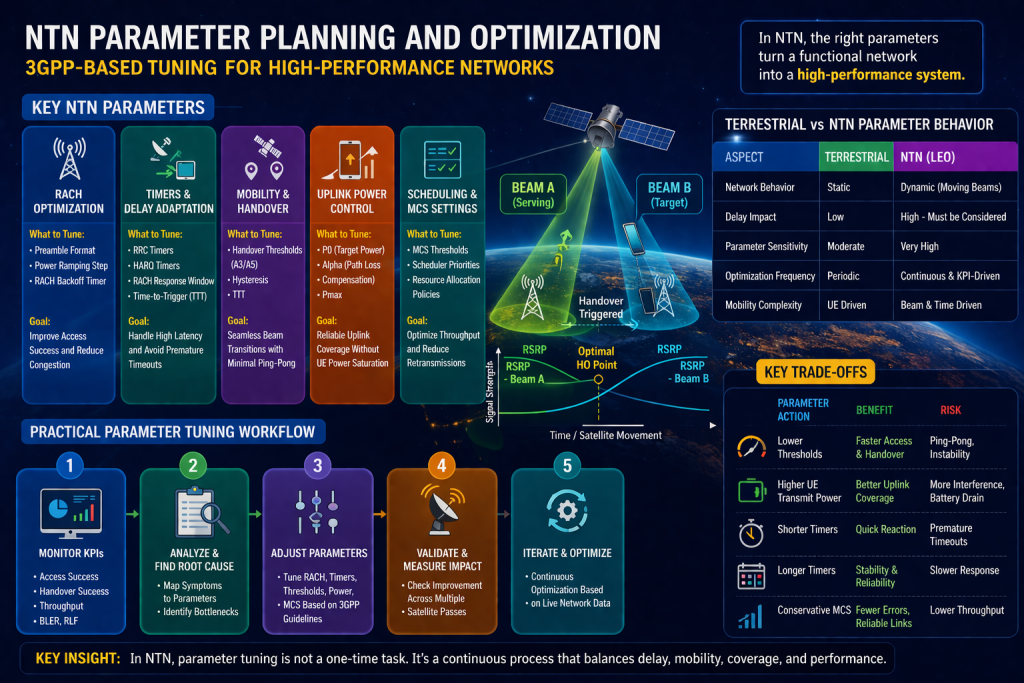
12. Practical Parameter Tuning Workflow
A structured approach is required:
Step 1: KPI Monitoring
- Identify performance issues
Step 2: Root Cause Analysis
- Map KPIs to parameter issues
Step 3: Parameter Adjustment
- Tune specific parameters
Step 4: Validation
- Monitor improvement across multiple satellite passes
Step 5: Iteration
- Continuous optimization cycle
13. Conclusion: From Static Configuration to Dynamic Optimization
In NTN, parameter planning is not a one time activity.
It is a continuous process requiring:
- Deep understanding of 3GPP standards
- Awareness of beam dynamics
- Delay aware configuration
- KPI driven optimization
For RF engineers, mastering parameter tuning is the key to transforming NTN from a functional network into a high performance system.