Introduction
Measuring performance is a critical part of digital marketing and e-commerce strategy. It allows marketers to understand what is working, what is not, and how campaigns can be optimized using real data instead of assumptions.
1. Evolution of Marketing Measurement
Marketing measurement has evolved significantly with the rise of digital platforms.
Key points:
- Traditional marketing had limited tracking capabilities
- Digital marketing enables real time performance tracking
- Marketers can now adjust campaigns based on live data
2. What is Performance Marketing
Performance marketing focuses on measurable outcomes rather than assumptions or reach alone.
Key idea:
- Decisions are driven by actual user behavior data
Core focus areas:
- Clicks and impressions
- Conversions and leads
- ROI based decision making
3. Importance of Metrics in Marketing
A metric is a measurable value used to evaluate performance of marketing activities.
Key points:
- Helps track progress toward goals
- Provides insight into campaign effectiveness
- Supports data driven decision making
4. Key Performance Metrics
Different metrics are used to measure different aspects of campaign performance.
Important metrics include:
- Impressions: number of times an ad is shown
- Click through rate (CTR): how often users click ads
- Cost per click (CPC): cost for each click
- Return on Ad Spend (ROAS): revenue generated per advertising dollar
- Customer Lifetime Value (CLV): total value a customer brings over time
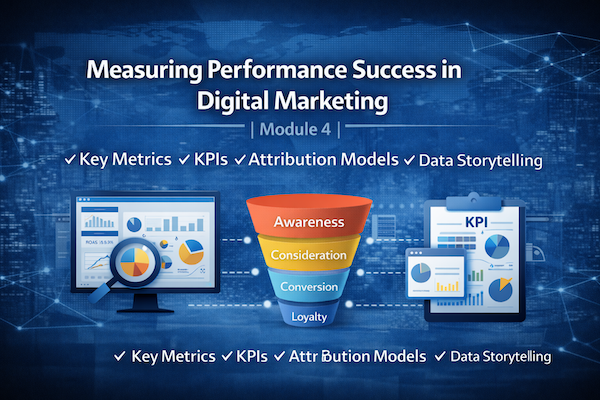
5. Metrics Across the Marketing Funnel
Each stage of the funnel requires different performance measurements.
Awareness stage:
- Impressions, reach, audience exposure
Consideration stage:
- Engagement rate, website visits, CTR
Conversion stage:
- Sales conversion rate, cart abandonment rate, average order value
Loyalty stage:
- Repeat purchase rate, CLV, retention rate
6. Importance of Data in Marketing
Data plays a central role in modern marketing performance evaluation.
Key uses:
- Understanding customer behavior
- Improving campaign targeting
- Predicting future trends
- Measuring KPI success

7. Data Roles in Marketing
Marketing performance relies on structured data handling.
Key roles:
- Data collection: gathering raw marketing data
- Data reporting: organizing and summarizing results
- Data analysis: interpreting data for decision making
8. Data Ethics in Performance Marketing
Ethical use of data ensures trust and compliance in marketing operations.
Key principles:
- Follow data privacy regulations
- Protect personally identifiable information (PII)
- Use anonymization techniques where needed
- Avoid biased data interpretation
9. Understanding Marketing Performance
Performance is measured by how effectively marketing drives customer actions.
Key focus:
- Identifying high impact touchpoints
- Understanding customer decision paths
- Improving conversion efficiency
10. Attribution in Marketing
Attribution identifies which channels or touchpoints contribute to conversions.
Common attribution models:
- First click attribution: credits first interaction
- Last click attribution: credits final interaction
- Linear attribution: equal credit across touchpoints
- Data driven attribution: uses analytics to assign credit
11. Data Storytelling in Marketing
Data storytelling transforms raw numbers into meaningful insights.
Key components:
- Data: key metrics and performance indicators
- Narrative: explanation of what happened and why
- Visualization: charts and graphs for clarity
Structure:
- Context: background situation
- Complication: what changed or went wrong/right
- Resolution: action taken based on insights
12. Importance of Measuring Success
Measuring success ensures continuous improvement in marketing strategies.
Key benefits:
- Identifies strengths and weaknesses
- Improves future campaign planning
- Supports ROI based decision making
- Enables real time optimization
13. Key Takeaways
- Digital marketing enables precise performance tracking
- Metrics are essential for evaluating success
- Data drives all modern marketing decisions
- Ethical data use is critical for trust and compliance
- Attribution and storytelling turn data into actionable insights