1. Introduction to Handover in NTN
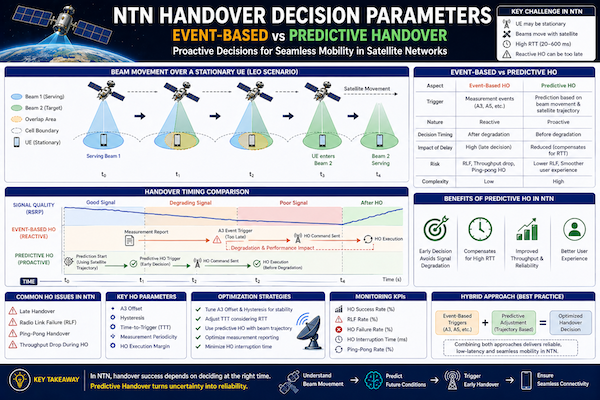
Handover in terrestrial networks is primarily driven by UE mobility. In NTN, mobility is fundamentally different because the satellite beams move while the UE may remain stationary.
- Beam movement drives mobility events
- Frequent cell changes are expected
- Handover design becomes critical for service continuity
2. Terrestrial Handover (Baseline Behavior)
In terrestrial networks:
- Handover is triggered based on signal measurements
- Common events:
- A3: Neighbor becomes better than serving
- A5: Serving becomes worse than threshold
Key characteristics:
- Reactive decision making
- Based on real time measurements
3. NTN Mobility Challenge
In NTN:
- UE may be stationary
- Beam footprint moves continuously (especially in LEO)
Implications:
- Frequent handovers even without UE movement
- Signal variations driven by satellite trajectory
Core issue:
- Traditional event based triggers may not be sufficient
4. Event Based Handover in NTN
Event based HO works similarly to terrestrial:
- Triggered by measurement events (A3, A5, etc.)
- Based on RSRP/RSRQ/SINR thresholds
Advantages:
- Simple implementation
- Compatible with existing standards
Limitations:
- Reactive nature
- Late decision due to delayed measurements
- May lead to ping pong or late HO
5. Predictive Handover Concept
Predictive HO anticipates future conditions rather than reacting to current ones.
- Uses satellite trajectory data
- Uses beam movement patterns
- Estimates when UE will exit current beam
Key idea:
- Trigger HO before signal degradation occurs
6. Event Based vs Predictive Handover (Comparison)
| Aspect | Event Based HO | Predictive HO |
|---|---|---|
| Trigger | Measurement based | Time/trajectory based |
| Nature | Reactive | Proactive |
| Accuracy | Depends on signal | Depends on prediction model |
| Delay Impact | High in NTN | Reduced |
| Complexity | Low | High |

AULA Mechanical Keyboard F75 Three Modes Gaming Mechanical Keyboard Multi-function
7. Impact of RTT on Handover Decisions
In NTN:
- Measurement reports are delayed
- HO commands are delayed
Result:
- Event based HO may occur too late
- Risk of radio link failure increases
Predictive HO helps:
- Compensate for delay
- Maintain seamless connectivity
8. Beam Movement and HO Frequency
In LEO systems:
- Beam dwell time is limited
- UE may experience frequent HO events
Impact:
- Increased signaling load
- Potential service interruption
Optimization goal:
- Reduce unnecessary HO while maintaining quality
9. Common Handover Issues in NTN
Typical symptoms:
- Late handover
- Radio link failure (RLF)
- Ping pong handovers
- Throughput drop during HO
Root causes:
- Improper threshold configuration
- Delay in HO execution
- Lack of predictive mechanisms
10. Troubleshooting Approach
Step by step:
- Analyze HO success rate
- Check timing of HO trigger vs signal degradation
- Evaluate measurement reports delay
- Correlate with beam movement patterns
Key insight:
- Timing of decision is more critical than threshold value
11. Optimization Strategy from RF Perspective
Key actions:
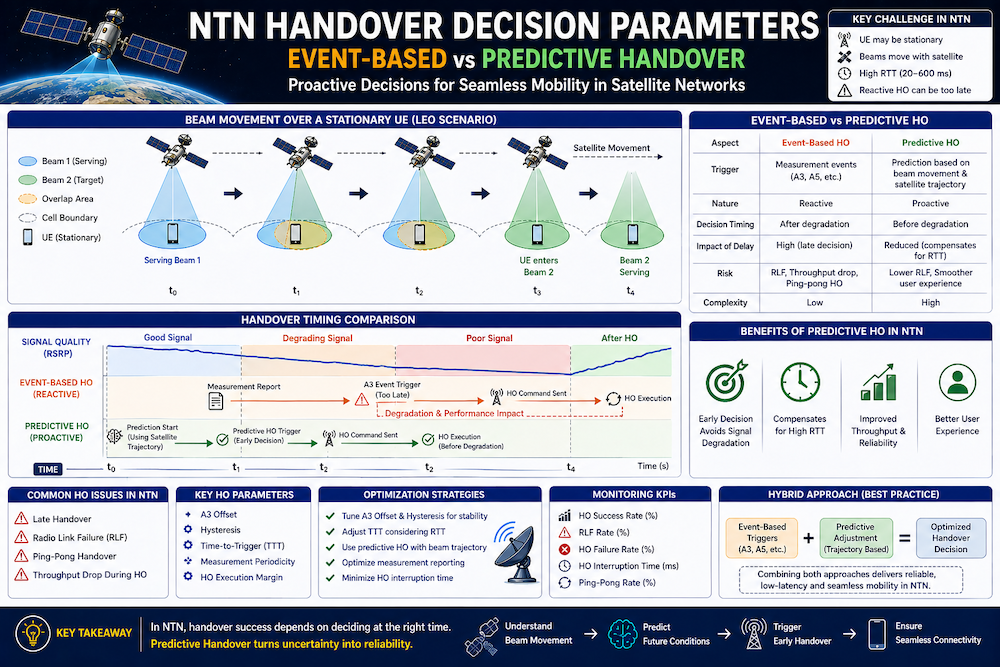
- Adjust A3 offset and hysteresis
- Increase Time to Trigger (TTT) carefully
- Implement predictive HO where supported
- Use beam trajectory awareness
Monitor:
- HO success rate
- RLF occurrences
- HO interruption time
12. Practical Deployment Strategies
Operators typically:
- Combine event based and predictive HO
- Use hybrid models:
- Event trigger + predictive adjustment
- Apply different strategies for:
- LEO vs GEO systems
Real world insight:
- Pure event based HO is rarely sufficient in NTN
13. Key Takeaways
- NTN mobility is driven by beam movement, not UE movement
- Event based HO is reactive and delay sensitive
- Predictive HO improves reliability in high RTT environments
- Hybrid approaches provide best performance