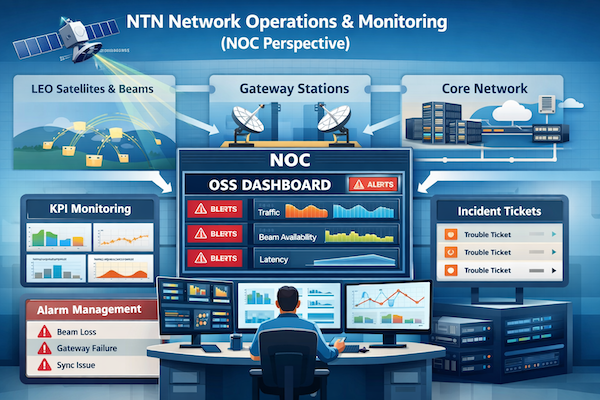
- Introduction to NTN Network Operations (NOC Perspective)
Non Terrestrial Network (NTN) operations introduce a new level of complexity compared to terrestrial RAN. A Network Operations Center (NOC) engineer must monitor not only ground infrastructure but also satellite behavior, beam dynamics, and feeder links.
- Continuous monitoring of moving beams instead of static cells
- Coordination between satellite, gateway, and core domains
- Handling high latency and intermittent link conditions
- NTN NOC Architecture Overview
An NTN NOC integrates multiple domains into a unified monitoring layer.
- Satellite Control System (orbit, health, payload status)
- Gateway / Feeder Link Monitoring
- NTN RAN (gNB / beam level KPIs)
- Core Network (AMF / SMF / UPF performance)
- OSS dashboards for visualization
Key challenge: Correlating space and ground events in real time.
- Typical NOC Shift Workflow (What You Actually Do)
A standard shift in NTN NOC is structured but highly dynamic.
- Shift handover review (open alarms, degraded beams, ongoing incidents)
- KPI dashboard check (availability, throughput, access success rate)
- Alarm monitoring (real time fault detection)
- Ticket handling and escalation
- Preventive checks (beam movement schedules, satellite passes)
Real world workflow:
- Identify degraded beam
- Verify satellite position
- Check feeder link
- Validate UE impact
- Escalate if needed
- Daily Monitoring Tasks in NTN NOC
Daily operations are KPI driven with proactive monitoring.
- Beam level availability tracking
- Satellite visibility and pass prediction monitoring
- Gateway utilization and congestion checks
- Synchronization and timing health
- UE access success rate monitoring
Key KPIs:
- Beam Availability (%)
- Access Success Rate (%)
- Throughput (DL / UL Mbps)
- Latency (ms)
- Packet Loss (%)
- Alarm Categories in NTN Operations
Alarms in NTN span multiple domains and must be prioritized correctly.
| Alarm Type | Description | Impact |
|---|---|---|
| Beam Loss | Beam unavailable due to satellite or payload issue | Service outage in coverage area |
| Gateway Failure | Ground station down or unreachable | Regional service disruption |
| Sync Issue | Timing mismatch between UE and network | Access failures |
| Feeder Link Degradation | Poor satellite - gateway link | Throughput degradation |
| Core Connectivity | AMF / UPF issues | Session failures |

- Beam Loss Monitoring and Handling
Beam loss is one of the most critical NTN alarms.
- Causes: satellite movement, payload fault, misconfiguration
- Detection via sudden drop in beam availability KPI
Immediate actions:
- Verify satellite position
- Check beam scheduling configuration
- Cross check neighboring beams
Mitigation:
- Traffic rerouting
- Fallback to terrestrial network
- Gateway Failure Handling Workflow
Gateway failures impact large geographical regions.
- Detect via feeder link alarms and traffic drop
Validation steps:
- Power status check
- Backhaul connectivity verification
Actions:
- Switch traffic to backup gateway
- Inform field team
- Monitor recovery KPIs
- Synchronization and Timing Issue Monitoring
Timing is critical due to long propagation delays in NTN.
- Monitor timing advance and sync KPIs
Common symptoms:
- Increased access failures
- HARQ instability
Troubleshooting steps:
- Check GNSS or timing source
- Validate configuration offsets
- Analyze UE timing logs
- OSS Tools Used in NTN NOC
NTN operations rely heavily on integrated OSS platforms.
- KPI Dashboards (real time + historical)
- Alarm Management Systems
- Performance Management (PM tools)
- Configuration Management (CM tools)
- Satellite monitoring interfaces
Capabilities:
- Drill down from network → beam → UE level
- Alarm and KPI correlation
- Beam movement visualization
- KPI Monitoring and Dashboard Analysis
KPI dashboards are the primary decision making tools.
- Real time monitoring for immediate issues
- Trend analysis for degradation patterns
- Threshold based alerting
Practical approach:
- Sudden KPI drop → check alarms
- Gradual degradation → analyze trends
- Compare performance across beams and gateways
- Incident Handling and Escalation Process
Structured incident handling ensures quick recovery.
- Alarm detection → ticket creation
- Initial diagnosis by NOC engineer
Escalation targets:
- Satellite team
- RAN team
- Core network team
Best practice:
- Attach KPI snapshots
- Include logs before escalation
- Challenges in NTN NOC Operations
NTN introduces unique operational challenges.
- Dynamic topology due to moving satellites
- High latency impacting real time decisions
- Multi domain fault correlation complexity
- Limited visibility into satellite internals
- Practical Tips for NTN NOC Engineers
- Always correlate KPIs with satellite position
- Avoid treating beams like static cells
- Use historical trends for pattern detection
- Coordinate closely with satellite teams
- Automate repetitive monitoring tasks