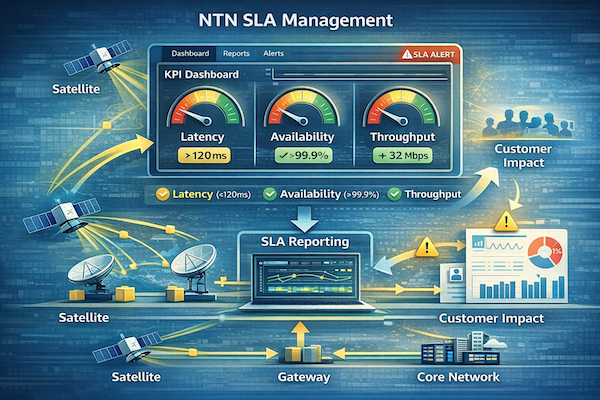
- Introduction to NTN SLA Management and Performance Assurance
In Non Terrestrial Networks (NTN), Service Level Agreements (SLAs) define the expected performance delivered to customers and partners. Unlike terrestrial networks, SLA management in NTN must account for satellite movement, higher latency, and variable link conditions.
- SLAs define measurable service expectations
- Performance assurance ensures SLA compliance
- Direct impact on customer satisfaction and revenue
Key objective: Guarantee agreed service levels despite dynamic network conditions.
- What is an SLA in NTN Context
An SLA is a contractual agreement between operator and customer defining performance targets.
- Defines measurable KPIs
- Includes penalties for non compliance
- Covers end to end service (UE to core)
In NTN, SLAs must consider:
- Satellite coverage variability
- Propagation delays
- Environmental factors (weather impact)
- Key SLA Parameters in NTN
NTN SLAs are typically defined using core performance metrics.
| SLA Parameter | Description | Typical Challenge in NTN |
|---|---|---|
| Latency | End to end delay | High due to satellite distance |
| Availability | Network uptime | Affected by satellite movement |
| Throughput | Data rate (DL/UL) | Limited by beam capacity |
| Packet Loss | Data reliability | Impacted by feeder link quality |
| Jitter | Delay variation | High in dynamic links |
Practical insight:
- Latency and availability are the most critical SLA metrics in NTN.
- Defining SLA Targets for NTN Services
SLA targets vary based on service type.
- Broadband services → High throughput, moderate latency
- IoT services → Low data rate, high reliability
- Aviation/maritime → High availability, stable connectivity
Example SLA targets:
- Latency: < 100 ms (LEO scenarios)
- Availability: > 99%
- Throughput: Defined per user or beam
Key challenge:
- Balancing realistic performance with customer expectations
- Performance Assurance Framework in NTN
Performance assurance ensures SLAs are continuously met.
- Continuous KPI monitoring
- Threshold based alerting
- Automated reporting systems
Core components:
- KPI dashboards
- Alarm systems
- Reporting tools
Goal: Detect SLA violations before customers are impacted.
- Monitoring SLA KPIs in Real Time
Real time monitoring is essential for proactive management.
- Beam level KPI tracking
- Gateway performance monitoring
- Core network performance visibility
Monitoring approach:
- Threshold based alerts (e.g., latency spike)
- Trend analysis (gradual degradation)
- Cross layer correlation
Practical tip:
- Monitor SLA KPIs per service, not just per network element

AOCHUAN 3-Axis Handheld Gimbal Stabilizer for Smartphone with Fill Light for iPhone Android Face Tracking Vlog Smart XE
- SLA Reporting and Analytics
Reporting is critical for both internal and external stakeholders.
Types of reports:
- Daily operational reports
- Weekly performance summaries
- Monthly SLA compliance reports
Report contents:
- KPI trends
- SLA compliance percentage
- Incident impact analysis
Best practice:
- Use automated reporting tools to reduce manual effort
- Customer Impact Analysis
Understanding customer impact is key for SLA management.
- Identify affected users or regions
- Measure duration of impact
- Evaluate severity (minor degradation vs outage)
Example:
- Beam outage → impacts entire coverage area
- Gateway failure → impacts multiple beams
Key goal:
- Quantify impact in terms of users and services
- SLA Violation Handling Process
When SLA thresholds are breached, immediate action is required.
Workflow:
- Detect violation via monitoring system
- Perform root cause analysis
- Implement corrective action
- Document incident
- Report to stakeholders
Important:
- SLA violations must be tracked and reported transparently
- Integration with Fault and Optimization Processes
SLA management is closely linked with other operational functions.
- Fault management → identifies issues causing SLA breach
- Optimization → improves KPIs to meet SLA targets
- NOC operations → monitors SLA compliance
Practical workflow:
- SLA violation → fault detection → optimization → validation
- Challenges in NTN SLA Management
- Dynamic satellite movement affecting availability
- High latency constraints
- Weather impact on feeder links
- Multi domain dependency (satellite + RAN + core)
- Limited historical SLA benchmarks
- Best Practices for SLA Assurance in NTN
- Define realistic SLA targets based on NTN limitations
- Monitor KPIs at beam and service level
- Automate SLA reporting and alerts
- Correlate SLA issues with root causes quickly
- Maintain clear communication with stakeholders
- Key Takeaways for Operator Facing Roles
- SLA management directly impacts customer trust
- Performance assurance is a continuous activity
- Monitoring and reporting are equally important
- Customer impact analysis is critical for decision making
- Strong coordination between NOC, optimization, and planning teams is required